

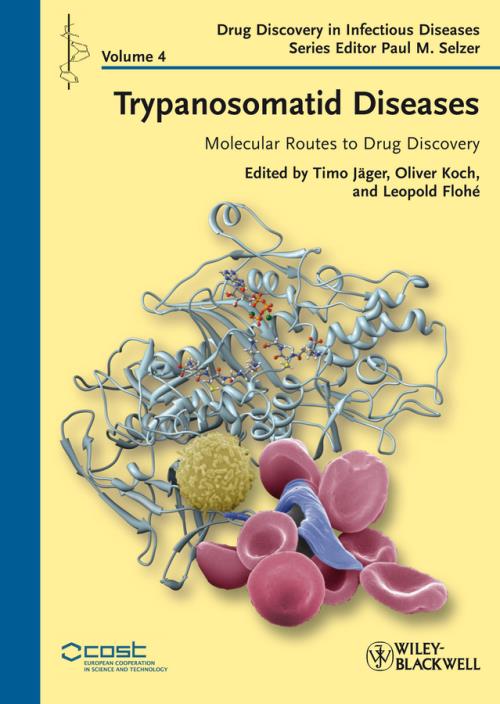
This is the first resource to provide researchers in academia and industry with an urgently needed update on drug intervention against trypanosomatides. As such, it
covers every aspect of the topic from basic research findings, via current treatments to translational approaches in drug development and includes both human and livestock diseases. The outstanding editor and contributor team reads like a Who?s Who of the field, thus guaranteeing the outstanding quality of this ready reference.
covers every aspect of the topic from basic research findings, via current treatments to translational approaches in drug development and includes both human and livestock diseases. The outstanding editor and contributor team reads like a Who?s Who of the field, thus guaranteeing the outstanding quality of this ready reference.
Table of Contents
DISEASE BURDEN, CURRENT TREATMENTS, MEDICAL NEEDS AND STRATEGIC APPROACHESVisceral leishmaniasis: current treatments and needs (Poonam Salotra, Ruchi Singh, Karin Seifert)
Chemotherapy of Leishmaniasis. A Veterinary perspective (Maria Jesus Corral-Caridad, Jose Maria Alunda)
Pharmacological metabolomics in trypanosomes (Darren J. Creek, Isabel M. Vincent, Michael P. Barrett)
Drug design and screening by in silico approaches (Mattia Mori, Maurizio Botta)
Computational Approaches and Collaborative Drug Discovery for Trypanosomal Diseases (Sean Ekins, Barry A. Bunin)
METABOLIC PECULIARITIES IN THE TRYPANOSOMATID FAMILY GUIDING DRUG
Interaction of Leishmania parasites with host cells and its functional consequences (Uta Schurigt, Anita Masic, Heidrun Moll)
The function of glycosomes in the metabolism of trypanosomatid parasites and the promise of glycosomal proteins as drug targets (Melisa Gualdron-Lopez, Paul A.M. Michels, Wilfredo Qui?ones, Ana J. Caceres, Luisana Avilan, Juan-Luis Concepcion)
The glyoxalase enzymes in trypanosomatids (Marta Sousa Silva, Antonio E. N. Ferreira, Ricardo Gomes, Ana M. Tomas, Ana Ponces Freire, Carlos Cordeiro)
The trypanothione-based redox metabolism of trypanosomatids (Marcelo A. Comini, Leopold Flohe)
Thiol peroxidases of trypanosomatids (Helena Castro, Ana M. Tomas)
Peroxynitrite as a cytotoxic effector against Trypanosoma cruzi: oxidative killing and antioxidant resistance mechanisms (Madia Trujillo, Maria Noel Alvarez, Lucia Piacenza, Martin Hugo, Gonzalo Peluffo, Rafael Radi)
Selenoproteome of Kinetoplastids (Alexei V. Lobanov, Vadim N. Gladyshev)
The Replication Machinery of Kinetoplast DNA (Rachel Bezalel-Buch, Nurit Yaffe, Joseph Shlomai)
Life and death of Trypanosoma brucei: New perspectives for drug development (Torsten Barth, Jasmin Stein, Stefan Mogk, Caroline Schonfeld, Bruno K. Kubata, Michael Duszenko)
VALIDATION AND SELECTION OF DRUG TARGETS IN KINETOPLASTS
Rational selection of antimicrobial drug targets: unique or conserved? (Boris Rodenko, Harry P. de Koning)
Drug Targets in Trypanosomal and Leishmanial Pentose Phosphate Pathway (Marcelo A. Comini, Cecilia Ortiz, Juan Jose Cazzulo)
GDP-mannose: a key point for target identification and drug design in kinetoplastids (S. Pomel, P.M. Loiseau)
Transporters in antiparasitic drug development and resistance (Vincent Delespaux, Harry P. de Koning)
Peptidases in autophagy are a therapeutic target for Leishmaniasis (Roderick A.M. Williams)
Proteases of Trypanosoma brucei (Dietmar Steverding)
EXAMPLES OF TARGET-BASED APPROACHES AND COMPOUNDS UNDER CONSIDERATION
Screening Approaches towards Trypanothione Reductase (Mathias Beig, Frank Oellien, Luise Krauth-Siegel, Paul M. Selzer)
Redox-active agents in reactions involving the trypanothione/trypanothione reductase-based system to fight kinetoplastidal parasites (Gendron Thibault, Don Antoine Lanfranchi, Elisabeth Davioud-Charvet)
Inhibition of trypanothione synthetase as therapeutic concept (Oliver Koch, Timo Jager, Leopold Flohe, Paul M. Selzer)
Targeting the trypanosomatidic enzymes pteridine reductase and dihydrofolate reductase (Stefania Ferrari, Valeria Losasso, Puneet Saxena, Maria Paola Costi)
Contribution to new therapies for Chagas? disease (Juan Patricia S. Doyle, C. Engel)
Ergosterol Biosynthesis for the Specific Treatment of Chagas disease: From Basic Science to Clinical Trials (Julio A. Urbina)
New Developments in the Treatment of Late Stage Human African Trypanosomiasis (Cyrus J. Bacchi, Robert T. Jacobs, Nigel Yarlett)


