



The Asia Pacific Intrinsically Safe Equipment Market is expected to reach $1.28 billion by 2027 and is expected to witness market growth of 7.6% CAGR during the forecast period (2025-2032).
The China market dominated the Asia Pacific Intrinsically Safe Equipment Market by country in 2024, and is expected to continue to be a dominant market till 2032; thereby, achieving a market value of $650.4 million by 2032. The Japan market is registering a CAGR of 6.4% during 2025-2032. Additionally, the India market is expected to showcase a CAGR of 8.6% during 2025-2032. The China and Japan led the Asia Pacific Intrinsically Safe Equipment Market by Country with a market share of 38.4% and 11.4% in 2024. The Singapore market is expected to witness a CAGR of 9.9% during throughout the forecast period.
The Asia Pacific Intrinsically Safe Equipment Market has grown along with the rapid growth of high-risk industries like oil and gas, chemicals, mining, and petrochemicals, where safety from explosive hazards is very important. At first, the goal was to limit electrical energy to stop fires from starting. But the market has changed as circuit design, materials, and certification standards have improved. This has made it possible to make complex, digitally integrated equipment. The adoption of harmonized international standards, such as IECEx and regional ATEX equivalents, has been a major step forward. It has made sure that safety compliance is consistent and made it easier for trade to happen across borders. The use of microprocessor-based systems, wireless communication, and remote diagnostics is also part of the larger trend toward industrial automation and digitalization. This greatly improves safety and efficiency in dangerous environments.
Three major trends are shaping the market right now: the rise of Industry 4.0, which is driving demand for IoT-enabled intrinsically safe devices; stricter safety and environmental rules in countries like China, India, and Australia; and a growing focus on localized manufacturing to make the supply chain more resilient. Market leaders are responding by coming up with new ideas, working together strategically, and expanding into new areas. They are focusing on smart, energy-efficient, and compliant products. There are both global and regional players in the competitive landscape. Companies can stand out by having strong technology skills, certifications, and the ability to customize their products. Global companies use advanced research and development and have a wide range of products, while regional companies use cost-effectiveness and local knowledge to drive innovation, keep prices low, and keep the market growing.
The China market dominated the Asia Pacific Intrinsically Safe Equipment Market by country in 2024, and is expected to continue to be a dominant market till 2032; thereby, achieving a market value of $650.4 million by 2032. The Japan market is registering a CAGR of 6.4% during 2025-2032. Additionally, the India market is expected to showcase a CAGR of 8.6% during 2025-2032. The China and Japan led the Asia Pacific Intrinsically Safe Equipment Market by Country with a market share of 38.4% and 11.4% in 2024. The Singapore market is expected to witness a CAGR of 9.9% during throughout the forecast period.
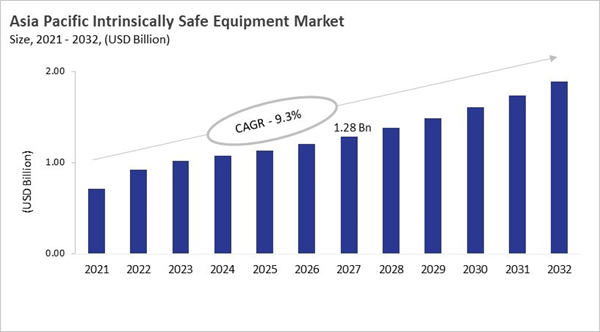
The Asia Pacific Intrinsically Safe Equipment Market has grown along with the rapid growth of high-risk industries like oil and gas, chemicals, mining, and petrochemicals, where safety from explosive hazards is very important. At first, the goal was to limit electrical energy to stop fires from starting. But the market has changed as circuit design, materials, and certification standards have improved. This has made it possible to make complex, digitally integrated equipment. The adoption of harmonized international standards, such as IECEx and regional ATEX equivalents, has been a major step forward. It has made sure that safety compliance is consistent and made it easier for trade to happen across borders. The use of microprocessor-based systems, wireless communication, and remote diagnostics is also part of the larger trend toward industrial automation and digitalization. This greatly improves safety and efficiency in dangerous environments.
Three major trends are shaping the market right now: the rise of Industry 4.0, which is driving demand for IoT-enabled intrinsically safe devices; stricter safety and environmental rules in countries like China, India, and Australia; and a growing focus on localized manufacturing to make the supply chain more resilient. Market leaders are responding by coming up with new ideas, working together strategically, and expanding into new areas. They are focusing on smart, energy-efficient, and compliant products. There are both global and regional players in the competitive landscape. Companies can stand out by having strong technology skills, certifications, and the ability to customize their products. Global companies use advanced research and development and have a wide range of products, while regional companies use cost-effectiveness and local knowledge to drive innovation, keep prices low, and keep the market growing.
Zone Outlook
Based on Zone, the market is segmented into Zone 1, Zone 2, Zone 22, Zone 0, Zone 21, and Zone 20. The Zone 1 market segment dominated the China Intrinsically Safe Equipment Market by Zone is expected to grow at a CAGR of 5.4 % during the forecast period thereby continuing its dominance until 2032. Also, The Zone 20 market is anticipated to grow as a CAGR of 7.2 % during the forecast period during 2025-2032.Product Outlook
Based on Product, the market is segmented into Sensors, Detectors, Transmitters, Isolators / Barriers, Switches, LED Indicators, and Other Product. With a compound annual growth rate (CAGR) of 7.9% over the projection period, the Sensors Market, dominate the Singapore Intrinsically Safe Equipment Market by Product in 2024 and would be a prominent market until 2032. The LED Indicators market is expected to witness a CAGR of 10.8% during 2025-2032.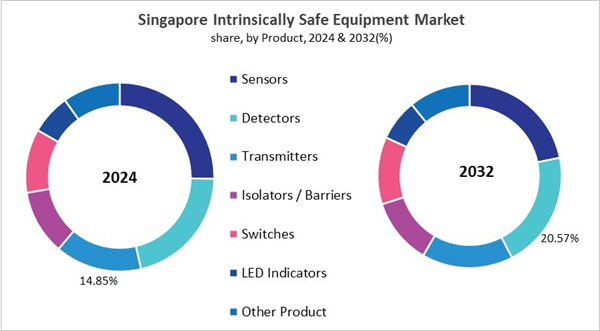
Country Outlook
The China Intrinsically Safe Equipment Market has grown along with the country's growing industrial sectors, such as mining, petrochemicals, and power generation. It has gone from relying on imported technologies to using advanced technologies developed in China that meet strict safety standards. After industrial accidents, the government has been keeping a closer eye on things, which has led to more demand for compliant, high-quality safety equipment. Digital technologies, such as IoT-enabled sensors and wireless monitoring, have changed the market from simple safety barriers to smart, real-time risk management systems. At the same time, making things more local has made supply chains stronger, made customization easier, and made prices more competitive. To meet the changing needs of the industry, top companies are focusing on innovation, partnerships, and strategies for expanding into new markets. Overall, the market strikes a balance between technological differentiation and pricing pressures. This encourages ongoing progress while making sure that rules are followed and everyone can get to the products.List of Key Companies Profiled
- Banner Engineering Corporation
- Honeywell International Inc.
- Eaton Corporation plc
- Emerson Electric Co.
- Rockwell Automation, Inc.
- Schneider Electric SE
- Siemens AG
- Fluke Corporation (Fortive Corporation)
- Pepperl+Fuchs SE
- R. STAHL AG
Market Report Segmentation
By Class Type- Class 1
- Class 2
- Class 3
- Oil & Gas
- Chemical & Petrochemical
- Mining
- Power
- Processing Industries & Other
- Zone 1
- Zone 2
- Zone 22
- Zone 0
- Zone 21
- Zone 20
- Sensors
- Detectors
- Transmitters
- Isolators / Barriers
- Switches
- LED Indicators
- Other Product
- China
- Japan
- India
- South Korea
- Singapore
- Malaysia
- Rest of Asia Pacific
Table of Contents
Chapter 1. Market Scope & Methodology
Chapter 2. Market at a Glance
Chapter 3. Market Overview
Chapter 4. Market Trends - Asia Pacific Mining Automation Market
Chapter 5. State of Competition - Asia Pacific Mining Automation Market
Chapter 6. Market Consolidation - Asia Pacific Mining Automation Market
Chapter 7. Key Customer Criteria - Asia Pacific Mining Automation Market
Chapter 8. Product Life Cycle - Asia Pacific Mining Automation Market
Chapter 9. Value Chain Analysis of Mining Automation Market
Chapter 10. Competition Analysis - Global
Chapter 11. Asia Pacific Mining Automation Market by Solution Type
Chapter 12. Asia Pacific Mining Automation Market by Application
Chapter 13. Asia Pacific Mining Automation Market by Country
Chapter 14. Company Profiles
Companies Mentioned
- Komatsu Ltd.
- Caterpillar, Inc.
- Sandvik AB
- Rockwell Automation, Inc.
- Epiroc AB
- Hexagon AB
- Trimble, Inc.
- Hitachi Construction Machinery Co., Ltd. (Hitachi, Ltd.)
- Liebherr-International AG
- Atlas Copco AB


