



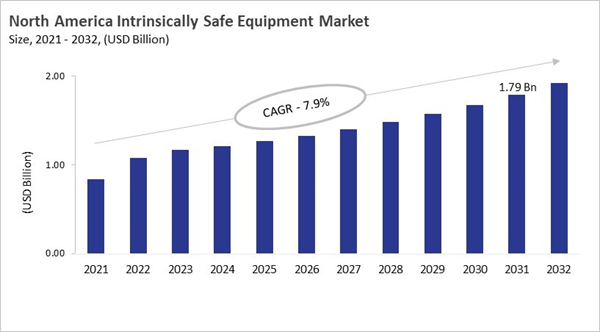
The North America Intrinsically Safe Equipment Market is expected to reach $1.79 billion by 2031 and is expected to witness market growth of 6.1% CAGR during the forecast period (2025-2032).
The US market dominated the North America Intrinsically Safe Equipment Market by country in 2024, and is expected to continue to be a dominant market till 2032; thereby, achieving a market value of $1.40 billion by 2032. The Canada market is experiencing a CAGR of 8.4% during 2025-2032. Additionally, the Mexico market is expected to exhibit a CAGR of 7.4% during 2025-2032. The US and Canada led the North America Intrinsically Safe Equipment Market by Country with a market share of 77.2% and 11.4% in 2024.
The North America intrinsically safe equipment market has changed from basic safety rules that were meant to keep fires from starting in dangerous places to a high-tech, regulated industry. The market moved from simple protective barriers to more advanced systems that included fault tolerance, power management, and real-time monitoring. This change was based on intrinsic safety principles from the middle of the 20th century and was made official by standards like NEC Article 504. This progress has been greatly affected by strict rules and certification processes that have broadened the range of products and encouraged constant innovation. Today, intrinsically safe equipment is very important in industries like oil and gas, mining, and chemicals, where safety is the most important thing, and integrated digital capabilities are becoming more and more important.
One of the most important trends in the market is the use of IoT and digital technologies in intrinsically safe devices. This makes it possible to get better operational intelligence and predictive maintenance in dangerous areas. Regulatory changes and stricter certification requirements keep raising product standards and encouraging companies to invest heavily in research and development. Also, the growing focus on sustainability and monitoring emissions has made the need for intrinsically safe sensors and control systems even greater. A mix of global and regional players using innovation, strategic partnerships, and localization to strengthen their presence in the market shapes the competitive landscape. Global companies focus on cutting-edge technologies and certifications, while regional companies focus on customized solutions. This leads to a market that is always changing, following the rules, and having fair pricing approaches.
The US market dominated the North America Intrinsically Safe Equipment Market by country in 2024, and is expected to continue to be a dominant market till 2032; thereby, achieving a market value of $1.40 billion by 2032. The Canada market is experiencing a CAGR of 8.4% during 2025-2032. Additionally, the Mexico market is expected to exhibit a CAGR of 7.4% during 2025-2032. The US and Canada led the North America Intrinsically Safe Equipment Market by Country with a market share of 77.2% and 11.4% in 2024.
The North America intrinsically safe equipment market has changed from basic safety rules that were meant to keep fires from starting in dangerous places to a high-tech, regulated industry. The market moved from simple protective barriers to more advanced systems that included fault tolerance, power management, and real-time monitoring. This change was based on intrinsic safety principles from the middle of the 20th century and was made official by standards like NEC Article 504. This progress has been greatly affected by strict rules and certification processes that have broadened the range of products and encouraged constant innovation. Today, intrinsically safe equipment is very important in industries like oil and gas, mining, and chemicals, where safety is the most important thing, and integrated digital capabilities are becoming more and more important.
One of the most important trends in the market is the use of IoT and digital technologies in intrinsically safe devices. This makes it possible to get better operational intelligence and predictive maintenance in dangerous areas. Regulatory changes and stricter certification requirements keep raising product standards and encouraging companies to invest heavily in research and development. Also, the growing focus on sustainability and monitoring emissions has made the need for intrinsically safe sensors and control systems even greater. A mix of global and regional players using innovation, strategic partnerships, and localization to strengthen their presence in the market shapes the competitive landscape. Global companies focus on cutting-edge technologies and certifications, while regional companies focus on customized solutions. This leads to a market that is always changing, following the rules, and having fair pricing approaches.
Class Type Outlook
Based on Class Type, the market is segmented into Class 1, Class 2, and Class 3. The Class 1 market segment dominated the Canada Intrinsically Safe Equipment Market by Class Type is expected to grow at a CAGR of 8 % during the forecast period thereby continuing its dominance until 2032. Also, The Class 3 market is anticipated to grow as a CAGR of 9.7 % during the forecast period during 2025-2032.End Use Outlook
Based on End Use, the market is segmented into Oil & Gas, Chemical & Petrochemical, Mining, Power, Power, and Processing Industries & Other. With a compound annual growth rate (CAGR) of 4.8% over the projection period, the Oil & Gas Market, dominate the US Intrinsically Safe Equipment Market by End Use in 2024 and would be a prominent market until 2032. The Processing Industries & Other market is expected to witness a CAGR of 5.6% during 2025-2032.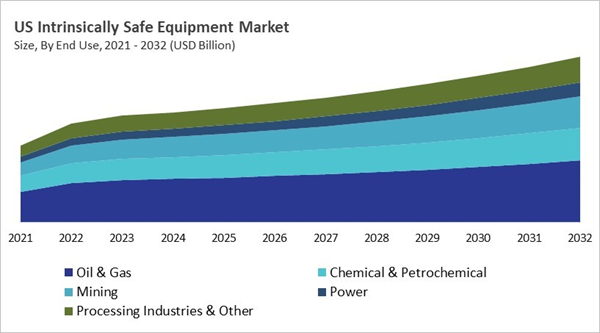
Country Outlook
The US intrinsically safe equipment market has grown from simple explosion-proof designs to advanced low-energy systems that stop fires from starting in dangerous places. This was first driven by strict safety rules in the oil, gas, and chemical industries. The establishment of standardized regulations significantly accelerated adoption and market confidence, while technological advancements enabled the integration of microelectronics, digital systems, and smart diagnostics aligned with Industry 4.0. Some important trends are the use of wireless communication for real-time monitoring, the growing need for small, portable devices, and the focus on solutions that are energy-efficient and environmentally friendly. To stay ahead of the competition, market leaders focus on ongoing research and development, strategic partnerships, and better certification capabilities. They also offer integrated safety services. Innovation, following the rules, and dependability all play a role in shaping the competitive landscape. Both global and regional players use their strengths to meet changing needs for safety and efficiency in the workplace.List of Key Companies Profiled
- Banner Engineering Corporation
- Honeywell International Inc.
- Eaton Corporation plc
- Emerson Electric Co.
- Rockwell Automation, Inc.
- Schneider Electric SE
- Siemens AG
- Fluke Corporation (Fortive Corporation)
- Pepperl+Fuchs SE
- R. STAHL AG
Market Report Segmentation
By Class Type- Class 1
- Class 2
- Class 3
- Oil & Gas
- Chemical & Petrochemical
- Mining
- Power
- Processing Industries & Other
- Zone 1
- Zone 2
- Zone 22
- Zone 0
- Zone 21
- Zone 20
- Sensors
- Detectors
- Transmitters
- Isolators / Barriers
- Switches
- LED Indicators
- Other Product
- US
- Canada
- Mexico
- Rest of North America
Table of Contents
Chapter 1. Market Scope & Methodology
Chapter 2. Market at a Glance
Chapter 3. Market Overview
Chapter 4. Market Trends - North America Mining Automation Market
Chapter 5. State of Competition - North America Mining Automation Market
Chapter 6. Market Consolidation - North America Mining Automation Market
Chapter 7. Key Customer Criteria - North America Mining Automation Market
Chapter 8. Product Life Cycle - North America Mining Automation Market
Chapter 9. Value Chain Analysis of Mining Automation Market
Chapter 10. Competition Analysis - Global
Chapter 11. North America Mining Automation Market by Solution Type
Chapter 12. North America Mining Automation Market by Application
Chapter 13. North America Mining Automation Market by Country
Chapter 14. Company Profiles
Companies Mentioned
- Komatsu Ltd.
- Caterpillar, Inc.
- Sandvik AB
- Rockwell Automation, Inc.
- Epiroc AB
- Hexagon AB
- Trimble, Inc.
- Hitachi Construction Machinery Co., Ltd. (Hitachi, Ltd.)
- Liebherr-International AG
- Atlas Copco AB


