

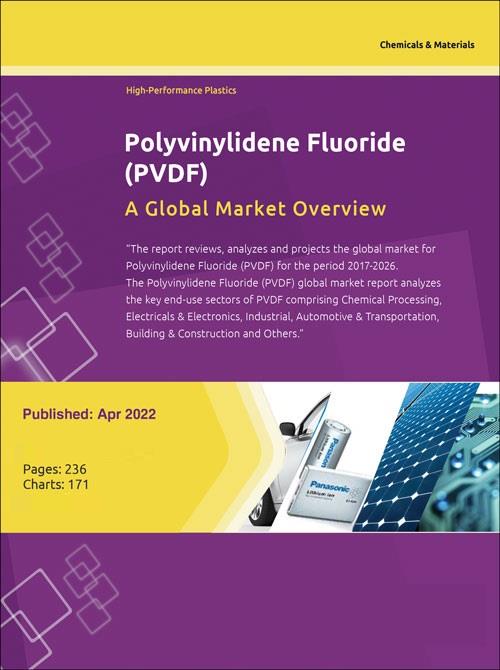

The global Polyvinylidene Fluoride (PVDF) market is undergoing a structural transformation, driven by the rapid expansion of lithium-ion battery (LiB) applications in electric vehicles (EVs) and energy storage systems (ESS). The market reached US$2.5 billion in 2025, following a period of exceptional price-driven growth during 2021-2022 and subsequent normalization in 2023. While earlier growth was characterized by supply tightness and elevated raw material costs, the market has now transitioned into a volume-led expansion phase supported by strong underlying demand across electrification, renewable energy, and semiconductor sectors. Looking ahead, the market is projected to grow robustly to 412 thousand metric tons and US$6.7 billion by 2032, registering a CAGR of 15% in value. This growth is primarily fueled by sustained EV adoption, increasing ESS deployments (particularly for data centers and grid stability), and rising demand for high-performance materials in advanced electronics and photovoltaic systems.New Energy Markets Driving Demand for PVDF in a Big Way

On the supply side, global PVDF production capacity is projected to reach around 350 thousand metric tons by 2031, based on expansion plans announced recently, broadly matching the expected demand of nearly 348 thousand metric tons. While these additions are likely to ease the supply tightness experienced during the 2021-2022 period and support market growth in the near term, the close alignment between capacity and demand, along with typical sub-100% operating rates, suggests that the market could tighten again toward the end of the decade. Consequently, additional capacity investments, particularly in battery-grade PVDF, will be essential beyond 2030 to ensure supply reliability and sustain stable pricing amid continued growth in EV and energy storage applications.
The PVDF market is led by a concentrated group of global chemical companies, including Arkema, Solvay, Kureha Corporation, Dongyue Group, and 3M. These players dominate through advanced material technologies, strong presence in battery-grade PVDF, and ongoing capacity expansions aligned with EV and ESS demand growth.
Iran War Impact: Polyvinylidene fluoride (PVDF) is produced from fluoropolymer feedstocks derived from petrochemical intermediates and involves energy-intensive processing, making its value chain sensitive to fluctuations in energy prices and upstream chemical availability. Widely used in lithium-ion batteries, coatings, and electrical insulation, PVDF demand is closely linked to battery materials and electronics supply chains, which depend on stable global logistics networks. The recent escalation of geopolitical tensions involving Iran has raised concerns about potential disruptions to petrochemical supply chains and shipping routes, which could indirectly influence feedstock costs and supply dynamics for PVDF. However, the situation remains in its early stages, and it is still premature to determine the overall impact on the PVDF market outlook for 2026. Our analysts are closely monitoring developments in energy markets, petrochemical trade flows, and battery materials supply chains to assess potential implications for PVDF pricing and availability.
Polyvinylidene Fluoride (PVDF) Regional Market Analysis
Asia-Pacific leads with 72.1% share in 2025, driven by its strong lithium-ion battery (LiB) manufacturing ecosystem, particularly in China, Japan, and South Korea, followed by North America and Europe, both supported by increasing EV production and localized battery supply chain investments. Historically, 2018-2022 growth was heavily concentrated in Asia-Pacific due to rapid EV adoption and LFP battery expansion, while 2022-2025 saw continued regional dominance despite price normalization. Looking ahead, Europe emerges as the fastest-growing region (20.4% CAGR), closely followed by North America (17.0%), fueled by aggressive investments in gigafactories, policy support for electrification, and supply chain localization, while Asia-Pacific continues strong growth maintaining its leadership with a 67.0% share by 2032.Polyvinylidene Fluoride (PVDF) Market Analysis by End-use Sector
In 2025, Electrical & Electronics leads with a share of 58.5% of volume and 68.9% of value, reflecting its premium pricing and dominant use in lithium-ion batteries (LiB) for EVs and ESS, followed by Building & Construction supported by infrastructure applications. Looking ahead, Electrical & Electronics remains the fastest-growing segment (18.2% value CAGR), significantly increasing its share to 83.2% in value by 2032, fueled by accelerating EV adoption, ESS demand (notably data centers), and rising PVDF intensity in advanced battery chemistries. The Other segment emerges as the second fastest-growing, supported by membranes and specialty applications, while traditional sectors such as Building & Construction and Chemical Processing grow steadily in volume but lose share, underscoring the market's transition toward electrification-led, high-performance applications.Polyvinylidene Fluoride (PVDF) Market Report Scope
This global report on Polyvinylidene Fluoride (PVDF) analyzes the global and regional markets based on end-use sector for the period 2022-2032 with projections from 2025 to 2032 in terms of volume in metric tons and value in US$. In addition to providing profiles of major companies operating in the PVDF industry, the latest corporate, product, capacity and industrial developments have been covered to offer a clear panorama of Polyvinylidene Fluoride (PVDF) industry.Key Metrics
- Historical Period: 2022-2025
- Base Year: 2025
- Forecast Period: 2025-2032
- Units: Volume consumption in Metric Tons and Value market in US$
- Companies Mentioned: 25
Global Polyvinylidene Fluoride (PVDF) Market by Geographic Region
- North America (United States, Canada and Mexico)
- Europe (France, Germany, Italy, Russia, Spain, The United Kingdom and Rest of Europe)
- Asia-Pacific (China, India, Japan, South Korea, Taiwan, Thailand and Rest of Asia-Pacific)
- South America (Argentina, Brazil and Rest of South America)
- Rest of World
Global Polyvinylidene Fluoride (PVDF) Market by End-Use Sector
- Automotive & Transportation
- Building & Construction
- Electrical & Electronics
- Mechanical/Industrial
- Other Sectors (include consumer goods, medical & healthcare, water filtration membranes etc.)
This product will be delivered within 2-4 business days.
Table of Contents
PART A: GLOBAL MARKET PERSPECTIVE2. KEY MARKET TRENDS4. KEY BUSINESS & PRODUCT TRENDSREGIONAL MARKET OVERVIEW
1. INTRODUCTION
3. INDUSTRY LANDSCAPE
5. GLOBAL MARKET OVERVIEW
PART B: REGIONAL MARKET PERSPECTIVE
6. NORTH AMERICA
7. EUROPE
8. ASIA-PACIFIC
9. SOUTH AMERICA
10. REST OF WORLD
PART C: GUIDE TO THE INDUSTRY
PART D: ANNEXURE
Executive Summary
Robust Growth in Demand from Electrical & Electronics Sector to Lead Polyvinylidene Fluoride (PVDF) Market to Reach 130K Metric Tons by 2026
As per the report, Asia-Pacific is the world’s largest volume market for PVDF with an estimated 62% volume share in 2021 and further projected to record the fastest 2021-2026 CAGR of 16.2%.
The impact of coronavirus pandemic has evident across all regions, and the demand for Polyvinylidene Fluoride (PVDF) witnessed a moderate year-over-year increase of 3% globally in 2020. Consumption of PVDF has decreased significantly by 5.2% in South America followed by Europe (-5.2% YOY) and North America (-4.2% YOY), while the impact was not evident in Asia-Pacific region and the demand for the same was registered a YOY growth of 8.6% in 2020, owing to the robust growth in Chinese, Japanese and South Korean lithium-ion battery separators market.
Almost all application sectors of Polyvinylidene Fluoride (PVDF) were impacted negatively by the COVID-19 pandemic, while Electrical & Electronics sector has not had any negative impact but rather demand was accelerated at a robust YOY rate of 21.6% in 2020. A year when the global economic downturn led to a sharp decline in overall vehicle sales, global sales of electrical vehicle (EV) increased by 36.4% in 2020. The overall PVDF market is expected to reach about 80K metric tons in 2022, valued at US$1.6 billion.
The market for end-use sectors of PVDF analyzed in this report includes analyzed in this report comprise Automotive & Transportation, Electrical & Electronics, Building & Construction, Chemical Processing, Industrial and Other.
This report reviews, analyzes and projects the PVDF market for global and the regional markets including North America, Europe, Asia-Pacific, South America and Rest of World for the period 2017-2026 in terms of volume in metric tons and value in USD. These regional markets further analyzed for 15 independent countries across North America - The United States, Canada and Mexico; Europe - France, Germany, Italy, Russia, Spain and the United Kingdom; Asia-Pacific - China, India, Japan, South Korea and Taiwan; and South America - Brazil.
This 236-page global PVDF market report includes 171 charts (includes a data table and graphical representation for each chart), supported with meaningful and easy to understand graphical presentation, of market numbers. This report profiles 7 key global players and 25 major players across North America - 3; Europe - 4; and Asia-Pacific - 18. The research also provides the listing of the companies engaged in manufacturing and processing of Polyvinylidene Fluoride resins. The global list of companies covers address, contact numbers and website addresses of 112 companies.
Companies Mentioned
- 3M Advanced Materials
- Arkema SA
- Gujarat Fluorochemicals Ltd
- Kureha Corporation
- Shandong Deyi New Material Co., Ltd.
- Shandong Huaan New Material Co., Ltd.
- Shandong Huaxia Shenzhou New Materials Co., Ltd.
- Shanghai Huayi 3F New Materials Co., Ltd.
- Shanghai PTL New Energy Technology Co., Ltd.
- Shaowu Yonghe Jintang New Material Co., Ltd
- Syensqo S.A.
- Zhejiang Fluorine Chemical New Material Co., Ltd
- Zhejiang Juhua Co. Ltd.
Table Information
| Report Attribute | Details |
|---|---|
| No. of Pages | 245 |
| Published | March 2026 |
| Forecast Period | 2025 - 2032 |
| Estimated Market Value ( USD | $ 2.5 Billion |
| Forecasted Market Value ( USD | $ 6.7 Billion |
| Compound Annual Growth Rate | 15.0% |
| Regions Covered | Global |
| No. of Companies Mentioned | 13 |


