

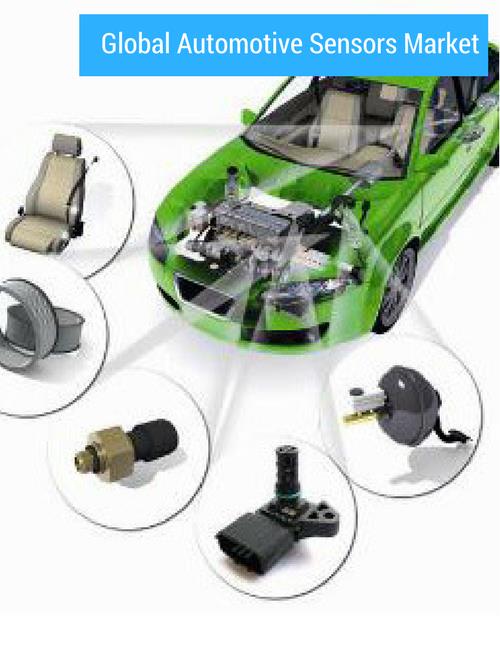

The automotive sensor market size was valued at USD 27.34 billion in 2025 and estimated to grow from USD 28.83 billion in 2026 to reach USD 38.67 billion by 2031, at a CAGR of 6.05% during the forecast period (2026-2031). This report is Segmented by Type (Temperature Sensors, Pressure Sensors, Speed Sensors, and More), Application (Powertrain, Body Electronics, and More), Vehicle Type (Passenger Cars and Commercial Vehicles), Propulsion Technology (Internal Combustion Engine (ICE) Vehicles, and More), Sales Channel (OEM-Fitted Sensors, and More), and Geography. The Market Forecasts are Provided in Terms of Value (USD).
The sensor landscape also features level, position, and gas sensors. Although ultrasonic parking aids may soon be overshadowed by high-resolution cameras, throttle-position and crankshaft sensors are poised to remain relevant, bolstered by a significant global fleet of internal combustion vehicles. Gas sensors, particularly those for NOx and particulate detection, are experiencing a resurgence in demand due to stricter regulations, granting companies like Continental and NGK NTK enhanced pricing leverage. In anticipation of updated standards, suppliers are integrating cybersecurity features into next-gen sensor chips, not only distinguishing their premium products but also bolstering the overall automotive sensor market.
Powertrain modules retained 40.55% of the revenue in 2025, due to the continued demand for oxygen, manifold-pressure, and crankshaft sensors, which are still required on internal-combustion engines. Yet telematics sensors represent the fastest-growing slice of the automotive sensor market, with an 8.86% CAGR driven by usage-based insurance and fleet analytics that monetize accelerometer, GPS, and cellular data.
As overall vehicle production rises, so too do body electronics, devices responding to rain, ambient light, and occupancy. Meanwhile, as smartphone-based access becomes more prevalent, vehicle security modules see a corresponding uptick. While the share of powertrains may wane due to the phasing out of exhaust-gas sensors in EVs, the introduction of voltage and thermal sensing in battery-management systems offers a counterbalance to this decline. Predictive-maintenance data harnessed from telematics has demonstrated its ability to reduce fleet downtime, underscoring the economic rationale for investing in sensors. Responding to the need for enhanced safety, ISO 26262 now requires telematics modules to have redundant signal paths. This addition, while raising the bill of materials, guarantees a fail-silent operation even during connectivity disruptions.
While North America and Europe account for a significant share of shipments, their growth is expected to slow as vehicle production stabilizes and sensor usage in premium trims nears saturation. The United States Infrastructure Investment and Jobs Act is backing public charging points, which is likely to boost the demand for sensors in EV chargers. With stricter thresholds for NOx and particulates, companies such as Continental and Bosch are experiencing a consistent demand for gas sensors. Both North America and Europe are striving for semiconductor independence, as evident from Intel's investments in Arizona and the European Chips Act. However, the automotive sector's qualification process lags behind consumer electronics, leading to a continued reliance on Asian production.
South America and the Middle East and Africa, which account for a smaller share of the market, are poised for faster growth. Brazil's incentives are bolstering the adoption of ESC and TPMS. Turkey's export vehicles, now equipped with EU-compliant ADAS, are driving local demand for sensors. Despite smaller production volumes, South Africa's adoption of stricter diesel regulations and the Gulf Cooperation Council's luxury fleet are both increasing the sensor count per vehicle. Argentina, while banking on currency stability for recovery, still presents an aftermarket opportunity due to its aging vehicle fleet.
Global Automotive Sensors Market Trends and Insights
ADAS and Autonomous-Driving Sensor Proliferation
New regulations mandate that United States light vehicles include automatic emergency braking systems capable of detecting pedestrians at night, requiring manufacturers to enhance their forward-looking sensor suites. Approvals for advanced driving systems, such as highway certifications, necessitate triple-redundant clusters, significantly increasing perception hardware costs. The transition from single-technology systems to hybrid radar-camera architectures is becoming more prominent with advancements in imaging-radar programs. However, research continues to highlight false-positive rates in current systems, emphasizing the need for higher-resolution lidar and thermal imaging. Additionally, updates to functional-safety standards are broadening audits to include cybersecurity, which extends validation processes but strengthens vendor positions in the market.Electric Vehicle (EV) Thermal-Battery Sensing Boom
Global production of battery-electric vehicles has increased significantly, with each car incorporating multiple temperature probes across cells and coolant loops to prevent thermal runaway incidents. China's updated standards require real-time monitoring at the cell level, resulting in a notable increase in sensor counts compared to earlier models. Research from the European Union's Joint Research Centre highlights that distributed thermal sensing can substantially reduce catastrophic failures during crash scenarios. In response to these developments, STMicroelectronics introduced advanced MEMS thermistors designed for high-voltage packs. Despite the growing share of pure electric vehicles, the demand for thermal sensors remains strong, particularly with the use of dual-zone cooling in plug-in hybrids. Additionally, updated standards now require tests for thermal-propagation resistance, emphasizing the importance of co-located pressure and temperature devices.Semiconductor Wafer-Supply Volatility
Automotive-grade lead times remain significantly higher than pre-pandemic levels, causing delays in new-model launches. While new fabs by Intel and Taiwan Semiconductor Manufacturing Company (TSMC) in Arizona are expected to enhance domestic capacity, the automotive qualification process is delaying substantial volume relief. Europe's Chips Act aims to increase the region's share of the semiconductor market. However, foundries continue to prioritize logic nodes, leaving sensor-specific production lines limited. Tier-1 suppliers are increasing inventory buffers, which is straining working capital and reducing returns. This approach places smaller vendors with weaker financial resources at a disadvantage. Consequently, dual-sourcing strategies are now widely adopted, even for long-life AEC-Q100 components.Other drivers and restraints analyzed in the detailed report include:
- Emission and Safety Mandates Driving Pressure/Gas Sensors
- Falling Micro-Electro-Mechanical Systems (MEMS) ASP Enabling Mass Adoption
- Sensor Cost Pressure on Mass-Market Vehicles
Segment Analysis
Inertial devices commanded 28.13% of the 2025 revenue within the automotive sensor market size and are expected to advance at a 6.47% CAGR to 2031 as global electronic stability control and sensor-fusion stacks standardize on six-axis IMUs. Bosch's SMI240 and Murata's steer-by-wire gyroscopes exemplify the industry's shift toward ASIL D-certified firmware, enabling minimal drift and withstanding extreme shocks. Temperature sensors, with multiple units in each electric vehicle battery pack, adeptly manage rapid thermal gradients during fast charging. Pressure modules play a crucial role, from monitoring tire pressure to regenerating diesel particulate filters in compliance with evolving standards. While commoditized speed sensors are vital for anti-lock braking systems and traction control, Hall-effect current transducers, designed for high-voltage packs, are carving out lucrative niches for companies like Allegro and Melexis.The sensor landscape also features level, position, and gas sensors. Although ultrasonic parking aids may soon be overshadowed by high-resolution cameras, throttle-position and crankshaft sensors are poised to remain relevant, bolstered by a significant global fleet of internal combustion vehicles. Gas sensors, particularly those for NOx and particulate detection, are experiencing a resurgence in demand due to stricter regulations, granting companies like Continental and NGK NTK enhanced pricing leverage. In anticipation of updated standards, suppliers are integrating cybersecurity features into next-gen sensor chips, not only distinguishing their premium products but also bolstering the overall automotive sensor market.
Powertrain modules retained 40.55% of the revenue in 2025, due to the continued demand for oxygen, manifold-pressure, and crankshaft sensors, which are still required on internal-combustion engines. Yet telematics sensors represent the fastest-growing slice of the automotive sensor market, with an 8.86% CAGR driven by usage-based insurance and fleet analytics that monetize accelerometer, GPS, and cellular data.
As overall vehicle production rises, so too do body electronics, devices responding to rain, ambient light, and occupancy. Meanwhile, as smartphone-based access becomes more prevalent, vehicle security modules see a corresponding uptick. While the share of powertrains may wane due to the phasing out of exhaust-gas sensors in EVs, the introduction of voltage and thermal sensing in battery-management systems offers a counterbalance to this decline. Predictive-maintenance data harnessed from telematics has demonstrated its ability to reduce fleet downtime, underscoring the economic rationale for investing in sensors. Responding to the need for enhanced safety, ISO 26262 now requires telematics modules to have redundant signal paths. This addition, while raising the bill of materials, guarantees a fail-silent operation even during connectivity disruptions.
Complete Report Scope:
- By Type
- Temperature Sensors
- Pressure Sensors
- Speed Sensors
- Level / Position Sensors
- Magnetic Sensors
- Gas Sensors
- Inertial Sensors
- By Application
- Powertrain
- Body Electronics
- Vehicle Security Systems
- Telematics
- By Vehicle Type
- Passenger Cars
- Commercial Vehicles
- By Propulsion Technology
- Internal Combustion Engine (ICE) Vehicles
- Battery-Electric Vehicles (BEV)
- Plug-in Hybrid Vehicles (PHEV)
- Fuel-cell Electric Vehicles (FCEV)
- By Sales Channel
- OEM-fitted Sensors
- Aftermarket
- By Geography
- North America
- United States
- Canada
- Rest of North America
- South America
- Brazil
- Argentina
- Rest of South America
- Europe
- Germany
- United Kingdom
- France
- Russia
- Rest of Europe
- Asia-Pacific
- China
- Japan
- India
- South Korea
- Rest of Asia-Pacific
- Middle East and Africa
- Turkey
- Gulf Cooperation Council (GCC)
- South Africa
- Rest of Middle East and Africa
- North America
Geography Analysis
The Asia-Pacific led the automotive sensor market with 42.30% revenue in 2025 and is forecasted to grow at a 9.10% CAGR through 2031. China's new-energy vehicle sales, now mandated to include cell-level thermal monitoring under updated regulations, have propelled the market. In India, a production-linked incentive is facilitating local MEMS assembly and reducing import bills for tier-2 suppliers. In Japan, ADAS penetration has increased significantly, driven by the use of imaging sensors from DENSO and Sony. Meanwhile, South Korea's Samsung and SK Hynix are expanding their regional MEMS foundry capacity.While North America and Europe account for a significant share of shipments, their growth is expected to slow as vehicle production stabilizes and sensor usage in premium trims nears saturation. The United States Infrastructure Investment and Jobs Act is backing public charging points, which is likely to boost the demand for sensors in EV chargers. With stricter thresholds for NOx and particulates, companies such as Continental and Bosch are experiencing a consistent demand for gas sensors. Both North America and Europe are striving for semiconductor independence, as evident from Intel's investments in Arizona and the European Chips Act. However, the automotive sector's qualification process lags behind consumer electronics, leading to a continued reliance on Asian production.
South America and the Middle East and Africa, which account for a smaller share of the market, are poised for faster growth. Brazil's incentives are bolstering the adoption of ESC and TPMS. Turkey's export vehicles, now equipped with EU-compliant ADAS, are driving local demand for sensors. Despite smaller production volumes, South Africa's adoption of stricter diesel regulations and the Gulf Cooperation Council's luxury fleet are both increasing the sensor count per vehicle. Argentina, while banking on currency stability for recovery, still presents an aftermarket opportunity due to its aging vehicle fleet.
List of Companies Covered in this Report:
- Robert Bosch GmbH
- DENSO Corporation
- Continental AG
- Infineon Technologies AG
- NXP Semiconductors NV
- Sensata Technologies PLC
- Texas Instruments Inc.
- Analog Devices Inc.
- Aptiv PLC
- ST Microelectronics NV
- Valeo SA
- Honeywell International Inc.
- Allegro MicroSystems LLC
- Murata Manufacturing Co.
- ON Semiconductor Corporation
- TE Connectivity Ltd.
- Autoliv Inc.
Additional Benefits:
- The market estimate (ME) sheet in Excel format
- 3 months of analyst support
Table of Contents
1 Introduction
4 Market Landscape
5 Market Size and Growth Forecasts (Value in USD)
6 Competitive Landscape
7 Market Opportunities and Future Outlook
Companies Mentioned (Partial List)
A selection of companies mentioned in this report includes, but is not limited to:
- Robert Bosch GmbH
- DENSO Corporation
- Continental AG
- Infineon Technologies AG
- NXP Semiconductors NV
- Sensata Technologies PLC
- Texas Instruments Inc.
- Analog Devices Inc.
- Aptiv PLC
- ST Microelectronics NV
- Valeo SA
- Honeywell International Inc.
- Allegro MicroSystems LLC
- Murata Manufacturing Co.
- ON Semiconductor Corporation
- TE Connectivity Ltd.
- Autoliv Inc.


