



The Asia Pacific Dark Fiber Market size is expected to reach USD 4.10 billion by 2030, rising at a market growth of 13.9% CAGR during the forecast period (2026-2033).
The China market dominated the Asia Pacific Dark Fiber Market by country in 2025 with a 31.5% revenue share and is expected to continue to be a dominant market till 2030. The India market is expected to witness a CAGR of 14.7% during 2026-2033. Additionally, the Malaysia market is expected to witness a CAGR of 16.3% during 2026-2033.
The Asia Pacific Dark Fiber Market is witnessing substantial expansion owing to rapid digital transformation, increasing hyperscale data center investments, accelerating 5G deployment, and rising demand for high-speed broadband connectivity across developing and developed economies. Governments and telecom operators across China, India, Japan, South Korea, Singapore, and Southeast Asia are heavily investing in fiber infrastructure modernization to support cloud computing, AI workloads, smart manufacturing, and enterprise connectivity.
The market is also benefiting from the increasing deployment of submarine cable systems, smart city projects, and intercity fiber backbone networks. Rising adoption of edge computing and growing enterprise dependence on low-latency networks are further accelerating dark fiber demand throughout the Asia Pacific region.
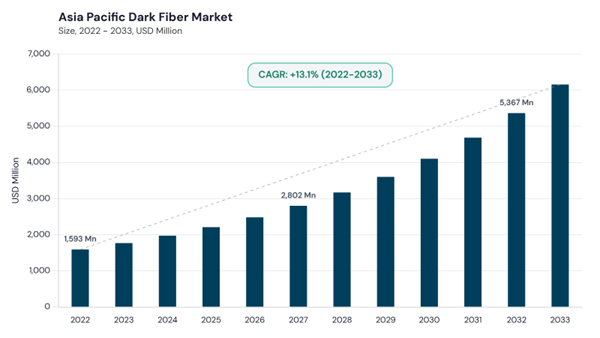
The China market dominated the Asia Pacific Dark Fiber Market by country in 2025 with a 31.5% revenue share and is expected to continue to be a dominant market till 2030. The India market is expected to witness a CAGR of 14.7% during 2026-2033. Additionally, the Malaysia market is expected to witness a CAGR of 16.3% during 2026-2033.
The Asia Pacific Dark Fiber Market is witnessing substantial expansion owing to rapid digital transformation, increasing hyperscale data center investments, accelerating 5G deployment, and rising demand for high-speed broadband connectivity across developing and developed economies. Governments and telecom operators across China, India, Japan, South Korea, Singapore, and Southeast Asia are heavily investing in fiber infrastructure modernization to support cloud computing, AI workloads, smart manufacturing, and enterprise connectivity.
The market is also benefiting from the increasing deployment of submarine cable systems, smart city projects, and intercity fiber backbone networks. Rising adoption of edge computing and growing enterprise dependence on low-latency networks are further accelerating dark fiber demand throughout the Asia Pacific region.
By Fiber Outlook
Based on Fiber, the market is segmented into Single-mode and Multimode. The Single-mode segment dominated the Asia Pacific Dark Fiber Market by Fiber in 2025 and is expected to continue to be a dominant segment till 2030; thereby, achieving a market value of USD 2.80 billion by 2030. Meanwhile, the Multimode segment is expected to witness a CAGR of 14.7% during 2026-2033.By Network Outlook
Based on Network, the market is segmented into Metro Network and Long-haul. The Metro Network segment acquired the largest revenue share of 62.2% in the Asia Pacific Dark Fiber Market by Network in 2025. The Long-haul segment is expected to witness a CAGR of 14.6% during 2026-2033.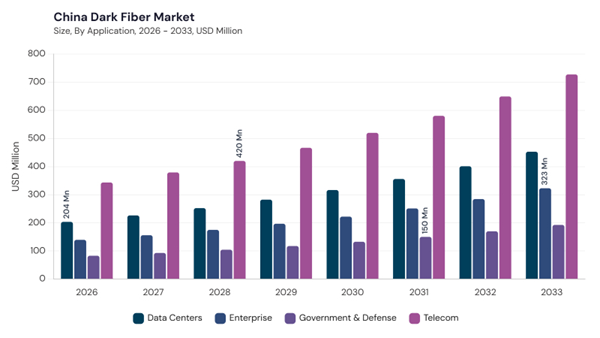
By Technology Outlook
Based on Technology, the market is segmented into DWDM and CWDM. The DWDM segment dominated the Asia Pacific Dark Fiber Market by Technology in 2025 and is expected to continue to be a dominant segment till 2030; thereby, achieving a market value of USD 2.58 billion by 2030. The CWDM segment is expected to witness a CAGR of 14.4% during the forecast period.By Application Outlook
Based on Application, the market is segmented into Telecom, Data Centers, Enterprise, and Government & Defense. The Telecom segment dominated the Asia Pacific Dark Fiber Market by Application in 2025 with a revenue share of 45.1%. The Enterprise segment is expected to witness the highest CAGR of 14.6% during 2026-2033. Additionally, the Government & Defense segment is expected to witness a CAGR of 14.7% during the forecast period.By Country Outlook
List of Key Companies Profiled
- AT&T Inc.
- Verizon Communications Inc.
- Lumen Technologies, Inc.
- Zayo Group Holdings, Inc.
- Colt Technology Services Group Limited
- euNetworks Group Limited
- Deutsche Telekom AG
- Orange S.A.
- Vodafone Group Plc
- Comcast Corporation
Market Report Segmentation
By Fiber- Single-mode
- Multimode
- Metro Network
- Long-haul
- DWDM
- CWDM
- Telecom
- Data Centers
- Enterprise
- Government & Defense
- China
- Japan
- India
- South Korea
- Singapore
- Malaysia
- Rest of Asia Pacific
Table of Contents
Chapter 1. Asia Pacific Market1.1 Market Overview
1.2 Key Factors Impacting Market
1.2.1 Market Drivers
1.2.2 Market Restraints
1.2.3 Market Opportunities
1.2.4 Market Challenges
1.2.5 Market Trends
1.2.6 State of Competition
1.2.7 Market Consolidation
1.2.8 Key Customer Criteria
1.3 Product Life Cycle
1.4 Segmentation By Fiber
1.4.1 Single-Mode
1.4.2 Multimode
1.5 Segmentation By Network
1.5.1 Metro Network
1.5.2 Long-Haul
1.6 Segmentation By Technology
1.6.1 DWDM
1.6.2 CWDM
1.7 Segmentation By Application
1.7.1 Telecom
1.7.2 Data Centers
1.7.3 Enterprise
1.7.4 Government & Defense
1.8 Segmentation By Country
1.8.1 China
1.8.1.1 Segmentation By Fiber
1.8.1.1.1 Single-mode
1.8.1.1.2 Multimode
1.8.1.2 Segmentation By Network
1.8.1.2.1 Metro Network
1.8.1.2.2 Long-haul
1.8.1.3 Segmentation By Technology
1.8.1.3.1 DWDM
1.8.1.3.2 CWDM
1.8.1.4 Segmentation By Application
1.8.1.4.1 Telecom
1.8.1.4.2 Data Centers
1.8.1.4.3 Enterprise
1.8.1.4.4 Government & Defense
1.8.2 Japan
1.8.2.1 Segmentation By Fiber
1.8.2.1.1 Single-mode
1.8.2.1.2 Multimode
1.8.2.2 Segmentation By Network
1.8.2.2.1 Metro Network
1.8.2.2.2 Long-haul
1.8.2.3 Segmentation By Technology
1.8.2.3.1 DWDM
1.8.2.3.2 CWDM
1.8.2.4 Segmentation By Application
1.8.2.4.1 Telecom
1.8.2.4.2 Data Centers
1.8.2.4.3 Enterprise
1.8.2.4.4 Government & Defense
1.8.3 India
1.8.3.1 Segmentation By Fiber
1.8.3.1.1 Single-mode
1.8.3.1.2 Multimode
1.8.3.2 Segmentation By Network
1.8.3.2.1 Metro Network
1.8.3.2.2 Long-haul
1.8.3.3 Segmentation By Technology
1.8.3.3.1 DWDM
1.8.3.3.2 CWDM
1.8.3.4 Segmentation By Application
1.8.3.4.1 Telecom
1.8.3.4.2 Data Centers
1.8.3.4.3 Enterprise
1.8.3.4.4 Government & Defense
1.8.4 South Korea
1.8.4.1 Segmentation By Fiber
1.8.4.1.1 Single-mode
1.8.4.1.2 Multimode
1.8.4.2 Segmentation By Network
1.8.4.2.1 Metro Network
1.8.4.2.2 Long-haul
1.8.4.3 Segmentation By Technology
1.8.4.3.1 DWDM
1.8.4.3.2 CWDM
1.8.4.4 Segmentation By Application
1.8.4.4.1 Telecom
1.8.4.4.2 Data Centers
1.8.4.4.3 Enterprise
1.8.4.4.4 Government & Defense
1.8.5 Singapore
1.8.5.1 Segmentation By Fiber
1.8.5.1.1 Single-mode
1.8.5.1.2 Multimode
1.8.5.2 Segmentation By Network
1.8.5.2.1 Metro Network
1.8.5.2.2 Long-haul
1.8.5.3 Segmentation By Technology
1.8.5.3.1 DWDM
1.8.5.3.2 CWDM
1.8.5.4 Segmentation By Application
1.8.5.4.1 Telecom
1.8.5.4.2 Data Centers
1.8.5.4.3 Enterprise
1.8.5.4.4 Government & Defense
1.8.6 Malaysia
1.8.6.1 Segmentation By Fiber
1.8.6.1.1 Single-mode
1.8.6.1.2 Multimode
1.8.6.2 Segmentation By Network
1.8.6.2.1 Metro Network
1.8.6.2.2 Long-haul
1.8.6.3 Segmentation By Technology
1.8.6.3.1 DWDM
1.8.6.3.2 CWDM
1.8.6.4 Segmentation By Application
1.8.6.4.1 Telecom
1.8.6.4.2 Data Centers
1.8.6.4.3 Enterprise
1.8.6.4.4 Government & Defense
1.8.7 Rest of Asia Pacific
1.8.7.1 Segmentation By Fiber
1.8.7.1.1 Single-mode
1.8.7.1.2 Multimode
1.8.7.2 Segmentation By Network
1.8.7.2.1 Metro Network
1.8.7.2.2 Long-haul
1.8.7.3 Segmentation By Technology
1.8.7.3.1 DWDM
1.8.7.3.2 CWDM
1.8.7.4 Segmentation By Application
1.8.7.4.1 Telecom
1.8.7.4.2 Data Centers
1.8.7.4.3 Enterprise
1.8.7.4.4 Government & Defense
Companies Mentioned
- AT&T Inc.
- Verizon Communications Inc.
- Lumen Technologies, Inc.
- Zayo Group Holdings, Inc.
- Colt Technology Services Group Limited
- euNetworks Group Limited
- Deutsche Telekom AG
- Orange S.A.
- Vodafone Group Plc
- Comcast Corporation


