



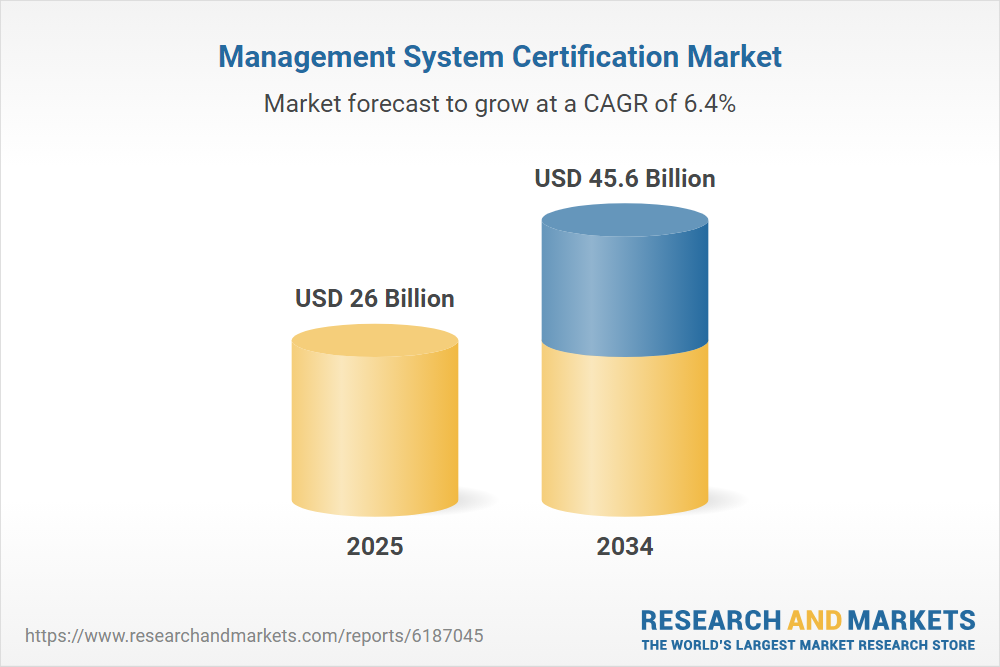
The Management System Certification Market is valued at USD 26 billion in 2025 and is projected to grow at a CAGR of 6.4% to reach USD 45.6 billion by 2034.
The institutional and office furniture market plays a pivotal role in shaping professional and learning environments around the world. Traditionally driven by corporate demand, educational institutions, and healthcare facilities, this market has steadily evolved in response to changes in work culture and technological innovation. Office furniture now goes beyond functional use, becoming a strategic tool to enhance productivity, promote collaboration, and reflect organizational culture. As businesses aim to create adaptive and inclusive workplaces, the demand for ergonomic, modular, and sustainable furniture has surged. Government regulations encouraging environmentally friendly materials and smart furniture integration are further influencing purchasing decisions. Globally, the market is witnessing increased investments from startups and established brands alike, with North America, Europe, and Asia-Pacific being the dominant regions. The competitive landscape remains dynamic, with companies focusing on customization, rapid delivery, and integrated services. Overall, the institutional and office furniture market is not only recovering post-pandemic but entering a new growth phase led by innovation, user-centric designs, and flexible work models.
The institutional and office furniture market has seen a significant transformation, primarily influenced by hybrid work strategies adopted by corporations. As organizations redefine physical spaces to support both remote and on-site teams, there has been a sharp rise in demand for multipurpose desks, adjustable chairs, acoustic panels, and tech-integrated solutions. Institutions have increasingly leaned towards modular configurations that support quick layout changes for group or individual needs. Sustainability has taken center stage, with furniture crafted from recyclable materials and featuring energy-efficient manufacturing processes gaining popularity. Additionally, educational and healthcare sectors have prioritized antimicrobial surfaces and easy-to-clean furniture to ensure safety and hygiene. Digitally enabled furniture, such as desks with charging ports and IoT capabilities for monitoring usage, is gaining traction in modern workspaces. Leading companies have begun collaborating with tech firms to embed smart features into furniture offerings. Meanwhile, direct-to-consumer sales models, online configurators, and AR-based visualization tools are helping buyers make informed decisions. All these developments are contributing to a steady year-over-year growth pattern across global markets.
The institutional and office furniture market is expected to evolve further with a deeper integration of AI, automation, and customization. As workplace well-being continues to dominate corporate agendas, furniture will increasingly be designed to support mental health, movement, and focus. Anticipated innovations include AI-driven workstations that adjust based on user preferences, voice-controlled conference setups, and climate-responsive materials. The rise of the gig economy and freelance workforce will influence demand for compact and home-office-friendly solutions. Institutions will also push for enhanced personalization and localized production, enabled by 3D printing and digital fabrication techniques. A major push is expected in circular economy practices, where furniture is designed for disassembly, reuse, or recycling. In education and healthcare settings, inclusive design for diverse user needs will become a priority. Additionally, emerging markets are likely to see increased investment and expansion from international players seeking new growth frontiers. With workplace strategies becoming more experience-focused, the role of office and institutional furniture will shift from static infrastructure to a dynamic element of organizational identity and performance.
Macroeconomic indicators, policy frameworks such as carbon pricing and energy security strategies, and evolving consumer behavior are considered in forecasting scenarios. Recent deal flows, partnerships, and technology innovations are incorporated to assess their impact on future market performance.
Regional insights highlight the most promising investment destinations, regulatory landscapes, and evolving partnerships across energy and industrial corridors.
This product will be delivered within 1-3 business days.
The institutional and office furniture market plays a pivotal role in shaping professional and learning environments around the world. Traditionally driven by corporate demand, educational institutions, and healthcare facilities, this market has steadily evolved in response to changes in work culture and technological innovation. Office furniture now goes beyond functional use, becoming a strategic tool to enhance productivity, promote collaboration, and reflect organizational culture. As businesses aim to create adaptive and inclusive workplaces, the demand for ergonomic, modular, and sustainable furniture has surged. Government regulations encouraging environmentally friendly materials and smart furniture integration are further influencing purchasing decisions. Globally, the market is witnessing increased investments from startups and established brands alike, with North America, Europe, and Asia-Pacific being the dominant regions. The competitive landscape remains dynamic, with companies focusing on customization, rapid delivery, and integrated services. Overall, the institutional and office furniture market is not only recovering post-pandemic but entering a new growth phase led by innovation, user-centric designs, and flexible work models.
The institutional and office furniture market has seen a significant transformation, primarily influenced by hybrid work strategies adopted by corporations. As organizations redefine physical spaces to support both remote and on-site teams, there has been a sharp rise in demand for multipurpose desks, adjustable chairs, acoustic panels, and tech-integrated solutions. Institutions have increasingly leaned towards modular configurations that support quick layout changes for group or individual needs. Sustainability has taken center stage, with furniture crafted from recyclable materials and featuring energy-efficient manufacturing processes gaining popularity. Additionally, educational and healthcare sectors have prioritized antimicrobial surfaces and easy-to-clean furniture to ensure safety and hygiene. Digitally enabled furniture, such as desks with charging ports and IoT capabilities for monitoring usage, is gaining traction in modern workspaces. Leading companies have begun collaborating with tech firms to embed smart features into furniture offerings. Meanwhile, direct-to-consumer sales models, online configurators, and AR-based visualization tools are helping buyers make informed decisions. All these developments are contributing to a steady year-over-year growth pattern across global markets.
The institutional and office furniture market is expected to evolve further with a deeper integration of AI, automation, and customization. As workplace well-being continues to dominate corporate agendas, furniture will increasingly be designed to support mental health, movement, and focus. Anticipated innovations include AI-driven workstations that adjust based on user preferences, voice-controlled conference setups, and climate-responsive materials. The rise of the gig economy and freelance workforce will influence demand for compact and home-office-friendly solutions. Institutions will also push for enhanced personalization and localized production, enabled by 3D printing and digital fabrication techniques. A major push is expected in circular economy practices, where furniture is designed for disassembly, reuse, or recycling. In education and healthcare settings, inclusive design for diverse user needs will become a priority. Additionally, emerging markets are likely to see increased investment and expansion from international players seeking new growth frontiers. With workplace strategies becoming more experience-focused, the role of office and institutional furniture will shift from static infrastructure to a dynamic element of organizational identity and performance.
Key Insights: Management System Certification Market
- Smart furniture integration is on the rise, with desks and chairs equipped with sensors, health monitoring, and IoT connectivity to support data-driven workplace decisions.
- Sustainability remains a central trend, with manufacturers using biodegradable materials, recycled content, and low-emission processes to align with eco-conscious buyer demands.
- Modular and reconfigurable furniture is gaining traction, enabling institutions to quickly adapt layouts to shifting team sizes or learning formats.
- The demand for acoustical and privacy-enhancing furniture has grown as open-plan offices evolve to balance collaboration and focused work.
- Home office furniture is expanding into a major sub-segment, driven by hybrid work patterns and the growing number of remote professionals worldwide.
- Hybrid work culture is pushing organizations to rethink office design, creating demand for adaptable furniture that supports both remote and on-site work styles.
- Health and ergonomics are top priorities, prompting investments in posture-supportive chairs, sit-stand desks, and wellness-centered design solutions.
- Digital transformation in procurement and planning, including 3D configurators and e-commerce platforms, is making office furniture more accessible and customizable.
- Government and institutional spending on education and healthcare infrastructure is boosting demand for specialized, durable, and user-friendly furniture solutions.
- Volatility in raw material prices, particularly wood, metal, and polymers, is straining profit margins and complicating long-term supply chain planning for manufacturers and suppliers.
Management System Certification Market Segmentation
By Certification Type
- Product Certification
- Management System Certification
By Service Type
- Certification and Verification
- Training and Business Assurance
By Application
- Quality Management Systems
- Occupational Health and Safety
- Information Security and Information Technology (IT)
- Cyber Security
- Food and Safety
- Environmental Management
- Other Applications
By Vertical
- Consumer Goods and Retail
- Agriculture and Food
- Chemicals
- Construction and Infrastructure
- Energy and Power
- Industrial and Manufacturing
- Mining
- Oil and Gas and Petroleum
- Public
- Other Verticals
Key Companies Analysed
- Bureau Veritas
- SGS SA
- TÜV SÜD AG
- TÜV Rheinland Group
- TÜV Nord Group
- Intertek Group plc
- DNV AS
- BSI Group (British Standards Institution)
- DEKRA SE
- Lloyd’s Register Group Services Ltd.
Management System Certification Market Analytics
The report employs rigorous tools, including Porter’s Five Forces, value chain mapping, and scenario-based modeling, to assess supply-demand dynamics. Cross-sector influences from parent, derived, and substitute markets are evaluated to identify risks and opportunities. Trade and pricing analytics provide an up-to-date view of international flows, including leading exporters, importers, and regional price trends.Macroeconomic indicators, policy frameworks such as carbon pricing and energy security strategies, and evolving consumer behavior are considered in forecasting scenarios. Recent deal flows, partnerships, and technology innovations are incorporated to assess their impact on future market performance.
Management System Certification Market Competitive Intelligence
The competitive landscape is mapped through proprietary frameworks, profiling leading companies with details on business models, product portfolios, financial performance, and strategic initiatives. Key developments such as mergers & acquisitions, technology collaborations, investment inflows, and regional expansions are analyzed for their competitive impact. The report also identifies emerging players and innovative startups contributing to market disruption.Regional insights highlight the most promising investment destinations, regulatory landscapes, and evolving partnerships across energy and industrial corridors.
Countries Covered
- North America - Management System Certification market data and outlook to 2034
- United States
- Canada
- Mexico
- Europe - Management System Certification market data and outlook to 2034
- Germany
- United Kingdom
- France
- Italy
- Spain
- BeNeLux
- Russia
- Sweden
- Asia-Pacific - Management System Certification market data and outlook to 2034
- China
- Japan
- India
- South Korea
- Australia
- Indonesia
- Malaysia
- Vietnam
- Middle East and Africa - Management System Certification market data and outlook to 2034
- Saudi Arabia
- South Africa
- Iran
- UAE
- Egypt
- South and Central America - Management System Certification market data and outlook to 2034
- Brazil
- Argentina
- Chile
- Peru
Research Methodology
This study combines primary inputs from industry experts across the Management System Certification value chain with secondary data from associations, government publications, trade databases, and company disclosures. Proprietary modeling techniques, including data triangulation, statistical correlation, and scenario planning, are applied to deliver reliable market sizing and forecasting.Key Questions Addressed
- What is the current and forecast market size of the Management System Certification industry at global, regional, and country levels?
- Which types, applications, and technologies present the highest growth potential?
- How are supply chains adapting to geopolitical and economic shocks?
- What role do policy frameworks, trade flows, and sustainability targets play in shaping demand?
- Who are the leading players, and how are their strategies evolving in the face of global uncertainty?
- Which regional “hotspots” and customer segments will outpace the market, and what go-to-market and partnership models best support entry and expansion?
- Where are the most investable opportunities - across technology roadmaps, sustainability-linked innovation, and M&A - and what is the best segment to invest over the next 3-5 years?
Your Key Takeaways from the Management System Certification Market Report
- Global Management System Certification market size and growth projections (CAGR), 2024-2034
- Impact of Russia-Ukraine, Israel-Palestine, and Hamas conflicts on Management System Certification trade, costs, and supply chains
- Management System Certification market size, share, and outlook across 5 regions and 27 countries, 2023-2034
- Management System Certification market size, CAGR, and market share of key products, applications, and end-user verticals, 2023-2034
- Short- and long-term Management System Certification market trends, drivers, restraints, and opportunities
- Porter’s Five Forces analysis, technological developments, and Management System Certification supply chain analysis
- Management System Certification trade analysis, Management System Certification market price analysis, and Management System Certification supply/demand dynamics
- Profiles of 5 leading companies - overview, key strategies, financials, and products
- Latest Management System Certification market news and developments
Additional Support
With the purchase of this report, you will receive:- An updated PDF report and an MS Excel data workbook containing all market tables and figures for easy analysis.
- 7-day post-sale analyst support for clarifications and in-scope supplementary data, ensuring the deliverable aligns precisely with your requirements.
- Complimentary report update to incorporate the latest available data and the impact of recent market developments.
This product will be delivered within 1-3 business days.
Table of Contents
1. Table of Contents
2. Global Management System Certification Market Summary, 2025
3. Management System Certification Market Insights, 2024-2034
4. Management System Certification Market Analytics
5. Global Management System Certification Market Statistics - Industry Revenue, Market Share, Growth Trends and Forecast by segments, to 2034
6. Asia Pacific Management System Certification Industry Statistics - Market Size, Share, Competition and Outlook
7. Europe Management System Certification Market Data, Penetration, and Business Prospects to 2034
8. North America Management System Certification Market Size, Growth Trends, and Future Prospects to 2034
9. South and Central America Management System Certification Market Drivers, Challenges, and Future Prospects
10. Middle East Africa Management System Certification Market Outlook and Growth Prospects
11. Management System Certification Market Structure and Competitive Landscape
12 Appendix
Companies Mentioned
- Bureau Veritas
- SGS SA
- TÜV SÜD AG
- TÜV Rheinland Group
- TÜV Nord Group
- Intertek Group PLC
- DNV AS
- BSI Group (British Standards Institution)
- DEKRA SE
- Lloyd’s Register Group Services Ltd.
Table Information
| Report Attribute | Details |
|---|---|
| No. of Pages | 160 |
| Published | October 2025 |
| Forecast Period | 2025 - 2034 |
| Estimated Market Value ( USD | $ 26 Billion |
| Forecasted Market Value ( USD | $ 45.6 Billion |
| Compound Annual Growth Rate | 6.4% |
| Regions Covered | Global |
| No. of Companies Mentioned | 10 |


