



The Asia Pacific On-device AI Market is expected to reach $5.16 billion by 2027 and is expected to witness market growth of 27.6% CAGR during the forecast period (2025-2032).
The China market dominated the Asia Pacific On-Device AI Market by country in 2024, and is expected to continue to be a dominant market till 2032; thereby, achieving a market value of $6.22 billion by 2032. The Japan market is showcasing a CAGR of 26.6% during 2025-2032. Additionally, the India market would register a CAGR of 28.8% during 2025-2032. The China and Japan led the Asia Pacific On-Device AI Market by Country with a market share of 37.4% and 15.4% in 2024.The Malaysia market is expected to witness a CAGR of 31.5% during throughout the forecast period.
The Asia Pacific on-device AI market is all about running AI directly on devices like smartphones, wearables, self-driving cars, and IoT products. This makes processing faster, more private, and less power-hungry. The area benefits from a strong consumer electronics industry, a high rate of smartphone use, and top OEMs like Samsung and Qualcomm. Partnerships between governments and businesses, especially in South Korea and Japan, help make low-power AI chips and localized inference systems. The market has changed from simple mobile AI features to advanced edge intelligence with NPUs and optimized SoCs. Structured programs that give developers access to tools and hardware are helping developer ecosystems grow. Because of this, AI on devices is becoming a major way to tell products apart in both the consumer and industrial sectors.
Some important trends are more support for developers, better integration of hardware and software, and more strategic involvement from the government. Qualcomm's regional innovation programs and Samsung's Galaxy AI features show how the push is on for device intelligence that is real-time and focused on privacy. OEMs are putting AI accelerators into chips and making software stacks work better to boost performance and battery life. Governments see AI on devices as a strategic part of the infrastructure that supports digital sovereignty and makes people less dependent on cloud systems. Innovation intensity, ecosystem building, and the size of the deployment all drive competition. OEMs and public institutions working together also speed up adoption. In general, Asia Pacific is building an on-device AI ecosystem that is based on innovation and focuses on responsiveness, security, and localized intelligence.
The China market dominated the Asia Pacific On-Device AI Market by country in 2024, and is expected to continue to be a dominant market till 2032; thereby, achieving a market value of $6.22 billion by 2032. The Japan market is showcasing a CAGR of 26.6% during 2025-2032. Additionally, the India market would register a CAGR of 28.8% during 2025-2032. The China and Japan led the Asia Pacific On-Device AI Market by Country with a market share of 37.4% and 15.4% in 2024.The Malaysia market is expected to witness a CAGR of 31.5% during throughout the forecast period.
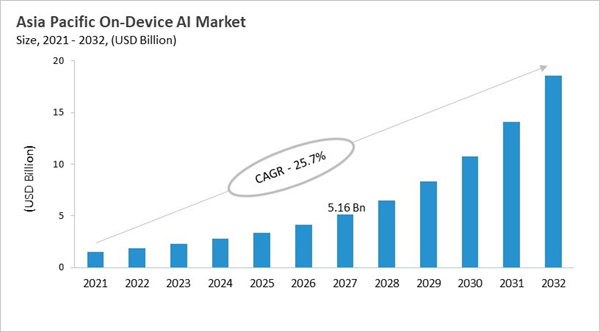
The Asia Pacific on-device AI market is all about running AI directly on devices like smartphones, wearables, self-driving cars, and IoT products. This makes processing faster, more private, and less power-hungry. The area benefits from a strong consumer electronics industry, a high rate of smartphone use, and top OEMs like Samsung and Qualcomm. Partnerships between governments and businesses, especially in South Korea and Japan, help make low-power AI chips and localized inference systems. The market has changed from simple mobile AI features to advanced edge intelligence with NPUs and optimized SoCs. Structured programs that give developers access to tools and hardware are helping developer ecosystems grow. Because of this, AI on devices is becoming a major way to tell products apart in both the consumer and industrial sectors.
Some important trends are more support for developers, better integration of hardware and software, and more strategic involvement from the government. Qualcomm's regional innovation programs and Samsung's Galaxy AI features show how the push is on for device intelligence that is real-time and focused on privacy. OEMs are putting AI accelerators into chips and making software stacks work better to boost performance and battery life. Governments see AI on devices as a strategic part of the infrastructure that supports digital sovereignty and makes people less dependent on cloud systems. Innovation intensity, ecosystem building, and the size of the deployment all drive competition. OEMs and public institutions working together also speed up adoption. In general, Asia Pacific is building an on-device AI ecosystem that is based on innovation and focuses on responsiveness, security, and localized intelligence.
Component Outlook
Based on Component, the market is segmented into Hardware, and Software. Among various South Korea On-Device AI Market by Component; The Hardware market achieved a market size of USD $190.6 Million in 2024 and is expected to grow at a CAGR of 28.9 % during the forecast period. The Software market is predicted to experience a CAGR of 29.9% throughout the forecast period from (2025-2032).Deployment Outlook
Based on Deployment, the market is segmented into On-premises, and Cloud. The On-premises market segment dominated the Singapore On-Device AI Market by Deployment is expected to grow at a CAGR of 29.9 % during the forecast period thereby continuing its dominance until 2032. Also, The Cloud market is anticipated to grow as a CAGR of 31.6 % during the forecast period during 2025-2032.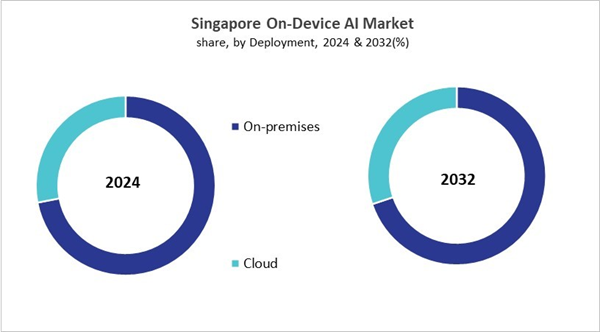
Country Outlook
China’s on-device AI market is closely shaped by national AI strategy and industrial policy that prioritize real-world deployment and reduced reliance on centralized cloud computing. Government support encourages the development of efficient AI models and chips for smartphones, robotics, and industrial sensors. A large digital population and strong AI ecosystem drive demand for localized, low-latency, and privacy-aware AI applications such as smart cameras and autonomous systems. Domestic firms like Huawei and Tencent integrate in-house AI stacks and custom NPUs into devices, while startups add specialized innovations. Adoption is reinforced by widespread 5G and IoT expansion, enabling faster edge inference. Competition includes both local champions and adapted global solutions under regulatory frameworks. Overall, growth is driven by technological self-reliance, hardware optimization, and smart infrastructure development.List of Key Companies Profiled
- Google LLC
- Apple, Inc.
- Amazon Web Services, Inc. (Amazon.com, Inc.)
- Microsoft Corporation
- IBM Corporation
- NVIDIA Corporation
- Intel Corporation
- Qualcomm Incorporated (Qualcomm Technologies, Inc.)
- Advanced Micro Devices, Inc.
- Huawei Technologies Co., Ltd. (Huawei Investment & Holding Co., Ltd.)
Market Report Segmentation
By Component- Hardware
- Software
- Machine Learning
- Computer Vision
- Natural Language Processing
- Speech Recognition
- On-premises
- Cloud
- Smartphones & Tablets
- Automotive
- Smart Home Devices
- Wearables
- Other Device
- Consumer Electronics
- Automotive
- Healthcare
- Security & Surveillance
- Manufacturing
- Retail
- Other Vertical
- China
- Japan
- India
- South Korea
- Singapore
- Malaysia
- Rest of Asia Pacific
Table of Contents
Chapter 1. Market Scope & Methodology
Chapter 2. Market at a Glance
Chapter 3. Market Overview
Chapter 10. Competition Analysis - Global
Chapter 11. Asia Pacific On-Device AI Market by Component
Chapter 12. Asia Pacific On-Device AI Market by Technology
Chapter 13. Asia Pacific On-Device AI Market by Deployment
Chapter 14. Asia Pacific On-Device AI Market by Device
Chapter 15. Asia Pacific On-Device AI Market by Vertical
Chapter 16. Asia Pacific On-Device AI Market by Country
Chapter 17. Company Profiles
Companies Mentioned
- Google LLC
- Apple, Inc.
- Amazon Web Services, Inc. (Amazon.com, Inc.)
- Microsoft Corporation
- IBM Corporation
- NVIDIA Corporation
- Intel Corporation
- Qualcomm Incorporated (Qualcomm Technologies, Inc.)
- Advanced Micro Devices, Inc.
- Huawei Technologies Co., Ltd. (Huawei Investment & Holding Co., Ltd.)


