



The Asia Pacific Piezoelectric Materials Market is expected to reach $715.84 million by 2028 and is expected to witness market growth of 4.5% CAGR during the forecast period (2025-2032).
The China market dominated the Asia Pacific Piezoelectric Materials Market by country in 2024, and is expected to continue to be a dominant market till 2032; thereby, achieving a market value of $297.9 million by 2032. The Japan market is registering a CAGR of 3.9% during 2025-2032. Additionally, the India market is expected to showcase a CAGR of 5.7% during 2025-2032. The China and Japan led the Asia Pacific Piezoelectric Materials Market by Country with a market share of 38.4% and 20.2% in 2024. The Malaysia market is expected to witness a CAGR of 8% during throughout the forecast period.
The Asia Pacific piezoelectric materials market has become a global center because the region is a leader in making electronics, advanced ceramics, and new ideas for industry. Early work in Japan made it possible to make piezoelectric ceramics for resonators, sensors, and actuators on an industrial scale, which made them widely used in consumer electronics. As the electronics and semiconductor industries grew in the Asia Pacific region, standardized piezoelectric parts became an important part of smartphones, home appliances, and industrial devices. Over time, China and South Korea expanded their uses to include automotive electronics, industrial automation, and mobile technologies. Government programs in intelligent manufacturing and energy efficiency also helped the market grow. Today, companies like Murata Manufacturing, TDK, Kyocera, and Samsung Electro-Mechanics use advanced ceramic processing, multilayer structures, and high-density manufacturing to make miniaturized electronics that can control vibrations, keep frequencies stable, and provide haptic feedback.
The market is currently growing because electric vehicles, robotics, smart factories, and energy-efficient systems are all growing quickly. Piezoelectric materials are being used more and more in ultrasonic sensors, engine monitoring, vibration detection, and precision actuators. Lead-free formulations and environmentally friendly new ideas are being developed because of the need for sustainability and following the rules. Key OEM strategies include vertical integration, investing in research and development, aligning with the ecosystem, and concentrating manufacturing in certain areas. These strategies make sure that high-performance components are available at scale and that they are quickly adopted by the market. The Asia Pacific market is very competitive and technologically advanced. It favors companies that combine materials science knowledge with cost-effective, large-scale production. Smaller companies, on the other hand, focus on niche applications in specialized industries.
The China market dominated the Asia Pacific Piezoelectric Materials Market by country in 2024, and is expected to continue to be a dominant market till 2032; thereby, achieving a market value of $297.9 million by 2032. The Japan market is registering a CAGR of 3.9% during 2025-2032. Additionally, the India market is expected to showcase a CAGR of 5.7% during 2025-2032. The China and Japan led the Asia Pacific Piezoelectric Materials Market by Country with a market share of 38.4% and 20.2% in 2024. The Malaysia market is expected to witness a CAGR of 8% during throughout the forecast period.
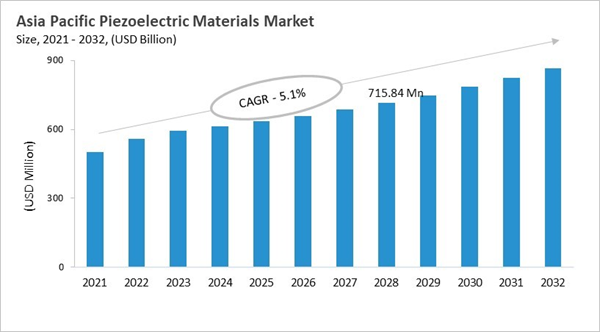
The Asia Pacific piezoelectric materials market has become a global center because the region is a leader in making electronics, advanced ceramics, and new ideas for industry. Early work in Japan made it possible to make piezoelectric ceramics for resonators, sensors, and actuators on an industrial scale, which made them widely used in consumer electronics. As the electronics and semiconductor industries grew in the Asia Pacific region, standardized piezoelectric parts became an important part of smartphones, home appliances, and industrial devices. Over time, China and South Korea expanded their uses to include automotive electronics, industrial automation, and mobile technologies. Government programs in intelligent manufacturing and energy efficiency also helped the market grow. Today, companies like Murata Manufacturing, TDK, Kyocera, and Samsung Electro-Mechanics use advanced ceramic processing, multilayer structures, and high-density manufacturing to make miniaturized electronics that can control vibrations, keep frequencies stable, and provide haptic feedback.
The market is currently growing because electric vehicles, robotics, smart factories, and energy-efficient systems are all growing quickly. Piezoelectric materials are being used more and more in ultrasonic sensors, engine monitoring, vibration detection, and precision actuators. Lead-free formulations and environmentally friendly new ideas are being developed because of the need for sustainability and following the rules. Key OEM strategies include vertical integration, investing in research and development, aligning with the ecosystem, and concentrating manufacturing in certain areas. These strategies make sure that high-performance components are available at scale and that they are quickly adopted by the market. The Asia Pacific market is very competitive and technologically advanced. It favors companies that combine materials science knowledge with cost-effective, large-scale production. Smaller companies, on the other hand, focus on niche applications in specialized industries.
End-use Outlook
Based on End-use, the market is segmented into Automotive, Healthcare, Information & Telecom, Consumer Goods and Other End-use. Among various Singapore Piezoelectric Materials Market by End-use; The Automotive market achieved a market size of USD $7.8 Million in 2024 and is expected to grow at a CAGR of 5.5 % during the forecast period. The Information & Telecom market is predicted to experience a CAGR of 7.5% throughout the forecast period from (2025-2032).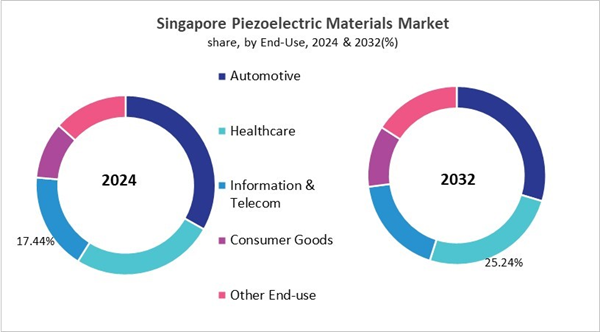
Material Type Outlook
Based on Material Type, the market is segmented into Ceramics, Polymers, Composites and Other Material Type. With a compound annual growth rate (CAGR) of 2.2% over the projection period, the Ceramics Market, dominate the China Piezoelectric Materials Market by Material Type in 2024 and would be a prominent market until 2032. The Composites market is expected to witness a CAGR of 3.9% during 2025-2032.Country Outlook
China is the biggest player in the Asia Pacific piezoelectric materials market because it has a large electronics manufacturing ecosystem and vertically integrated supply chains. Sinocera, HC Materials, and Sparkler Ceramics are some of the top domestic OEMs that make a lot of customizable piezoelectric ceramics, crystals, and composites for sensors, actuators, buzzers, and ultrasonic devices used in consumer electronics, cars, industrial automation, and medicine. Strong demand at home, government-backed investments in advanced materials, and a focus on meeting environmental standards and improving performance are all important factors in growth. Market trends show that more and more people are using electronics in cars, industrial automation, and energy-harvesting applications. There is a lot of competition between manufacturers in the country, but companies from other countries have trouble with costs and customization. The market is likely to grow in the future, with Chinese OEMs focusing on piezoceramics that are more stable, perform better, and can be used in a variety of ways to meet the changing needs of industrial and electronic systems.List of Key Companies Profiled
- L3Harris Technologies, Inc.
- Piezosystem Jena GmbH
- Mad City Labs, Inc.
- TDK Corporation
- Arkema S.A.
- Kemet Corporation
- Solvay SA
- TE Connectivity Ltd.
- Kistler Group (Kistler Holding AG)
- Morgan Advanced Materials PLC
Market Report Segmentation
By End-use- Automotive
- Healthcare
- Information & Telecom
- Consumer Goods
- Other End-use
- Actuators
- Sensors
- Transducers
- Acoustic Devices
- Generators & SONAR
- Motors
- Other Application
- Ceramics
- Polymers
- Composites
- Other Material Type
- China
- Japan
- India
- South Korea
- Singapore
- Malaysia
- Rest of Asia Pacific
Table of Contents
Chapter 1. Market Scope & Methodology
Chapter 2. Market at a Glance
Chapter 3. Market Overview
Chapter 10. Asia Pacific Piezoelectric Materials Market by End-use
Chapter 11. Asia Pacific Piezoelectric Materials Market by Application
Chapter 12. Asia Pacific Piezoelectric Materials Market by Material Type
Chapter 13. Asia Pacific Piezoelectric Materials Market by Country
Chapter 14. Company Profiles
Companies Mentioned
- L3Harris Technologies, Inc.
- Piezosystem Jena GmbH
- Mad City Labs, Inc.
- TDK Corporation
- Arkema S.A.
- Kemet Corporation
- Solvay SA
- TE Connectivity Ltd.
- Kistler Group (Kistler Holding AG)
- Morgan Advanced Materials PLC


