



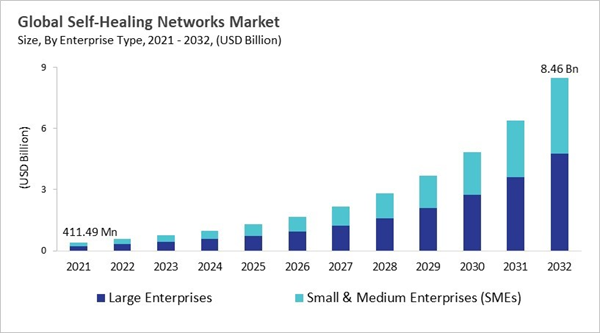
The Global Self-Healing Networks Market size is estimated at $1.28 billion in 2025 and is expected to reach $8.46 billion by 2032, rising at a market growth of 30.9% CAGR during the forecast period (2025-2032). This market is anticipated to expand quickly because networks are becoming more complex, AI-driven automation is becoming more popular, demand for zero-downtime connectivity is growing, 5G and cloud infrastructures are expanding, and telecom and enterprise networks around the world need to be able to find and fix problems before they develop.
Self-healing networks are smart communication and IT systems developed to automatically diagnose, detect, and resolve faults while optimizing performance without human intervention. Their development traces back to early automated restoration tools in telecom networks, which allow basic fault recovery through predefined mechanisms. With the advent of network function virtualization, software-defined networking, and real-time analytics, self-healing abilities advanced substantially, enabling networks to act on detected issues using policy-based automation. Industry frameworks like the TM Forum’s Autonomous Networks Manifesto position self-healing as a core element of autonomous and intent-based networking, propelling higher resilience, uptime, and service continuity across largely distributed and complex environments, including enterprise IT, cloud, telecom, and public sector infrastructure.
Modern self-healing networks largely rely on machine learning and artificial intelligence to shift from reactive to proactive and predictive operations. AI-based systems continuously anticipate failures, analyze performance data, and trigger closed-loop automation to adjust configurations, reroute traffic, or fail over services across hybrid and multi-cloud environments. Key vendors like Nokia and Cisco embed these capabilities into autonomous networks, and intent-based architectures, prioritizing open standards, interoperability, and ecosystem collaboration. Further, adoption is increasing among enterprises and government agencies seeking resilient critical infrastructure, while competition resolves around explainable AI, predictive analytics, and collaborations that allow scalable, end-to-end automated network resilience.
The leading players in the market are competing with diverse innovative offerings to remain competitive in the market. The above illustration shows the percentage of revenue shared by some of the leading companies in the market. The leading players of the market are adopting various strategies in order to cater demand coming from the different industries. The key developmental strategies in the market are Acquisitions, and Partnerships & Collaborations.
In the Asia Pacific and LAMEA regions, the self-healing networks market is anticipated to grow at a substantial rate. The market is driven by extensive 5G rollouts, rapid digitalization, government-led smart infrastructure projects, and IoT proliferation in South Korea, Japan, India, and China. Also, expanding network complexity and the rising need for autonomous fault detection and remediation. Furthermore, the LAMEA self-healing networks market is predicted to capture growth during the forecast period. This is because of rising investments in digital infrastructure modernization, 5G adoption, and demand for resilient networks in industries such as enterprise IT and telecom, thereby positioning the regions as awareness and deployment of self-healing technologies rise.
Key Market Trends & Insights:
- The North America market dominated Global Self-Healing Networks Market in 2024, accounting for a 38.90% revenue share in 2024.
- The U.S. market is projected to maintain its leadership in North America, reaching a market size of USD 2.29 billion by 2032.
- Among the Enterprise Type, the Large Enterprises segment dominated the Europe market, contributing a revenue share of 57.84% in 2024.
- In terms of Offering, Solutions segment are expected to lead the Asia Pacific market, with a projected revenue share of 59.29% by 2032.
- The Hybrid market emerged as the leading Network Type in 2024, capturing a 47.93% revenue share, and is projected to retain its dominance during the forecast period.
- The Security Compliance Management & Others Market in Application is poised to grow at the market in 2032 in North America with a market size of USD 884.26 million and is projected to maintain its dominant position throughout the forecast period.
- By Industry Vertical the IT & ITES Segment captured the market size of USD 242.81 million in 2024 and this segment will maintain its position during the forecast period.
Self-healing networks are smart communication and IT systems developed to automatically diagnose, detect, and resolve faults while optimizing performance without human intervention. Their development traces back to early automated restoration tools in telecom networks, which allow basic fault recovery through predefined mechanisms. With the advent of network function virtualization, software-defined networking, and real-time analytics, self-healing abilities advanced substantially, enabling networks to act on detected issues using policy-based automation. Industry frameworks like the TM Forum’s Autonomous Networks Manifesto position self-healing as a core element of autonomous and intent-based networking, propelling higher resilience, uptime, and service continuity across largely distributed and complex environments, including enterprise IT, cloud, telecom, and public sector infrastructure.
Modern self-healing networks largely rely on machine learning and artificial intelligence to shift from reactive to proactive and predictive operations. AI-based systems continuously anticipate failures, analyze performance data, and trigger closed-loop automation to adjust configurations, reroute traffic, or fail over services across hybrid and multi-cloud environments. Key vendors like Nokia and Cisco embed these capabilities into autonomous networks, and intent-based architectures, prioritizing open standards, interoperability, and ecosystem collaboration. Further, adoption is increasing among enterprises and government agencies seeking resilient critical infrastructure, while competition resolves around explainable AI, predictive analytics, and collaborations that allow scalable, end-to-end automated network resilience.
Driving and Restraining Factors
Drivers- Increasing Network Complexity And Scalability Challenges
- Adoption Of Ai And Machine Learning For Autonomous Remediation
- Demand For Enhanced Reliability, Uptime, And User Experience
- Operational Efficiency And Cost Reduction Objectives
- Implementation Complexity And Integration Challenges
- Cost And Resource Barrier (Upfront Investment & Specialized Skills)
- Security, Data Privacy, And Trust Concerns In Autonomous Decision-Making
- Integrated Self-Healing At The Network Edge (Edge Computing & MEC)
- AI-Driven Autonomous Networks (Closed-Loop Automation & Agentic AI)
- Self-Healing For Iot & 5G Mesh Networks (Resilience & Reliability)
- Complexity Of Integration And Interoperability Across Heterogeneous Networks
- Trust, Reliability And Predictability Of Autonomous Operations
- Security Risks And New Attack Surfaces In Autonomous Networks
Market Share Analysis
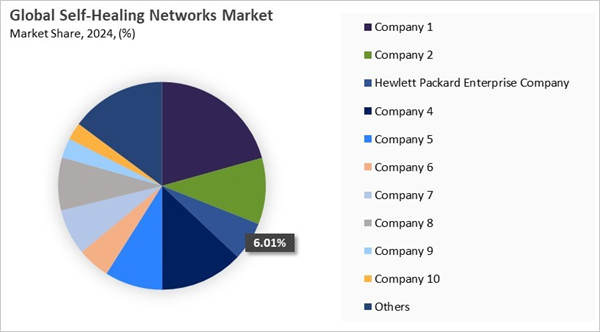
The leading players in the market are competing with diverse innovative offerings to remain competitive in the market. The above illustration shows the percentage of revenue shared by some of the leading companies in the market. The leading players of the market are adopting various strategies in order to cater demand coming from the different industries. The key developmental strategies in the market are Acquisitions, and Partnerships & Collaborations.
COVID-19 Impact Analysis
The COVID-19 pandemic makes it more difficult to deploy and grow self-healing network solutions, as it hinders on-site installation, network upgrades, and workforce recruitment due to lockdowns and movement restrictions. Telecom companies and businesses had to put off or cut back on investments in advanced networking technologies because of economic uncertainty. This led to longer sales cycles and lower short-term demand. Also, problems in the global supply chain, like shortages of semiconductors and delays in logistics, made deployment take longer and cost more to run. Limits on research, testing, and working together made it even harder for AI-driven network automation solutions to be developed and sold. Thus, the COVID-19 pandemic had a negative impact on the market.Enterprise Type Outlook
Based on Enterprise Type, the market is segmented into Large Enterprises and Small & Medium Enterprises (SMEs). The small & medium enterprises (SMEs) segment attained 42% revenue share in the Self-Healing Networks Market in 2024. Globally, small and medium enterprises are increasingly integrating self-healing network solutions as they expand their digital operations and reliance on connected technologies. SMEs benefit from self-healing capabilities that reduce manual network management, minimize downtime, and enhance overall performance without requiring extensive in-house IT resources.Offering Outlook
Based on Offering, the market is segmented into Solutions and Services. The services segment recorded 39% revenue share in the self-healing networks market in 2024. Globally, services play a crucial role in supporting the adoption and long-term effectiveness of self-healing networks. Organizations rely on professional, managed, and support services to assist with network assessment, deployment, integration, optimization, and continuous monitoring. As network environments become more complex, service providers help enterprises maximize the value of self-healing technologies while ensuring smooth operations and consistent performance.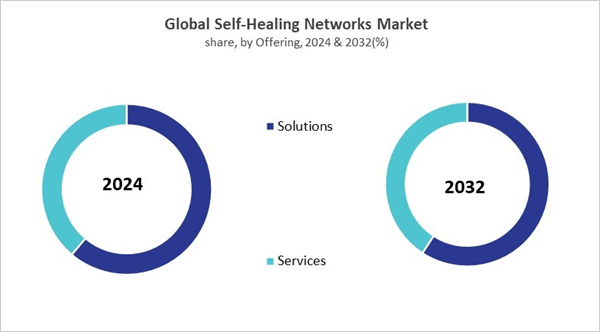
Regional Outlook
Region-wise, the self-healing networks market is analyzed across North America, Europe, Asia Pacific, and LAMEA. The North America segment recorded 39% revenue share in the self-healing networks market in 2024. The self-healing networks market is estimated to experience substantial growth in the North America and Europe regions. The expansion is supported by early adoption of network automation technologies, advanced digital infrastructure, and the presence of key market players in the region. The region captures noticeable share with widespread deployment of 5G infrastructure, AI-based automation, and cloud-centric solutions across finance, telecom, healthcare, and IT sectors. Additionally, high IT spending, strong regulatory focus on resilience and cybersecurity, and early integration of intent-based networking and closed-loop remediation frameworks are driving regional growth. In addition, Europe self-healing networks market is driven by strict data protection/regulatory frameworks, strong digital transformation initiatives across countries like France, Germany, and the UK. Also, adoption is steady as enterprises emphasize interoperability, compliance, and resilient network architectures.In the Asia Pacific and LAMEA regions, the self-healing networks market is anticipated to grow at a substantial rate. The market is driven by extensive 5G rollouts, rapid digitalization, government-led smart infrastructure projects, and IoT proliferation in South Korea, Japan, India, and China. Also, expanding network complexity and the rising need for autonomous fault detection and remediation. Furthermore, the LAMEA self-healing networks market is predicted to capture growth during the forecast period. This is because of rising investments in digital infrastructure modernization, 5G adoption, and demand for resilient networks in industries such as enterprise IT and telecom, thereby positioning the regions as awareness and deployment of self-healing technologies rise.
List of Key Companies Profiled
- Cisco Systems, Inc.
- Ericsson AB
- Hewlett Packard Enterprise Company
- Huawei Technologies Co., Ltd. (Huawei Investment & Holding Co., Ltd.)
- IBM Corporation
- Juniper Networks, Inc.
- Nokia Corporation
- VMware, Inc. (Broadcom Inc.)
- CommScope Holding Company, Inc.
- BMC Software, Inc. (KKR & Co., Inc.)
Market Report Segmentation
By Enterprise Type- Large Enterprises
- Small & Medium Enterprises (SMEs)
- Solutions
- Services
- Hybrid
- Physical
- Virtual
- Network Traffic Management
- Networking Configuration & Provisioning
- Root Cause Analysis
- Network Access Control
- Security Compliance Management & Others
- IT & ITES
- Telecommunications
- BFSI
- Healthcare
- Retail
- Education
- Other Industry Vertical
- North America
- US
- Canada
- Mexico
- Rest of North America
- Europe
- Germany
- UK
- France
- Russia
- Spain
- Italy
- Rest of Europe
- Asia Pacific
- China
- Japan
- India
- South Korea
- Singapore
- Malaysia
- Rest of Asia Pacific
- LAMEA
- Brazil
- Argentina
- UAE
- Saudi Arabia
- South Africa
- Nigeria
- Rest of LAMEA
Table of Contents
Chapter 1. Market Scope & Methodology
Chapter 2. Market at a Glance
Chapter 3. Market Overview
Chapter 10. Competition Analysis - Global
Chapter 11. Global Self-Healing Networks Market by Enterprise Type
Chapter 12. Global Self-Healing Networks Market by Offering
Chapter 13. Global Self-Healing Networks Market by Network Type
Chapter 14. Global Self-Healing Networks Market by Application
Chapter 15. Global Self-Healing Networks Market by Industry Vertical
Chapter 16. Global Self-Healing Networks Market by Region
Chapter 17. Company Profiles
Companies Mentioned
- Cisco Systems, Inc.
- Ericsson AB
- Hewlett Packard Enterprise Company
- Huawei Technologies Co., Ltd. (Huawei Investment & Holding Co., Ltd.)
- IBM Corporation
- Juniper Networks, Inc.
- Nokia Corporation
- VMware, Inc. (Broadcom Inc.)
- CommScope Holding Company, Inc.
- BMC Software, Inc. (KKR & Co., Inc.)


