



The Global 5G Fixed Wireless Access Market size is estimated at $61.05 billion in 2025 and is expected to reach $606.31 billion by 2032, rising at a market growth of 38.8% CAGR during the forecast period (2025-2032). The market is growing rapidly due to increasing demand for high-speed broadband, rising adoption of 5G networks, expansion of smart cities, and the need for reliable connectivity in remote areas.
The 5G fixed wireless access market has developed as a vital solution for delivering high-speed broadband without relying on traditional wired infrastructure. 5G marks a turning point by introducing advanced capabilities like massive MIMO, higher spectral efficiency, millimeter-wave support, and beamforming. These innovations have substantially enhanced throughput, improved reliability, reduced latency, making 5G FWA a credible alternative to fiber and cable in many regions. Regulators, governments, and OEMs like Samsung, Nokia, Ericsson, and Qualcomm have actively demonstrated and promoted 5G FWA as a means to bridge digital divides, especially in underserved areas, while supporting broadband expansion goals.
5G FWA has developed from a niche connectivity option into a mainstream broadband strategy developed by public policy support, cloud-native network architectures, and advanced radio technologies. Key market trends include the use of FWA in government-supported broadband programs, growing deployment of millimeter-wave spectrum in urban areas for the integration of virtualized, software-defined and AI-based networks to enhance efficiency and scalability. Key market players focus on collaboration with regulators, spectrum flexibility, future-ready network designs, and innovation in customer-premises equipment. The market seems to be highly competitive driven by technological differentiation among OEMs and rapid deployment strategies by telecom providers, positioning 5G FWA as a crucial pillar of broadband ecosystems aligned with digital inclusion objectives.
The leading players in the market are competing with diverse innovative offerings to remain competitive in the market. The above illustration shows the percentage of revenue shared by some of the leading companies in the market. The leading players of the market are adopting various strategies in order to cater demand coming from the different industries. The key developmental strategies in the market are Acquisitions, and Partnerships & Collaborations.
In Asia Pacific and LAMEA region, the 5G fixed wireless access market is estimated to experience expansion during the projection period. The market is driven by expanding digital economies, rapid urbanization, and the demand for cost-effective broadband expansion. In Asia Pacific, nations like Japan, South Korea, Australia, and China are witnessing expanding 5G adoption, with vendors deploying FWA to support enterprise connectivity, smart cities, and residential broadband. Furthermore, the LAMEA 5G fixed wireless access market is predicted to capture prominent growth. The market is propelled by the need to overcome limited fixed-line infrastructure and enhance broadband penetration. Middle East is experiencing rising deployment driven by national digital transformation programs. Latin America is adopting FWA as a scalable and affordable alternative to fiber. These regions are predicted to experience strong growth as spectrum availability enhances and 5G ecosystems develops.
Key Market Trends & Insights:
- The North America market dominated Global 5G Fixed Wireless Access Market in 2024, accounting for a 38.20% revenue share in 2024.
- The U.S. market is projected to maintain its leadership in North America, reaching a market size of USD 160.70 billion by 2032.
- Among the Offering, the Hardware segment dominated the Europe market, contributing a revenue share of 67.65% in 2024.
- In terms of Demography, Urban segment are expected to lead the Asia Pacific market, with a projected revenue share of 50.56% by 2032.
- The Residential market emerged as the leading Application in 2024, capturing a 46.82% revenue share, and is projected to retain its dominance during the forecast period.
- The Sub-6 GHz Market in Operating Frequency is poised to grow at the market in 2032 in North America with a market size of USD 119.83 billion and is projected to maintain its dominant position throughout the forecast period.
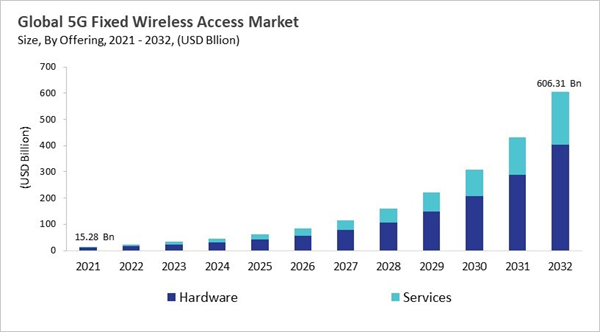
The 5G fixed wireless access market has developed as a vital solution for delivering high-speed broadband without relying on traditional wired infrastructure. 5G marks a turning point by introducing advanced capabilities like massive MIMO, higher spectral efficiency, millimeter-wave support, and beamforming. These innovations have substantially enhanced throughput, improved reliability, reduced latency, making 5G FWA a credible alternative to fiber and cable in many regions. Regulators, governments, and OEMs like Samsung, Nokia, Ericsson, and Qualcomm have actively demonstrated and promoted 5G FWA as a means to bridge digital divides, especially in underserved areas, while supporting broadband expansion goals.
5G FWA has developed from a niche connectivity option into a mainstream broadband strategy developed by public policy support, cloud-native network architectures, and advanced radio technologies. Key market trends include the use of FWA in government-supported broadband programs, growing deployment of millimeter-wave spectrum in urban areas for the integration of virtualized, software-defined and AI-based networks to enhance efficiency and scalability. Key market players focus on collaboration with regulators, spectrum flexibility, future-ready network designs, and innovation in customer-premises equipment. The market seems to be highly competitive driven by technological differentiation among OEMs and rapid deployment strategies by telecom providers, positioning 5G FWA as a crucial pillar of broadband ecosystems aligned with digital inclusion objectives.
COVID-19 Impact Analysis
The COVID-19 pandemic harmed the growth of the 5G Fixed Wireless Access market because lockdowns, travel restrictions, and social distancing made it harder to build networks and expand infrastructure. Delays in getting sites, putting up towers, and setting up equipment slowed down planned 5G rollouts and pushed back the start of FWA service in many areas. Disruptions in the supply chain, such as semiconductor shortages and factory closures, made it even harder to get network equipment and customer premises devices. This raised costs and lengthened deployment times. Telecom companies also had to rethink or put off capital spending because of economic uncertainty. This hit smaller companies the hardest because they don't have as much financial flexibility. At the same time, less spending by businesses and delays in digital transformation projects temporarily lowered demand for 5G FWA solutions. Thus, the COVID-19 pandemic had a negative impact on the market.Driving and Restraining Factors
Drivers- Surging Demand For High-Speed Broadband And Digital Inclusion
- Technological Advancements In 5g And Fwa-Specific Enhancements
- Cost-Effective Deployment And Last-Mile Connectivity Advantages
- Enterprise, Iot And Evolving Work Patterns Driving Fwa Adoption
- Limitations In Wireless Signal Propagation And Service Consistency
- Security Risks And Network Architecture Complexity
- Infrastructure Readiness, Spectrum Constraints, And Regulatory Barriers
- Expansion Into Underserved And Unconnected Areas
- Integration With Advanced 5g Technologies And Service Innovation
- Competitive Broadband Disruption And Expanded Service Monetization
- Complexity Of Customer Premises Equipment (Cpe) And Installation Barriers
- Capacity And Spectrum Management Strain On Mobile Networks
- Integration With Evolving 5g Standards And Legacy Networks
Market Share Analysis
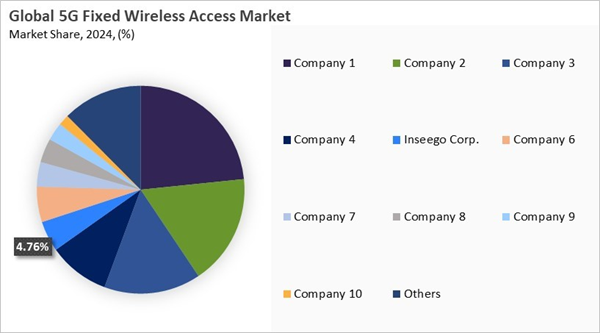
The leading players in the market are competing with diverse innovative offerings to remain competitive in the market. The above illustration shows the percentage of revenue shared by some of the leading companies in the market. The leading players of the market are adopting various strategies in order to cater demand coming from the different industries. The key developmental strategies in the market are Acquisitions, and Partnerships & Collaborations.
Offering Outlook
Based on Offering, the market is segmented into Hardware, and Services. The Services segment acquired 32% revenue share in the market in 2024. The services segment of the 5G Fixed Wireless Access market plays a vital role in supporting deployment, operation, and long-term optimization of wireless connectivity solutions. This segment includes network planning and design, installation and integration services, managed services, monitoring, maintenance, customer support, and performance optimization offerings.Demography Outlook
Based on Demography, the market is segmented into Urban, Semi-urban, and Rural. The Semi-urban segment attained 27% revenue share in the market in 2024. The semi-urban segment of the 5G Fixed Wireless Access market reflects regions that are transitioning between metropolitan and rural characteristics, where demand for dependable broadband connectivity is steadily increasing. These areas often face limitations in wired infrastructure expansion, making fixed wireless access a practical and cost-effective solution for bridging connectivity gaps.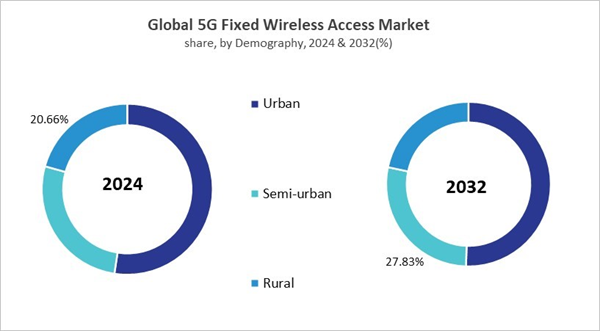
Regional Outlook
Region-wise, the 5G Fixed Wireless Access Market is analyzed across North America, Europe, Asia Pacific, and LAMEA. The North America segment recorded 38% revenue share in the market in 2024. The 5G fixed wireless access market is anticipated to expand at a substantial rate in North America and Europe. The market is driven by advanced telecom infrastructure, strong regulatory support, and high demand of broadband. In North America, especially Canada and the US, 5G FWA is largely positioned as a competitive alternative to cable and fiber, with major providers leveraging extensive mid-band spectrum holding to deliver high-speed enterprise and residential broadband. Government-supported rural broadband programs and spectrum auctions have surged deployments, particularly in suburban and underserved areas. Moreover, Europe 5G fixed wireless access market is growing at a rapid rate. The market is propelled by strong public policy emphasis on universal broadband coverage and digital inclusion. European providers are largely adopting 5G FWA to complement fiber rollouts, especially in semi-urban regions where fiber deployment is cost-intensive.In Asia Pacific and LAMEA region, the 5G fixed wireless access market is estimated to experience expansion during the projection period. The market is driven by expanding digital economies, rapid urbanization, and the demand for cost-effective broadband expansion. In Asia Pacific, nations like Japan, South Korea, Australia, and China are witnessing expanding 5G adoption, with vendors deploying FWA to support enterprise connectivity, smart cities, and residential broadband. Furthermore, the LAMEA 5G fixed wireless access market is predicted to capture prominent growth. The market is propelled by the need to overcome limited fixed-line infrastructure and enhance broadband penetration. Middle East is experiencing rising deployment driven by national digital transformation programs. Latin America is adopting FWA as a scalable and affordable alternative to fiber. These regions are predicted to experience strong growth as spectrum availability enhances and 5G ecosystems develops.
Recent Strategies Deployed in the Market
- Aug-2024: Inseego Corp. unveiled the Inseego Wavemaker 5G indoor router FX3110, a multi-carrier device certified on all major U.S. networks, offering fast 5G connectivity, robust security, and easy remote management. Designed for diverse applications like retail, education, and remote work, the FX3110 features dual SIM capability, dual-band Wi-Fi 6, and integrated antennas for quick, plug-and-play deployment. Built with the Snapdragon X62 5G Modem-RF System, it supports up to 64 wireless connections and includes advanced security features like encryption, VPN/ZTNA support, and TAA compliance. The router is complemented by Inseego Connect and SD EDGE SaaS platforms, enabling remote management, geofencing, and advanced network configuration.
- Jul-2024: Nokia Corporation unveiled a 5G Fixed Wireless Access (FWA) outdoor receiver and indoor gateway with Wi-Fi 7 for North America. The devices enhance broadband connectivity using high-gain antennas, carrier aggregation, and tri-band Wi-Fi 7. They improve coverage, efficiency, and ease of installation, addressing urban, suburban, and rural connectivity gaps.
- Feb-2024: Nokia Corporation unveiled a 5G mmWave outdoor receiver to boost Fixed Wireless Access (FWA) networks. Featuring a high-gain 27dBi antenna and Nokia Bell Labs algorithms, it ensures reliable broadband in non-Line-of-Sight conditions. Easily installed, it enhances capacity and performance in urban, suburban, and rural areas using low-cost mmWave spectrum.
- Dec-2023: Qualcomm Incorporated teamed up with Airties to optimize Airties’ Smart Wi-Fi solutions for Qualcomm’s 5G Fixed Wireless Access platforms. This collaboration enhances broadband carriers' service quality, improving connectivity through advanced Wi-Fi and 5G technologies. The integration aims to simplify deployments and optimize network performance for a seamless user experience.
- Sep-2023: Ericsson AB announced the partnership with Sound Broadband and Xtreme Enterprises to provide ultra-high-speed internet in rural America. A successful trial achieved near 1 Gbps speeds, demonstrating Ericsson’s advanced 5G RAN technology for improved broadband connectivity in underserved regions.
- Aug-2022: MediaTek, Inc. unveiled the T830 platform for 5G fixed wireless access routers and mobile hotspots, featuring a 4nm design, 7Gbps speeds, and power efficiency. With an integrated M80 modem, Cortex-A55 CPU, and Wi-Fi 7 support, it enables compact, high-performance 5G CPE devices for seamless global connectivity.
Market Report Segmentation
By Offering- Hardware
- Services
- Urban
- Semi-urban
- Rural
- Residential
- Commercial
- Industrial
- Government
- Sub-6 GHz
- 24-39 GHz
- Above 39 GHz
- North America
- US
- Canada
- Mexico
- Rest of North America
- Europe
- Germany
- UK
- France
- Russia
- Spain
- Italy
- Rest of Europe
- Asia Pacific
- China
- Japan
- India
- South Korea
- Singapore
- Malaysia
- Rest of Asia Pacific
- LAMEA
- Brazil
- Argentina
- UAE
- Saudi Arabia
- South Africa
- Nigeria
- Rest of LAMEA
Table of Contents
Chapter 1. Market Scope & Methodology
Chapter 2. Market at a Glance
Chapter 3. Market Overview
Chapter 10. Competition Analysis - Global
Chapter 11. Global 5G Fixed Wireless Access Market by Offering
Chapter 12. Global 5G Fixed Wireless Access Market by Demography
Chapter 13. Global 5G Fixed Wireless Access Market by Application
Chapter 14. Global 5G Fixed Wireless Access Market by Operating Frequency
Chapter 15. Global 5G Fixed Wireless Access Market by Region
Chapter 16. Company Profiles
Companies Mentioned
- Huawei Technologies Co., Ltd. (Huawei Investment & Holding Co., Ltd.)
- Ericsson AB
- Nokia Corporation
- Samsung Electronics Co., Ltd. (Samsung Group)
- Inseego Corp.
- Qualcomm Incorporated (Qualcomm Technologies, Inc.)
- Intel Corporation
- MediaTek, Inc.
- CommScope Holding Company, Inc.
- Verizon Communications Inc.


