



The Asia Pacific API Management Market is expected to reach $4.06 billion by 2029 and is expected to witness market growth of 24.7% CAGR during the forecast period (2025-2032).
The China market dominated the Asia Pacific API Management Market by country in 2024, and is expected to continue to be a dominant market till 2032; thereby, achieving a market value of $2.40 billion by 2032. The Japan market is experiencing a CAGR of 23.8% during 2025-2032. Additionally, the India market would register a CAGR of 25.4% during 2025-2032. The China and India led the Asia Pacific API Management Market by Country with a market share of 33.9% and 16.5% in 2024.The Singapore market is expected to witness a CAGR of 26.9% during throughout the forecast period.
The Asia Pacific API management market has grown quickly as the region's digital transformation, mobile-first adoption, and government-led digitization programs have sped up. APIs were first used for internal integration in fields like banking, telecommunications, and government. As businesses grew their mobile, e-commerce, and citizen platforms, APIs became necessary for digital services. The rise of cloud computing made adoption happen much faster. Because of different rules and old systems, hybrid API management became the norm. In countries like Singapore, Australia, and Japan, the government took steps to encourage standardized, secure, and interoperable API-driven digital ecosystems.
API management in APAC is now a strategic layer of digital infrastructure that helps businesses grow and work together in an ecosystem. Increasingly, businesses see APIs as reusable assets that are backed by lifecycle management, security enforcement, analytics, and developer enablement. A lot of people use hybrid and multicloud deployments to deal with data residency and infrastructure diversity. Security is still a top priority, with a lot of emphasis on governance and access control. The market is very competitive, with global cloud and enterprise vendors at the top. Companies compete by offering different levels of scalability, compliance alignment, and flexible deployment options
The China market dominated the Asia Pacific API Management Market by country in 2024, and is expected to continue to be a dominant market till 2032; thereby, achieving a market value of $2.40 billion by 2032. The Japan market is experiencing a CAGR of 23.8% during 2025-2032. Additionally, the India market would register a CAGR of 25.4% during 2025-2032. The China and India led the Asia Pacific API Management Market by Country with a market share of 33.9% and 16.5% in 2024.The Singapore market is expected to witness a CAGR of 26.9% during throughout the forecast period.
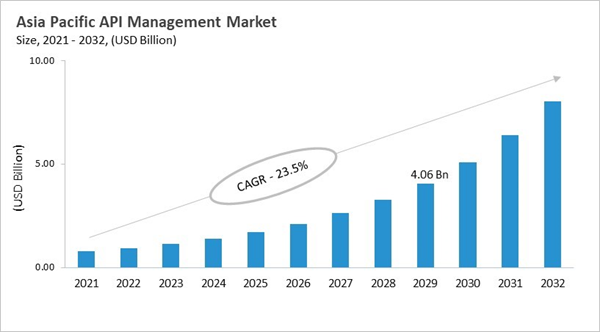
The Asia Pacific API management market has grown quickly as the region's digital transformation, mobile-first adoption, and government-led digitization programs have sped up. APIs were first used for internal integration in fields like banking, telecommunications, and government. As businesses grew their mobile, e-commerce, and citizen platforms, APIs became necessary for digital services. The rise of cloud computing made adoption happen much faster. Because of different rules and old systems, hybrid API management became the norm. In countries like Singapore, Australia, and Japan, the government took steps to encourage standardized, secure, and interoperable API-driven digital ecosystems.
API management in APAC is now a strategic layer of digital infrastructure that helps businesses grow and work together in an ecosystem. Increasingly, businesses see APIs as reusable assets that are backed by lifecycle management, security enforcement, analytics, and developer enablement. A lot of people use hybrid and multicloud deployments to deal with data residency and infrastructure diversity. Security is still a top priority, with a lot of emphasis on governance and access control. The market is very competitive, with global cloud and enterprise vendors at the top. Companies compete by offering different levels of scalability, compliance alignment, and flexible deployment options
Deployment Outlook
Based on Deployment, the market is segmented into Cloud, and On-Premise. With a compound annual growth rate (CAGR) of 23% over the projection period, the Cloud Market, dominate the China API Management Market by Deployment in 2024 and would be a prominent market until 2032. From 2025 to 2032 The On-Premise market is expected to witness a CAGR of 22.5% during 2025-2032.Application Outlook
Based on Application, the market is segmented into Security, Performance Analytics, Gateway, Governance, and Other Application. The Security market segment dominated the Singapore API Management Market by Application is expected to grow at a CAGR of 25.8 % during the forecast period thereby continuing its dominance until 2032. Also, The Governance market is anticipated to grow as a CAGR of 27.8 % during the forecast period during 2025-2032.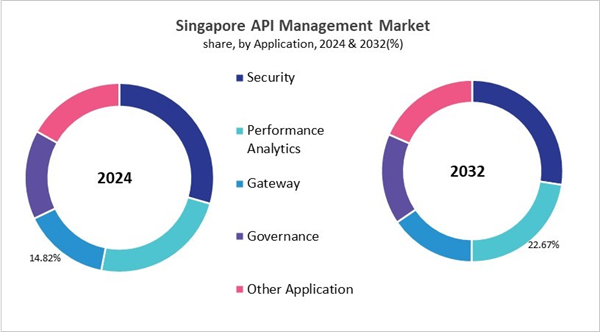
Country Outlook
China’s API management market is expanding alongside the country’s rapidly growing digital economy and government-led Digital China initiatives. APIs play a key role in enabling data sharing, system interoperability, and digital service integration across public and private sectors. National action plans and regulatory frameworks emphasize secure, governed data exchange, driving adoption of API management platforms for lifecycle control, security, and performance monitoring. Enterprises across finance, e-commerce, manufacturing, and public services use APIs to modernize legacy systems and support cloud-native architectures. The market features both global and domestic providers, competing on security, compliance, and local integration needs. Continued government digitalization and enterprise modernization are expected to sustain market growth.Market Report Segmentation
By Enterprise Type- Large Enterprises
- Small & Medium Enterprises
- Cloud
- On-Premise
- Security
- Performance Analytics
- Gateway
- Governance
- Other Application
- IT & Telecom
- BFSI
- Government
- Retail
- Healthcare
- Transport & Logistics
- Other End-User Industry
- China
- Japan
- India
- South Korea
- Singapore
- Malaysia
- Rest of Asia Pacific
Table of Contents
Chapter 1. Market Scope & Methodology
Chapter 2. Market at a Glance
Chapter 3. Market Overview
Chapter 10. Competition Analysis - Global
Chapter 11. Asia Pacific API Management Market by Enterprise Type
Chapter 12. Asia Pacific API Management Market by Deployment
Chapter 13. Asia Pacific API Management Market by Application
Chapter 14. Asia Pacific API Management Market by End-User Industry
Chapter 15. Asia Pacific API Management Market by Country
Chapter 16. Company Profiles
Companies Mentioned
- IBM Corporation
- Microsoft Corporation
- Broadcom, Inc.
- Google LLC (Alphabet Inc.)
- Oracle Corporation
- SAP SE
- Amazon Web Services, Inc. (Amazon.com, Inc.)
- Salesforce, Inc.
- Dell Technologies, Inc.
- TIBCO Software, Inc.


