



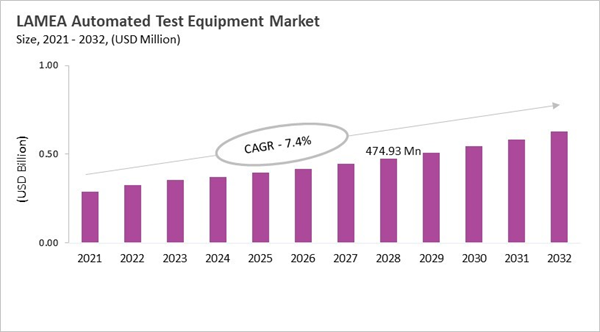
The Latin America, Middle East and Africa Automated Test Equipment Market is expected to reach $474.93 million by 2028 and is expected to witness market growth of 6.9% CAGR during the forecast period (2025-2032).
The Brazil market dominated the LAMEA Automated Test Equipment Market by country in 2024, and is expected to continue to be a dominant market till 2032; thereby, achieving a market value of $139.7 million by 2032. The Argentina market is showcasing a CAGR of 7.5% during 2025-2032. Additionally, the UAE market would register a CAGR of 6% during 2025-2032. The Brazil and UAE led the LAMEA Automated Test Equipment Market by Country with a market share of 24.8% and 17.3% in 2024. The Nigeria market is expected to witness a CAGR of 8% during throughout the forecast period.
Automated Test Equipment (ATE) is a set of integrated systems, handlers, interfaces, and software that lets you test electronic parts like semiconductors, circuit boards, and modules automatically and over and over again. Since the middle of the 20th century, ATE has grown from simple electrical testing to very advanced platforms that can test digital, analog, RF, power, and mixed-signal devices, even advanced SoC designs. Advantest and Teradyne are two of the most important OEMs that are helping to make these systems more widely used around the world. These systems are scalable and very accurate, and they support quality assurance, manufacturing validation, and final product verification in the semiconductor, automotive, telecommunications, and industrial sectors.
Advanced ATE solutions are becoming more important in the LAMEA region because of the growth of electronics manufacturing, telecommunications, automotive electrification, and government-led industrial initiatives. OEMs meet this need by providing multifunction test platforms, test cell automation, and machine-learning-enabled monitoring that improve yield, lower the need for manual work, and are in line with Industry 4.0 practices. Technological differentiation, automation capability, scalability, and strong service ecosystems all play a role in competitive dynamics. Global leaders stay ahead by continuing to invest in research and development, building regional support networks, and encouraging collaboration in innovation. Emerging markets like LAMEA are becoming more important in global ATE deployment strategies.
The Brazil market dominated the LAMEA Automated Test Equipment Market by country in 2024, and is expected to continue to be a dominant market till 2032; thereby, achieving a market value of $139.7 million by 2032. The Argentina market is showcasing a CAGR of 7.5% during 2025-2032. Additionally, the UAE market would register a CAGR of 6% during 2025-2032. The Brazil and UAE led the LAMEA Automated Test Equipment Market by Country with a market share of 24.8% and 17.3% in 2024. The Nigeria market is expected to witness a CAGR of 8% during throughout the forecast period.
Automated Test Equipment (ATE) is a set of integrated systems, handlers, interfaces, and software that lets you test electronic parts like semiconductors, circuit boards, and modules automatically and over and over again. Since the middle of the 20th century, ATE has grown from simple electrical testing to very advanced platforms that can test digital, analog, RF, power, and mixed-signal devices, even advanced SoC designs. Advantest and Teradyne are two of the most important OEMs that are helping to make these systems more widely used around the world. These systems are scalable and very accurate, and they support quality assurance, manufacturing validation, and final product verification in the semiconductor, automotive, telecommunications, and industrial sectors.
Advanced ATE solutions are becoming more important in the LAMEA region because of the growth of electronics manufacturing, telecommunications, automotive electrification, and government-led industrial initiatives. OEMs meet this need by providing multifunction test platforms, test cell automation, and machine-learning-enabled monitoring that improve yield, lower the need for manual work, and are in line with Industry 4.0 practices. Technological differentiation, automation capability, scalability, and strong service ecosystems all play a role in competitive dynamics. Global leaders stay ahead by continuing to invest in research and development, building regional support networks, and encouraging collaboration in innovation. Emerging markets like LAMEA are becoming more important in global ATE deployment strategies.
Type Outlook
Based on Type, the market is segmented into Logic Testing, Printed Circuit Board (PCB) Testing, and Interconnection & Verification Testing. The Logic Testing market segment dominated the South Africa Automated Test Equipment Market by Type is expected to grow at a CAGR of 7.1 % during the forecast period thereby continuing its dominance until 2032. Also, The Interconnection & Verification Testing market is anticipated to grow as a CAGR of 8.8 % during the forecast period during 2025-2032.Product Outlook
Based on Product, the market is segmented into Non-Memory ATE, Memory ATE, Discrete ATE Product, and Other Product. Among various Brazil Automated Test Equipment Market by Product; The Non-Memory ATE market achieved a market size of USD $55.3 Million in 2024 and is expected to grow at a CAGR of 5 % during the forecast period. The Discrete ATE Product market is predicted to experience a CAGR of 6.9% throughout the forecast period from (2025-2032).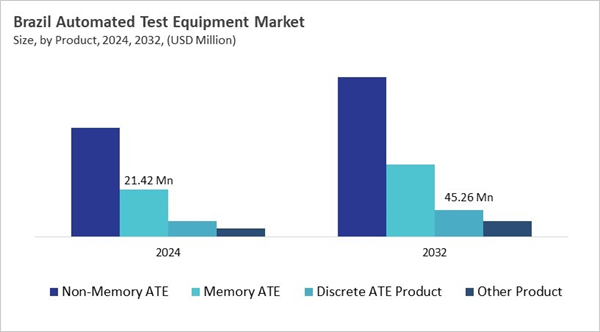
Country Outlook
Brazil is an important market for Automated Test Equipment in the LAMEA region because it has a strong industrial base and a wide range of electronics manufacturing, including consumer electronics, automotive, telecommunications, and industrial automation. The increasing complexity of electronic parts and stricter quality and regulatory standards are keeping the demand for accurate and automated testing solutions high. Government-led programs that promote technological self-sufficiency, digital infrastructure, and innovation make manufacturers even more likely to upgrade their production lines and use more advanced testing systems. Market trends show a clear move toward ATE platforms that are fully automated, modular, and driven by software. This is in line with Industry 4.0 and factory automation efforts. Global OEMs are the most competitive companies in the market. They stand out because of their accuracy, flexibility, software capabilities, and strong technical support. Brazil is still a big market for end users, and automated testing has become a strategic necessity there. This makes Brazil even more important in the larger LAMEA ATE landscape.List of Key Companies Profiled
- Chroma ATE, Inc.
- Teradyne, Inc.
- Danaher Corporation
- Viavi Solutions, Inc.
- Emerson Electric Co. (National Instruments Corporation)
- Keysight Technologies, Inc.
- ScienceSoft USA Corporation
- Advantest Corporation
- Astronics Corporation
- Teledyne Technologies Incorporated
Market Report Segmentation
By Type- Logic Testing
- Printed Circuit Board (PCB) Testing
- Interconnection & Verification Testing
- Non-Memory ATE
- Memory ATE
- Discrete ATE Product
- Other Product
- Consumer Electronics
- IT & Telecommunication
- Automotive
- Aerospace & Defense
- Healthcare
- Other Vertical
- Brazil
- Argentina
- UAE
- Saudi Arabia
- South Africa
- Nigeria
- Rest of LAMEA
Table of Contents
Chapter 1. Market Scope & Methodology
Chapter 2. Market at a Glance
Chapter 3. Market Overview
Chapter 10. Competition Analysis - Global
Chapter 11. LAMEA Automated Test Equipment Market by Type
Chapter 12. LAMEA Automated Test Equipment Market by Product
Chapter 13. LAMEA Automated Test Equipment Market by Vertical
Chapter 14. LAMEA Automated Test Equipment Market by Country
Chapter 15. Company Profiles
Companies Mentioned
- Chroma ATE, Inc.
- Teradyne, Inc.
- Danaher Corporation
- Viavi Solutions, Inc.
- Emerson Electric Co. (National Instruments Corporation)
- Keysight Technologies, Inc.
- ScienceSoft USA Corporation
- Advantest Corporation
- Astronics Corporation
- Teledyne Technologies Incorporated


