



The North America Automatic Content Recognition Market is expected to reach $3.14 billion by 2028 and is expected to witness market growth of 22.5% CAGR during the forecast period (2025-2032).
The US market dominated the North America Automatic Content Recognition Market by country in 2024, and is expected to continue to be a dominant market till 2032; thereby, achieving a market value of $5.23 billion by 2032. The Canada market is experiencing a CAGR of 25% during 2025-2032. Additionally, the Mexico market is expected to exhibit a CAGR of 24.1% during 2025-2032. The US and Canada led the North America Automatic Content Recognition Market by Country with a market share of 76.2% and 11.7% in 2024.
In North America, Automatic Content Recognition (ACR) has become a key technology that lets connected devices, especially smart TVs, streaming services, and media devices, recognize audio, video, and multimedia content in real time. Using methods like fingerprinting and watermark detection, ACR helps people find content, get personalized recommendations, and measure their audience in real time without needing any input from them. The development of the technology is closely tied to the rise of smart TVs and OTT streaming services, as well as new ideas from music recognition services like Shazam, whose audio fingerprinting methods made it possible to recognize content on millions of devices. Regulatory concerns about openness and consumer consent have also affected deployment. As a result, OEMs have added opt-in mechanisms and privacy disclosures, which show a balance between protecting consumers and advancing technology.
In North America, ACR is still growing beyond regular TVs to include streaming devices, mobile platforms, car infotainment systems, and smart home ecosystems. This shows that it is still a multi-context recognition layer. To improve recognition accuracy, lower latency, and get deeper engagement insights, artificial intelligence and machine learning are becoming more and more connected. This helps with precise personalization and optimization of user experiences. ACR lets advertisers measure how many people see their ads, target specific groups of people, and give credit to the right campaign, all while following privacy laws. Top OEMs like LG and Roku build ACR into their systems and work with advertising platforms to make money from anonymized data. This creates competition based on how well recognition, analytics, and privacy are handled. Overall, ACR's growth in North America shows that the region is a leader in connected media, data-driven advertising, and AI-enabled content innovation.
The US market dominated the North America Automatic Content Recognition Market by country in 2024, and is expected to continue to be a dominant market till 2032; thereby, achieving a market value of $5.23 billion by 2032. The Canada market is experiencing a CAGR of 25% during 2025-2032. Additionally, the Mexico market is expected to exhibit a CAGR of 24.1% during 2025-2032. The US and Canada led the North America Automatic Content Recognition Market by Country with a market share of 76.2% and 11.7% in 2024.
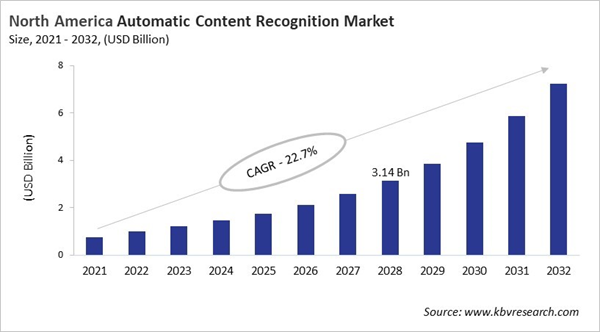
In North America, Automatic Content Recognition (ACR) has become a key technology that lets connected devices, especially smart TVs, streaming services, and media devices, recognize audio, video, and multimedia content in real time. Using methods like fingerprinting and watermark detection, ACR helps people find content, get personalized recommendations, and measure their audience in real time without needing any input from them. The development of the technology is closely tied to the rise of smart TVs and OTT streaming services, as well as new ideas from music recognition services like Shazam, whose audio fingerprinting methods made it possible to recognize content on millions of devices. Regulatory concerns about openness and consumer consent have also affected deployment. As a result, OEMs have added opt-in mechanisms and privacy disclosures, which show a balance between protecting consumers and advancing technology.
In North America, ACR is still growing beyond regular TVs to include streaming devices, mobile platforms, car infotainment systems, and smart home ecosystems. This shows that it is still a multi-context recognition layer. To improve recognition accuracy, lower latency, and get deeper engagement insights, artificial intelligence and machine learning are becoming more and more connected. This helps with precise personalization and optimization of user experiences. ACR lets advertisers measure how many people see their ads, target specific groups of people, and give credit to the right campaign, all while following privacy laws. Top OEMs like LG and Roku build ACR into their systems and work with advertising platforms to make money from anonymized data. This creates competition based on how well recognition, analytics, and privacy are handled. Overall, ACR's growth in North America shows that the region is a leader in connected media, data-driven advertising, and AI-enabled content innovation.
Technology Outlook
Based on Technology, the market is segmented into Audio & Video Fingerprinting, Digital Watermarking, Speech & Voice Recognition, Optical Character Recognition (OCR) and Other Technology. The Audio & Video Fingerprinting market segment dominated the Canada Automatic Content Recognition Market by Technology is expected to grow at a CAGR of 24.3 % during the forecast period thereby continuing its dominance until 2032. Also, The Optical Character Recognition (OCR) market is anticipated to grow as a CAGR of 26.2 % during the forecast period during 2025-2032.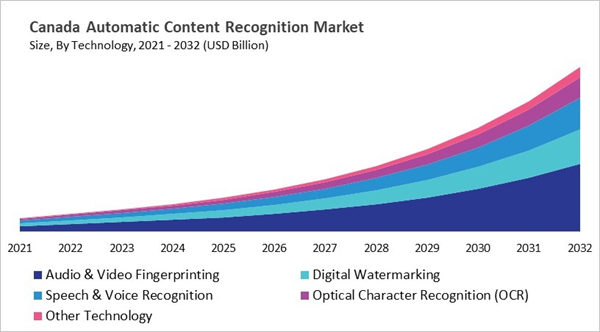
End-User Industry Outlook
Based on End-User Industry, the market is segmented into Media & Entertainment, Consumer Electronics OEMs, Advertising & Marketing, Telecom & IT, Automotive, Healthcare and Other End-User Industry. Among various US Automatic Content Recognition Market by End-User Industry; The Media & Entertainment market achieved a market size of USD $397.5 Million in 2024 and is expected to grow at a CAGR of 20.1 % during the forecast period. The Healthcare market is predicted to experience a CAGR of 22.9% throughout the forecast period from (2025-2032).Country Outlook
The United States has the most developed market for Automatic Content Recognition (ACR) in North America. This is because connected TVs are becoming more popular, there is a strong digital advertising ecosystem, and there is a lot of money going into data-driven media measurement. Major OEMs like Samsung and LG build ACR into their smart TVs. This lets them identify content in real time across broadcast and OTT platforms, which helps with content analytics, personalized experiences, and precise ad targeting. The technology solves the problem of people watching TV in different ways by giving insights at the device level that improve programmatic advertising, dynamic ad insertion, and cross-platform measurement. OEMs, technology providers, and data partners all play a role in shaping competition. Privacy laws like the CCPA also help guide clear, consent-based data practices. This makes ACR a key part of modern U.S. media measurement.List of Key Companies Profiled
- Apple, Inc.
- Clarifai, Inc.
- Digimarc Corporation
- Google LLC (Alphabet Inc.)
- IBM Corporation
- KT Corporation
- Kudelski Group
- Microsoft Corporation
- Samsung Electronics Co., Ltd. (Samsung Health)
- Harmonic Inc.
Market Report Segmentation
By Solution- Security & Copyright Management
- Real-time Content Analytics
- Voice & Speech Interfaces
- Data Management & Metadata
- Other Solution
- Software
- Services
- Audio & Video Fingerprinting
- Digital Watermarking
- Speech & Voice Recognition
- Optical Character Recognition (OCR)
- Other Technology
- Media & Entertainment
- Consumer Electronics OEMs
- Advertising & Marketing
- Telecom & IT
- Automotive
- Healthcare
- Other End-User Industry
- US
- Canada
- Mexico
- Rest of North America
Table of Contents
Chapter 1. Market Scope & Methodology
Chapter 2. Market at a Glance
Chapter 3. Market Overview
Chapter 9. Competition Analysis - Global
Chapter 11. North America Automatic Content Recognition Market by Solution
Chapter 12. North America Automatic Content Recognition Market by Component
Chapter 13. North America Automatic Content Recognition Market by Technology
Chapter 14. North America Automatic Content Recognition Market by End-User Industry
Chapter 15. North America Automatic Content Recognition Market by Country
Chapter 16. Company Profiles
Companies Mentioned
- Apple, Inc.
- Clarifai, Inc.
- Digimarc Corporation
- Google LLC (Alphabet Inc.)
- IBM Corporation
- KT Corporation
- Kudelski Group
- Microsoft Corporation
- Samsung Electronics Co., Ltd. (Samsung Health)
- Harmonic Inc.


