



The Global Cloud Radio Access Network (C-RAN) Market size is expected to reach $15.62 billion in 2025 and is expected to reach $47.13 billion by 2032, rising at a market growth of 17.1% CAGR during the forecast period (2025-2032).
The cloud radio access network market has developed in response to increasing mobile data demand, spectrum limitations, and the transition toward software-driven telecom infrastructure. Early cloud radio access network concepts developed from collaborative research in regions like Europe and East Asia, emphasizing decoupling radio units from baseband processing to enhance operational flexibility and spectral efficiency. With the progression from 3G and LTE to 5G, C-RAN gained traction as national digital strategies and standards bodies focused on software-defined networking, virtualization, and cloud-native principles, positioning C-RAN as a foundation for advanced services like industrial automation, mission-critical communications, and smart cities.
The cloud radio access network market has advanced toward cloud-native, fully virtualized, and open C-RAN models characterized by AI-driven automation, standardized interfaces, and multi-vendor interoperability. These trends are reinforced by government-supported telecom modernization programs that prioritize resilience, flexibility, and digital sovereignty. Key market players focus on ecosystem development, public-private collaboration, R&D investment, and sustainability to align with long-term infrastructure goals. The cloud radio access network market is experiencing accelerating competition driven by software capabilities and technological differentiation. The cloud radio access network (C-RAN) market reflects the convergence of cloud computing, telecom engineering, and public policy, supporting efficient, scalable, and future-ready mobile networks globally.
The major strategies followed by the market participants are Partnerships as the key developmental strategy to keep pace with the changing demands of end users. For instance, In November, 2024, Fujitsu Limited and SoftBank are strengthening their partnership to commercialize AI-RAN by 2026. They will co-develop AI-powered vRAN software, establish a verification lab in Texas, and aim to enhance RAN performance, efficiency, and communication quality across real-world mobile network environments. Additionally, In May, 2024, Ericsson AB and Dell Technologies partnered to accelerate telecom network transformation through Cloud RAN solutions. The collaboration aims to help CSPs adopt Open RAN, enhance network agility, and simplify deployment using Dell infrastructure and Ericsson Cloud RAN software for cloud-native operations.
Based on the Analysis presented in the KBV Cardinal matrix; Samsung Electronics Co., Ltd. is the forerunners in the Cloud Radio Access Network (C-RAN) Market. Companies such as Qualcomm Incorporated, Huawei Technologies Co., Ltd. and Cisco Systems, Inc. are some of the key innovators in Cloud Radio Access Network (C-RAN) Market. In October, 2022, Samsung Electronics Co., Ltd. and Vodafone partnered with Marvell to enhance 5G Open RAN performance across Europe. By integrating Marvell’s OCTEON Fusion processor with Samsung’s vRAN software, the trio aims to deliver efficient, high-performance, cloud-native networks supporting C-RAN and dense urban deployments.
The leading players in the market are competing with diverse innovative offerings to remain competitive in the market. The above illustration shows the percentage of revenue shared by some of the leading companies in the market. The leading players of the market are adopting various strategies to cater demand coming from the different industries. The key developmental strategies in the market are Acquisitions, and Partnerships & Collaborations.
In Asia Pacific and LAMEA region, the cloud radio access network market is expected to showcase prominent growth. The market is shaped by varying levels of digital maturity, and rapid network expansion. Asia Pacific is witnessing accelerated C-RAN adoption in terms of scale, supported by dense urban populations, government-supported research initiatives and aggressive 5G investments in nations such as South Korea, Japan, and China. Providers in the region leverage C-RAN to reduce costs and manage network densification while supporting developing use cases like smart manufacturing and industrial IoT. Furthermore, LAMEA cloud radio access network (C-RAN) market is predicted to expand at steady pace. This is because operators in the region seek cost-efficient and flexible network architectures to expand coverage and enhance service quality. Smart infrastructure projects, rising mobile broadband penetration and government digital inclusion programs are predicted to support steady C-RAN growth across LAMEA region.
Competition in the Cloud Radio Access Network (C-RAN) market is moderately high and intensifying as telecom operators accelerate network virtualization and 5G deployments. Market players compete on performance, scalability, energy efficiency, and cost optimization, with strong emphasis on software-defined architectures and open interfaces. Rapid technological innovation, interoperability requirements, and customization capabilities are key differentiators. Strategic partnerships, R&D investments, and regional expansion play a crucial role in strengthening market positioning and gaining competitive advantage.
Key Market Trends & Insights:
- The North America Cloud Radio Access Network (C-RAN) market dominated the Global Market in 2024, accounting for a 34.90% revenue share in 2024.
- The US Cloud Radio Access Network (C-RAN) market is expected to continue its dominance in North America region, thereby reaching a market size of 11.55 billion by 2032.
- Among the various End User segments, the Mobile Network Operators (MNOs) dominated the global market contributing a revenue share of 62.50% in 2024.
- In terms of the Deployment Model segmentation, the Centralised RAN (C-RAN) segment is projected to dominate the global market with the projected revenue share of 43.28% in 2032.
- 5G led the Network Type segments in 2024, capturing a 59.13% revenue share and is projected to continue its dominance during projected period.
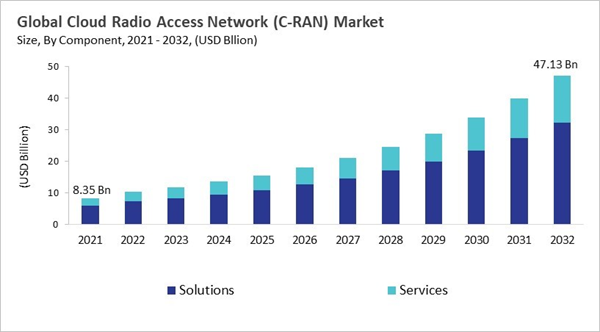
The cloud radio access network market has developed in response to increasing mobile data demand, spectrum limitations, and the transition toward software-driven telecom infrastructure. Early cloud radio access network concepts developed from collaborative research in regions like Europe and East Asia, emphasizing decoupling radio units from baseband processing to enhance operational flexibility and spectral efficiency. With the progression from 3G and LTE to 5G, C-RAN gained traction as national digital strategies and standards bodies focused on software-defined networking, virtualization, and cloud-native principles, positioning C-RAN as a foundation for advanced services like industrial automation, mission-critical communications, and smart cities.
The cloud radio access network market has advanced toward cloud-native, fully virtualized, and open C-RAN models characterized by AI-driven automation, standardized interfaces, and multi-vendor interoperability. These trends are reinforced by government-supported telecom modernization programs that prioritize resilience, flexibility, and digital sovereignty. Key market players focus on ecosystem development, public-private collaboration, R&D investment, and sustainability to align with long-term infrastructure goals. The cloud radio access network market is experiencing accelerating competition driven by software capabilities and technological differentiation. The cloud radio access network (C-RAN) market reflects the convergence of cloud computing, telecom engineering, and public policy, supporting efficient, scalable, and future-ready mobile networks globally.
The major strategies followed by the market participants are Partnerships as the key developmental strategy to keep pace with the changing demands of end users. For instance, In November, 2024, Fujitsu Limited and SoftBank are strengthening their partnership to commercialize AI-RAN by 2026. They will co-develop AI-powered vRAN software, establish a verification lab in Texas, and aim to enhance RAN performance, efficiency, and communication quality across real-world mobile network environments. Additionally, In May, 2024, Ericsson AB and Dell Technologies partnered to accelerate telecom network transformation through Cloud RAN solutions. The collaboration aims to help CSPs adopt Open RAN, enhance network agility, and simplify deployment using Dell infrastructure and Ericsson Cloud RAN software for cloud-native operations.
KBV Cardinal Matrix - Market Competition Analysis
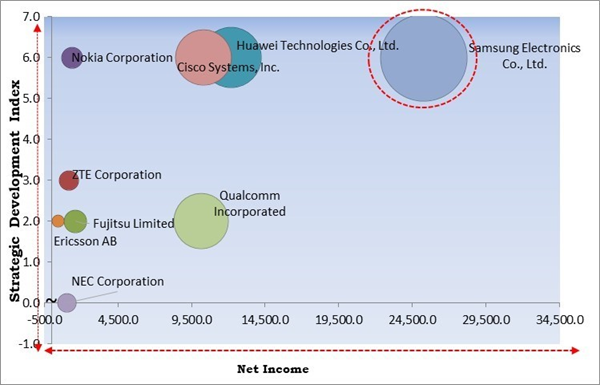
Based on the Analysis presented in the KBV Cardinal matrix; Samsung Electronics Co., Ltd. is the forerunners in the Cloud Radio Access Network (C-RAN) Market. Companies such as Qualcomm Incorporated, Huawei Technologies Co., Ltd. and Cisco Systems, Inc. are some of the key innovators in Cloud Radio Access Network (C-RAN) Market. In October, 2022, Samsung Electronics Co., Ltd. and Vodafone partnered with Marvell to enhance 5G Open RAN performance across Europe. By integrating Marvell’s OCTEON Fusion processor with Samsung’s vRAN software, the trio aims to deliver efficient, high-performance, cloud-native networks supporting C-RAN and dense urban deployments.
COVID-19 Impact Analysis
The COVID-19 pandemic had a small negative effect on the Cloud Radio Access Network (C-RAN) market. This was mostly because of short-term problems with the supply chain and delays in getting projects done. Limitations on manufacturing and logistics made it take longer to deliver important network parts, which messed up deployment schedules. Telecom companies were unsure about their finances for a while, so they were careful about spending money and put off upgrades that weren't necessary. There were even more delays in on-site installation and optimization activities because of a lack of workers and travel restrictions. But these problems were only temporary and didn't stop long-term use. As restrictions were lifted, the growing need for reliable connectivity helped the economy recover.Driving and Restraining Factors
Drivers- Enhanced Network Scalability and Flexibility Through Centralized Architecture
- Improved Operational Efficiency and Reduced Total Cost of Ownership (TCO)
- Facilitation Of Advanced 5G Capabilities and Innovation
- Enhanced Energy Efficiency and Reduced Environmental Impact
- High Capital Expenditure and Integration Complexity
- Fronthaul Requirements and Latency Constraints
- Security And Standardization Challenges
- Integration With Edge Computing and Multi-Access Edge Compute (MEC) Ecosystems
- Expansion Of Virtualization and Open RAN Ecosystems
- Growing Demand For AI-Driven Network Optimization and Automation
- Skill Gap And Workforce Transformation in Virtualized Network Environments
- Interoperability And Multi-Vendor Integration Complexity Due To Open RAN Evolution
- Ensuring End-to-End Performance and Quality of Service Across Shared Cloud Resources
Market Share Analysis
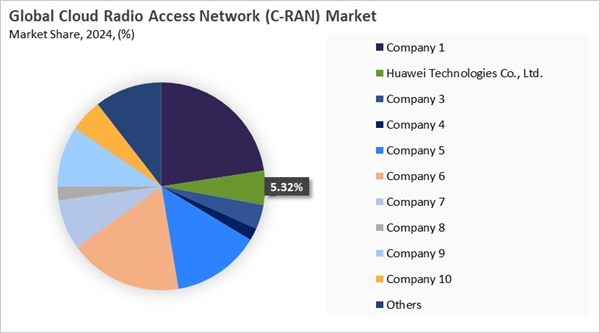
The leading players in the market are competing with diverse innovative offerings to remain competitive in the market. The above illustration shows the percentage of revenue shared by some of the leading companies in the market. The leading players of the market are adopting various strategies to cater demand coming from the different industries. The key developmental strategies in the market are Acquisitions, and Partnerships & Collaborations.
Component Outlook
Based on component, the cloud radio access network (C-RAN) market is characterized into solutions and services. The services segment attained 30% revenue share in the cloud radio access network (C-RAN) market in 2024. Services form an essential component of the cloud radio access network (C-RAN) market, providing support across the entire lifecycle of C-RAN deployment and operation. This includes consulting, integration, deployment, optimization, and ongoing management of network infrastructure.Network type Outlook
On the basis of network type, the cloud radio access network (C-RAN) market is classified into 5G, 4G, LTE, and 3G (EDGE). The 4G segment recorded 20% revenue share in the cloud radio access network (C-RAN) market in 2024. The 4G network type holds an important position in the cloud radio access network (C-RAN) market, supported by widespread adoption and ongoing optimization of existing mobile networks. C-RAN solutions are utilized in 4G environments to improve network efficiency, enhance coverage, and reduce operational complexity through centralized baseband processing.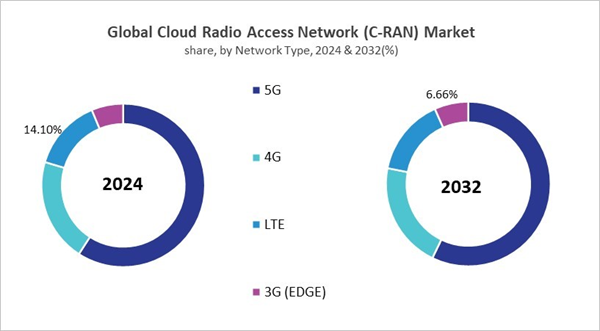
Regional Outlook
Region-wise, the cloud radio access network (C-RAN) market is analyzed across North America, Europe, Asia Pacific, and LAMEA. The North America segment recorded 34.90% revenue share in the cloud radio access network (C-RAN) market in 2024. The cloud radio access network market is anticipated to expand at a significant rate in the North America and Europe regions. The market is supported by early 5G rollouts, advanced telecom infrastructure, and strong regulatory emphasis on network modernization. In North America, large mobile network operators and hyperscale cloud vendors play a crucial role in surging C-RAN deployment, especially through open RAN initiatives, virtualization, and cloud-native architectures aimed at enhancing operational efficiency and scalability. Government-supported spectrum programs further encourage centralized and software-defined RAN models. Moreover, Europe cloud radio access network market is expanding substantially, driven by sustainability targets, regional digitalization strategies, and policy frameworks promoting vendor diversity and interoperability. European providers actively participate in open-interface deployments and multi-vendor trials, positioning C-RAN as a key component for energy-efficient networks, cross-border digital services, and smart cities.In Asia Pacific and LAMEA region, the cloud radio access network market is expected to showcase prominent growth. The market is shaped by varying levels of digital maturity, and rapid network expansion. Asia Pacific is witnessing accelerated C-RAN adoption in terms of scale, supported by dense urban populations, government-supported research initiatives and aggressive 5G investments in nations such as South Korea, Japan, and China. Providers in the region leverage C-RAN to reduce costs and manage network densification while supporting developing use cases like smart manufacturing and industrial IoT. Furthermore, LAMEA cloud radio access network (C-RAN) market is predicted to expand at steady pace. This is because operators in the region seek cost-efficient and flexible network architectures to expand coverage and enhance service quality. Smart infrastructure projects, rising mobile broadband penetration and government digital inclusion programs are predicted to support steady C-RAN growth across LAMEA region.
Market Competition and Attributes
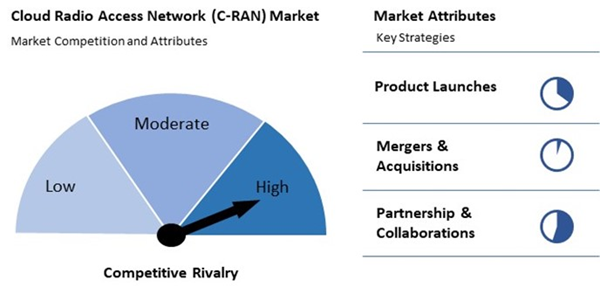
Competition in the Cloud Radio Access Network (C-RAN) market is moderately high and intensifying as telecom operators accelerate network virtualization and 5G deployments. Market players compete on performance, scalability, energy efficiency, and cost optimization, with strong emphasis on software-defined architectures and open interfaces. Rapid technological innovation, interoperability requirements, and customization capabilities are key differentiators. Strategic partnerships, R&D investments, and regional expansion play a crucial role in strengthening market positioning and gaining competitive advantage.
Recent Strategies Deployed in the Market
- Mar-2025: Samsung Electronics partnered with Amazon Web Services (AWS) to showcase the CognitiV NOS Copilot at MWC 2025. The AI-powered solution simplifies RAN management using Amazon Bedrock, supporting cloud-based C-RAN environments with advanced automation and natural language insights.
- Mar-2025: ZTE Corporation launched the industry's first intelligent 400GE base station router, ZXCTN 6120H-SE, to support 5G-A/6G and fixed-mobile convergence. It features high capacity, AI-powered O&M, energy efficiency, and flexible interfaces, advancing intelligent, green, and future-ready C-RAN transport networks.
- Mar-2025: Huawei Technologies Co., Ltd. launched AI-Centric 5.5G solutions to support mobile AI through enhanced user experience, autonomous O&M, and value-based monetization. Key technologies like GigaGear, GreenPulse, and GainLeap enable intent-driven, energy-efficient, and adaptive Cloud RAN infrastructures.
- Oct2024: Huawei launched 5G-AA solutions to power the Mobile AI era, featuring intelligent RAN Agents, digitalized sites, and innovative hardware. These solutions enhance automation, efficiency, and network performance, supporting key advancements in the Cloud RAN (C-RAN) market.
- 2024-Oct: Cisco Systems, Inc. launched an end-to-end private 5G solution combining Cisco’s 5G SA Core and cloud control with NEC’s radio and integration services. Targeting enterprise digital transformation, the solution supports C-RAN architecture and multiple industry use cases globally.
List of Key Companies Profiled
- Nokia Corporation
- Huawei Technologies Co., Ltd. (Huawei Investment & Holding Co., Ltd.)
- Intel Corporation
- ZTE Corporation
- Samsung Electronics Co., Ltd. (Samsung Group)
- Ericsson AB
- NEC Corporation
- Cisco Systems, Inc.
- Fujitsu Limited
- Qualcomm Incorporated (Qualcomm Technologies, Inc.)
Market Report Segmentation
By Component- Solutions
- Services
- Professional Services
- Managed Services
- 5G
- 4G
- LTE
- 3G (EDGE)
- Centralised RAN (C-RAN)
- Virtualised RAN (vRAN)
- Open RAN (O-RAN)
- Hybrid Cloud RAN
- Mobile Network Operators (MNOs)
- Enterprises
- Government & Public Safety
- Neutral Host / Tower Companies
- North America
- US
- Canada
- Mexico
- Rest of North America
- Europe
- Germany
- UK
- France
- Russia
- Spain
- Italy
- Rest of Europe
- Asia Pacific
- China
- Japan
- India
- South Korea
- Singapore
- Malaysia
- Rest of Asia Pacific
- LAMEA
- Brazil
- Argentina
- UAE
- Saudi Arabia
- South Africa
- Nigeria
- Rest of LAMEA
Table of Contents
Chapter 1. Market Scope & Methodology
Chapter 2. Market at a Glance
Chapter 3. Market Overview
Chapter 9. Competition Analysis - Global
Chapter 11. Global Cloud Radio Access Network (C-RAN) Market by Component
Chapter 12. Global Cloud Radio Access Network (C-RAN) Market by Network Type
Chapter 13. Global Cloud Radio Access Network (C-RAN) Market by Deployment Model
Chapter 14. Global Cloud Radio Access Network (C-RAN) Market by End User
Chapter 15. Global Cloud Radio Access Network (C-RAN) Market by Region
Chapter 16. Company Profiles
Companies Mentioned
- Nokia Corporation
- Huawei Technologies Co., Ltd. (Huawei Investment & Holding Co., Ltd.)
- Intel Corporation
- ZTE Corporation
- Samsung Electronics Co., Ltd. (Samsung Group)
- Ericsson AB
- NEC Corporation
- Cisco Systems, Inc.
- Fujitsu Limited
- Qualcomm Incorporated (Qualcomm Technologies, Inc.)


