



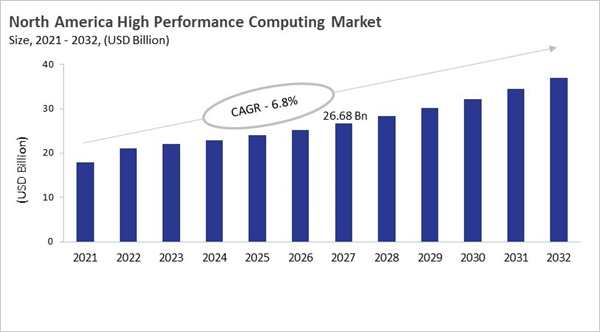
The North America High Performance Computing Market is expected to reach $37.03 billion by 2032 and is expected to witness market growth of 6.4% CAGR during the forecast period (2025-2032).
The US market dominated the North America High Performance Computing Market by country in 2024, and is expected to continue to be a dominant market till 2032; thereby, achieving a market value of $28.88 billion by 2032. The Canada market is experiencing a CAGR of 7.9% during 2025-2032. Additionally, the Mexico market is expected to exhibit a CAGR of 7.6% during 2025-2032. The US and Canada led the North America High Performance Computing Market by Country with a market share of 79.9% and 9.5% in 2024.
High Performance Computing (HPC) in North America has a long history that goes back to government-funded supercomputing projects that helped with defense, aerospace, and scientific research. Early leadership by national labs laid the groundwork for strong work in computational science. HPC systems changed from specialized architectures to cost-effective clustered platforms over time. This made them more popular in universities and private businesses. Ongoing public funding made sure that hardware, software, and cyberinfrastructure kept getting better. Increasingly, industries like automotive, energy, and pharmaceuticals use HPC for modeling, simulation, and analyzing large amounts of data.
Artificial intelligence, big data analytics, and exascale computing projects have changed the North American HPC market in the last few years. Hybrid models that mix on-premises systems with cloud-based HPC resources have made things more flexible and scalable. Using GPUs and AI processors in accelerator-based architectures is now the most common way to design systems. Open software ecosystems and co-design strategies make sure that systems work with real-world workloads. Energy efficiency and sustainability are now top priorities. Performance leadership, AI integration, and strong partnerships with the government are what drive competition in the market.
The US market dominated the North America High Performance Computing Market by country in 2024, and is expected to continue to be a dominant market till 2032; thereby, achieving a market value of $28.88 billion by 2032. The Canada market is experiencing a CAGR of 7.9% during 2025-2032. Additionally, the Mexico market is expected to exhibit a CAGR of 7.6% during 2025-2032. The US and Canada led the North America High Performance Computing Market by Country with a market share of 79.9% and 9.5% in 2024.
High Performance Computing (HPC) in North America has a long history that goes back to government-funded supercomputing projects that helped with defense, aerospace, and scientific research. Early leadership by national labs laid the groundwork for strong work in computational science. HPC systems changed from specialized architectures to cost-effective clustered platforms over time. This made them more popular in universities and private businesses. Ongoing public funding made sure that hardware, software, and cyberinfrastructure kept getting better. Increasingly, industries like automotive, energy, and pharmaceuticals use HPC for modeling, simulation, and analyzing large amounts of data.
Artificial intelligence, big data analytics, and exascale computing projects have changed the North American HPC market in the last few years. Hybrid models that mix on-premises systems with cloud-based HPC resources have made things more flexible and scalable. Using GPUs and AI processors in accelerator-based architectures is now the most common way to design systems. Open software ecosystems and co-design strategies make sure that systems work with real-world workloads. Energy efficiency and sustainability are now top priorities. Performance leadership, AI integration, and strong partnerships with the government are what drive competition in the market.
Deployment Outlook
Based on Deployment, the market is segmented into On-premise and Cloud. The On-premise market segment dominated the Mexico High Performance Computing Market by Deployment is expected to grow at a CAGR of 7.2 % during the forecast period thereby continuing its dominance until 2032. Also, The Cloud market is anticipated to grow as a CAGR of 8.3 % during the forecast period during 2025-2032.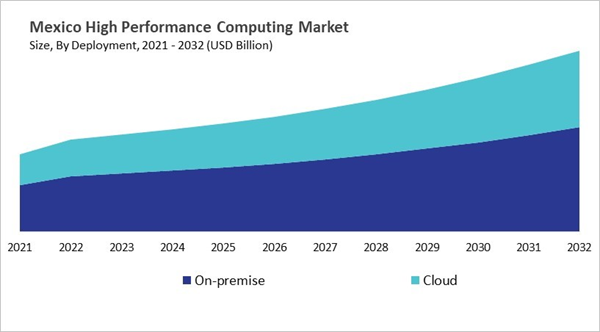
End Use Outlook
Based on End Use, the market is segmented into Government & Defense, Healthcare & Bioscience, Education & Research, Manufacturing, BFSI, Media & Entertainment, Transportation, Retail and Gaming & Others. Among various Canada High Performance Computing Market by End Use; The Government & Defense market achieved a market size of USD $461 Million in 2024 and is expected to grow at a CAGR of 6.6 % during the forecast period. The Gaming & Others market is predicted to experience a CAGR of 8.6% throughout the forecast period from (2025-2032).Country Outlook
The United States has the most advanced HPC market in North America because of strong federal funding, a well-developed research infrastructure, and active participation from top OEMs. HPC systems help with national goals like defense, climate modeling, energy research, aerospace, and big AI workloads. The U.S. Department of Energy and other government agencies are very important because they run world-class supercomputers and promote HPC as a strategic national asset. Federal programs encourage national labs, universities, and businesses to work together, which speeds up the process of bringing new technologies to market and getting people to use them in the real world. As HPC and AI come together, the need for heterogeneous, accelerator-based architectures is growing. Hybrid and cloud-enabled HPC models are growing to make them more secure, flexible, and scalable. Competition is still fierce because of performance, energy efficiency, and software optimization.List of Key Companies Profiled
- Atos SE
- Advanced Micro Devices, Inc.
- Hewlett Packard Enterprise Company
- Dell Technologies, Inc.
- Cisco Systems, Inc.
- Fujitsu Limited
- Intel Corporation
- IBM Corporation
- Microsoft Corporation
- Amazon Web Services, Inc. (Amazon.com, Inc.)
Market Report Segmentation
By Component- Servers
- Storage
- Software
- Services
- Cloud
- Networking Devices
- Other Component
- On-premise
- Cloud
- Government & Defense
- Healthcare & Bioscience
- Education & Research
- Manufacturing
- BFSI
- Media & Entertainment
- Transportation
- Retail
- Gaming & Others
- US
- Canada
- Mexico
- Rest of North America
Table of Contents
Chapter 1. Market Scope & Methodology
Chapter 2. Market at a Glance
Chapter 3. Market Overview
Chapter 9. Competition Analysis - Global
Chapter 11. North America High Performance Computing Market by Component
Chapter 12. North America High Performance Computing Market by Deployment
Chapter 13. North America High Performance Computing Market by End Use
Chapter 14. North America High Performance Computing Market by Country
Chapter 15. Company Profiles
Companies Mentioned
- Atos SE
- Advanced Micro Devices, Inc.
- Hewlett Packard Enterprise Company
- Dell Technologies, Inc.
- Cisco Systems, Inc.
- Fujitsu Limited
- Intel Corporation
- IBM Corporation
- Microsoft Corporation
- Amazon Web Services, Inc. (Amazon.com, Inc.)


