



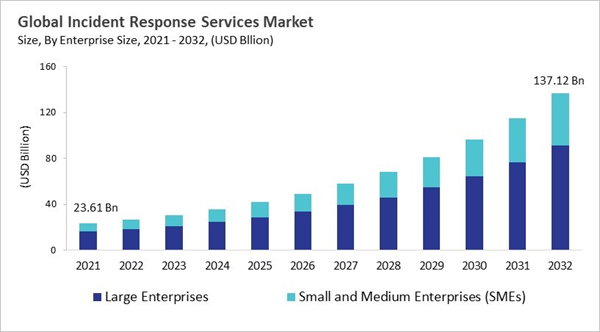
The Global Incident Response Services Market size is estimated at $41.81 billion in 2025 and is expected to reach $137.12 billion by 2032, rising at a market growth of 18.5% CAGR during the forecast period. The growth of this Market is justified by the rapid rise in sophisticated cyberattacks, increasing regulatory compliance requirements, widespread digital transformation, and growing reliance on cloud and remote infrastructures.
The incident response services market has developed in response to the increasing scale, sophistication, and impact of cyber incidents across enterprises, governments, and critical infrastructure. Early approaches were increasingly reactive and internally managed, relying on manual remediation and basic log analysis. As cyber threats became more damaging and coordinated, public-sector frameworks from enterprises like CERTs, NIST, ENISA, and CISA established structured incident response lifecycles, surging the shift toward third-party service providers. The expansion of remote work, cloud computing, and mobile environments further evolved incident response into strategic function, backed by OEMs that integrated managed response, malware analytics, and digital forensics into their cybersecurity portfolios.
The incident response market reflects a standards-driven ecosystem aligned with global and regional cybersecurity frameworks. Key market trends include closer integration with government guidelines, a transition from reactive response to proactive readiness through simulations, retainers, and playbooks, and rising specialization in cloud security and ransomware response. Key market players focus on partnerships with public agencies, continuous investment in advanced automation, skilled talent, and transparent post-incident reporting to support long-term risk reduction. Competition in the market is propelled by response speed, technical depth, regulatory compliance, and sector expertise, while partnership remains essential during cross-border incidents. With increasing cyber risks and developing regulatory mandates, incident response services are largely positioned as long-term strategic partners.
The major strategies followed by the market participants are Partnerships as the key developmental strategy to keep pace with the changing demands of end users. For instance, In March, 2025, Accenture PLC teamed up with CrowdStrike, a software company to enhance cybersecurity, integrating Accenture’s expertise with CrowdStrike’s Falcon platform. Their collaboration streamlines security operations, boosts threat detection, and reduces costs using AI-driven solutions. Focus areas include SecOps modernization, managed detection and response, and continuous threat exposure management to help businesses strengthen cyber resilience. Moreover, In March, 2025, Cisco Systems, Inc. announced the partnership with Safe Security, a Cybersecurity and Digital Business Risk Quantification (CRQ) space leader to enhance AI-driven cyber risk management for enterprises. By integrating Safe Security's solutions with Cisco’s security platforms, organizations gain real-time insights into cyber risks, combining financial risks with cybersecurity signals. Key features include improved visibility via Cisco XDR and future integration with Splunk Cloud.
Based on the Analysis presented in the KBV Cardinal matrix; AT&T, Inc., Cisco Systems, Inc., Accenture PLC, IBM Corporation, and VMware, Inc. are the forerunners in the Incident Response Services Market. In March, 2025, Accenture PLC teamed up with Verizon Business, a telecommunications company to enhance cybersecurity resilience for businesses of all sizes. Their collaboration introduces advanced services, including Identity and Access Management (IAM), Managed Extended Detection and Response (MxDR), and cyber risk services, integrating with Verizon’s network solutions to combat evolving threats and improve security defenses. Companies such as BAE Systems PLC, NEC Corporation, and CrowdStrike Holdings, Inc. are some of the key innovators in Incident Response Services Market.
The leading players in the market are competing with diverse innovative offerings to remain competitive in the market. The above illustration shows the percentage of revenue shared by some of the leading companies in the market. The leading players of the market are adopting various strategies in order to cater demand coming from the different industries. The key developmental strategies in the market are Acquisitions, and Partnerships & Collaborations.
Free Valuable Insights: [external URL]
In the Asia Pacific region, the incident response market is projected to capture a prominent share in the forecast period. The market is propelled by rapid cloud adoption, digital transformation, rising cybercrime, and expanding cybersecurity budgets in markets such as Japan, Australia, India, and China. With a substantial rise in enterprise digitization and regulations in several APAC nations, demand for regional, cloud-native incident response services continues to surge. Moreover, the LAMEA incident response services market is growing at a steady rate. The expansion is driven by rising cybersecurity awareness, national cyber strategies, and private-public collaboration in developing regions like the UAE, Saudi Arabia, and Brazil.
The market for incident response services is very competitive. It changes frequently due to growing cyber threats and regulatory pressure. Providers compete on speed, knowledge, global coverage, and integration with security ecosystems. Proactive readiness, automation, threat intelligence, and compliance support now play a bigger role in standing out. Competition also focuses on adaptable engagement models, sector specialization, and the ability to scale quickly in times of crisis. As digital business environments evolve globally, buyers strongly value reliability, confidentiality, and proven response effectiveness. Continuous skill development and trust-based client relationships remain crucial.
Key Market Trends & Insights:
- The North America market dominated Global Incident Response Services Market in 2024, accounting for a 38.20% revenue share in 2024.
- The U.S. market is projected to maintain its leadership in North America, reaching a market size of USD 37.43 billion by 2032.
- Among the Enterprise Size, the Large Enterprises segment dominated the Europe market, contributing a revenue share of 68.52% in 2024.
- In terms of Deployment Mode, Cloud-based segment are expected to lead the Asia Pacific market, with a projected revenue share of 51.50% by 2032.
- The Managed Detection and Response (MDR) market emerged as the leading Service Type in 2024, capturing a 34.64% revenue share, and is projected to retain its dominance during the forecast period.
- The BFSI in End-User Industry is poised to grow at the market in North America in 2032 with a market size of USD 29.80 billion and is projected to maintain its dominant position throughout the forecast period.
The incident response services market has developed in response to the increasing scale, sophistication, and impact of cyber incidents across enterprises, governments, and critical infrastructure. Early approaches were increasingly reactive and internally managed, relying on manual remediation and basic log analysis. As cyber threats became more damaging and coordinated, public-sector frameworks from enterprises like CERTs, NIST, ENISA, and CISA established structured incident response lifecycles, surging the shift toward third-party service providers. The expansion of remote work, cloud computing, and mobile environments further evolved incident response into strategic function, backed by OEMs that integrated managed response, malware analytics, and digital forensics into their cybersecurity portfolios.
The incident response market reflects a standards-driven ecosystem aligned with global and regional cybersecurity frameworks. Key market trends include closer integration with government guidelines, a transition from reactive response to proactive readiness through simulations, retainers, and playbooks, and rising specialization in cloud security and ransomware response. Key market players focus on partnerships with public agencies, continuous investment in advanced automation, skilled talent, and transparent post-incident reporting to support long-term risk reduction. Competition in the market is propelled by response speed, technical depth, regulatory compliance, and sector expertise, while partnership remains essential during cross-border incidents. With increasing cyber risks and developing regulatory mandates, incident response services are largely positioned as long-term strategic partners.
The major strategies followed by the market participants are Partnerships as the key developmental strategy to keep pace with the changing demands of end users. For instance, In March, 2025, Accenture PLC teamed up with CrowdStrike, a software company to enhance cybersecurity, integrating Accenture’s expertise with CrowdStrike’s Falcon platform. Their collaboration streamlines security operations, boosts threat detection, and reduces costs using AI-driven solutions. Focus areas include SecOps modernization, managed detection and response, and continuous threat exposure management to help businesses strengthen cyber resilience. Moreover, In March, 2025, Cisco Systems, Inc. announced the partnership with Safe Security, a Cybersecurity and Digital Business Risk Quantification (CRQ) space leader to enhance AI-driven cyber risk management for enterprises. By integrating Safe Security's solutions with Cisco’s security platforms, organizations gain real-time insights into cyber risks, combining financial risks with cybersecurity signals. Key features include improved visibility via Cisco XDR and future integration with Splunk Cloud.
KBV Cardinal Matrix - Market Competition Analysis
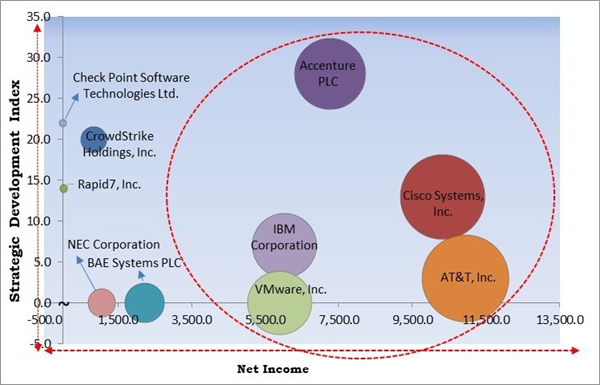
Based on the Analysis presented in the KBV Cardinal matrix; AT&T, Inc., Cisco Systems, Inc., Accenture PLC, IBM Corporation, and VMware, Inc. are the forerunners in the Incident Response Services Market. In March, 2025, Accenture PLC teamed up with Verizon Business, a telecommunications company to enhance cybersecurity resilience for businesses of all sizes. Their collaboration introduces advanced services, including Identity and Access Management (IAM), Managed Extended Detection and Response (MxDR), and cyber risk services, integrating with Verizon’s network solutions to combat evolving threats and improve security defenses. Companies such as BAE Systems PLC, NEC Corporation, and CrowdStrike Holdings, Inc. are some of the key innovators in Incident Response Services Market.
COVID-19 Impact Analysis
The COVID-19 pandemic accelerated digital transformation in many industries. More people worked from home and used cloud platforms. Digital collaboration tools also became widespread. This shift increased cybersecurity risks. Cyberattacks on remote infrastructures rose, and companies saw their internal security teams as insufficient. As a result, they began hiring incident response service providers for expert assistance, rapid containment, and forensic support. The crisis also led businesses to adopt structured incident response planning and conduct simulation exercises. Many established retainer-based agreements to ensure continued operations. Stricter rules and higher expectations for data protection, especially in healthcare and finance, made professional incident response services even more important. These factors together strengthened long-term demand and helped the market grow during and after the pandemic. Thus, the COVID-19 pandemic had a positive impact on the market.Driving and Restraining Factors
Drivers- Escalating Frequency And Sophistication Of Cyber Threats
- Digital Transformation And Expanded Attack Surfaces
- Regulatory Compliance And Data Protection Mandates
- Cybersecurity Skills Gap And Demand For Specialized Expertise
- High Cost And Resource Intensity Of Incident Response Services
- Shortage Of Skilled Cybersecurity Professionals
- Complexity Of Integration With Existing Security Architectures
- Increasing Adoption Of Zero Trust And Proactive Security Frameworks
- Expansion Of Cyber Insurance And Regulatory Incident Reporting Requirements
- Growing Emphasis On Threat Intelligence And Cross-Sector Collaboration
- Complex Legal And Jurisdictional Issues In Cross-Border Incident Response
- Rapidly Evolving Technology Landscape And Toolchain Fragmentation
- Balancing Transparency With Security And Confidentiality During Incident Response
Market Share Analysis
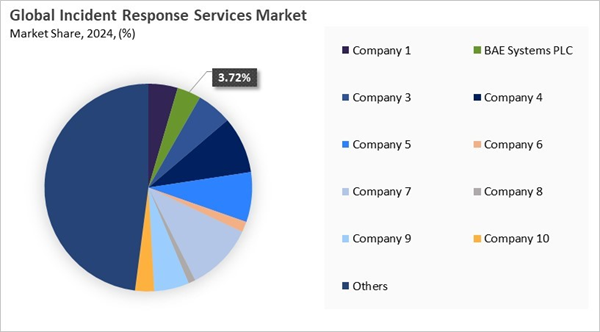
The leading players in the market are competing with diverse innovative offerings to remain competitive in the market. The above illustration shows the percentage of revenue shared by some of the leading companies in the market. The leading players of the market are adopting various strategies in order to cater demand coming from the different industries. The key developmental strategies in the market are Acquisitions, and Partnerships & Collaborations.
Free Valuable Insights: [external URL]
Enterprise Size Outlook
Based on Enterprise Size, the market is segmented into Large Enterprises and Small and Medium Enterprises (SMEs). The Small and Medium Enterprises (SMEs) segment acquired 32% revenue share in the market in 2024. The Small and Medium Enterprises segment of the Incident Response Services Market is shaped by growing digital adoption, increased reliance on cloud-based tools, and expanding exposure to cyber threats. SMEs often operate with limited internal cybersecurity resources, making external incident response services essential for effective threat handling and recovery.Deployment Mode Outlook
Based on Deployment Mode, the market is segmented into Hybrid, Cloud-based and On-Premises. The Cloud-based segment attained 53% revenue share in the market in 2024. The Cloud-based deployment mode in the Incident Response Services Market is driven by the increasing migration of business applications, data storage, and collaboration platforms to cloud environments. Incident response services delivered through the cloud focus on real-time threat detection, rapid analysis, and automated containment using scalable cloud-native tools.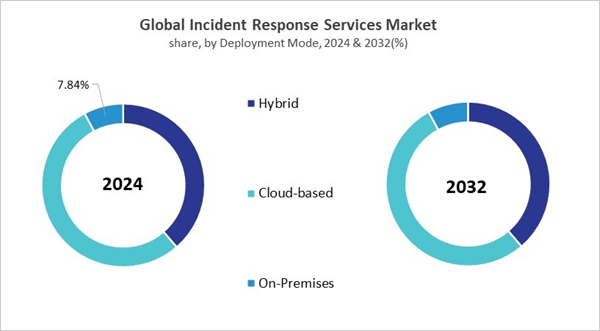
Regional Outlook
Region-wise, the Incident Response Services Market is analyzed across North America, Europe, Asia Pacific, and LAMEA. The North America segment recorded 38% revenue share in the market in 2024. The incident response services market is anticipated to grow at a significant rate in North America. The growth is driven by the advanced digital infrastructures, presence of major cybersecurity vendors, high-profile cyberattacks, and strict regulatory environments-like sector-specific cyber mandates, and breach notification laws-which encourage enterprises and government agencies to invest heavily in retention services, incident response planning, and automated threat detection and remediation capabilities. Europe incident response market is predicted to grow at a substantial rate. This is because of robust regulatory frameworks such as GDPR and NIS2 that mandate incident prevention, response readiness, and reporting, which drives public and private sector investment in these services. Nations like France, the UK, and Germany are key contributors, prioritizing response capabilities across key industries.In the Asia Pacific region, the incident response market is projected to capture a prominent share in the forecast period. The market is propelled by rapid cloud adoption, digital transformation, rising cybercrime, and expanding cybersecurity budgets in markets such as Japan, Australia, India, and China. With a substantial rise in enterprise digitization and regulations in several APAC nations, demand for regional, cloud-native incident response services continues to surge. Moreover, the LAMEA incident response services market is growing at a steady rate. The expansion is driven by rising cybersecurity awareness, national cyber strategies, and private-public collaboration in developing regions like the UAE, Saudi Arabia, and Brazil.
Market Competition and Attributes
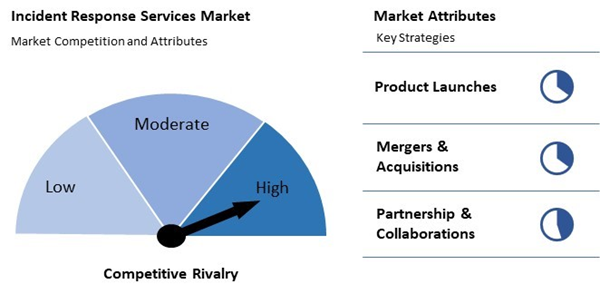
The market for incident response services is very competitive. It changes frequently due to growing cyber threats and regulatory pressure. Providers compete on speed, knowledge, global coverage, and integration with security ecosystems. Proactive readiness, automation, threat intelligence, and compliance support now play a bigger role in standing out. Competition also focuses on adaptable engagement models, sector specialization, and the ability to scale quickly in times of crisis. As digital business environments evolve globally, buyers strongly value reliability, confidentiality, and proven response effectiveness. Continuous skill development and trust-based client relationships remain crucial.
Recent Strategies Deployed in the Market
- Mar-2025: CrowdStrike Holdings, Inc. announced the partnership with NTT DATA, an IT company to enhance cybersecurity with AI-driven solutions. By integrating the CrowdStrike Falcon platform into NTT DATA’s managed services, clients benefit from advanced threat detection, threat hunting, and global support, ensuring robust protection and swift response to cyber threats across digital environments.
- Jan-2025: Accenture PLC unveiled its cybersecurity services by integrating generative AI, enhancing threat detection and automated incident response. The new offerings leverage machine learning algorithms for improved vulnerability prediction and faster responses. Tailored to different industries, these solutions help organizations strengthen resilience, particularly in sectors like finance and healthcare.
- Jan-2025: CrowdStrike Holdings, Inc. teamed up with Cognizant, an outsourcing company to transform enterprise cybersecurity. By combining CrowdStrike’s AI-native Falcon platform with Cognizant’s Neuro Cybersecurity platform, they aim to streamline security operations, consolidate legacy tools, and enhance cloud security. This collaboration helps organizations mitigate advanced cyber threats and improve their overall security posture.
- Jan-2025: CrowdStrike Holdings, Inc. unveiled Insider Risk Services to help organizations detect and prevent insider threats. Combining its Falcon platform with advanced threat intelligence, the services include risk assessments, tabletop exercises, and expert-led incident response. These offerings aim to proactively address insider risks, strengthening defenses and minimizing potential impacts on organizations.
- Jan-2025: CrowdStrike Holdings, Inc. teamed up with Commvault, a software company to enhance cyber resilience and data protection for hybrid cloud organizations. This collaboration improves threat detection, accelerates data recovery, and enables seamless collaboration between security and IT operations teams, helping businesses maintain continuous operations during sophisticated cyberattacks and minimize downtime.
- Dec-2024: Cisco Systems, Inc. acquired SnapAttack, a threat detection company, to enhance Splunk's security capabilities. SnapAttack's platform offers detection engineering, threat hunting, and SIEM migration. The acquisition will improve visibility, detection engineering, and SIEM modernization, helping organizations stay ahead of emerging threats.
List of Key Companies Profiled
- Accenture PLC
- BAE Systems PLC
- Check Point Software Technologies Ltd.
- Cisco Systems, Inc.
- CrowdStrike Holdings, Inc.
- AT&T, Inc.
- IBM Corporation
- NEC Corporation
- Rapid7, Inc.
- VMware, Inc. (Broadcom Inc.)
Market Report Segmentation
By Enterprise Size- Large Enterprises
- Small and Medium Enterprises (SMEs)
- Hybrid
- Cloud-based
- On-Premises
- Managed Detection and Response (MDR)
- Containment & Mitigation
- Remediation & Recovery
- Digital Forensics & Analytics
- Other Service Type
- BFSI
- IT & Telecom
- Government & Defense
- Healthcare & Life Sciences
- Industrial Manufacturing
- Energy & Utilities
- Retail & E-commerce
- Other End-User Industry
- North America
- US
- Canada
- Mexico
- Rest of North America
- Europe
- Germany
- UK
- France
- Russia
- Spain
- Italy
- Rest of Europe
- Asia Pacific
- China
- Japan
- India
- South Korea
- Australia
- Malaysia
- Rest of Asia Pacific
- LAMEA
- Brazil
- Argentina
- UAE
- Saudi Arabia
- South Africa
- Nigeria
- Rest of LAMEA
Table of Contents
Chapter 1. Market Scope & Methodology
Chapter 2. Market at a Glance
Chapter 3. Market Overview
Chapter 9. Competition Analysis - Global
Chapter 11. Global Incident Response Services Market by Enterprise Size
Chapter 12. Global Incident Response Services Market by Deployment Mode
Chapter 13. Global Incident Response Services Market by Service Type
Chapter 14. Global Incident Response Services Market by End-User Industry
Chapter 15. Global Incident Response Services Market by Region
Chapter 16. Company Profiles
Companies Mentioned
- Accenture PLC
- BAE Systems PLC
- Check Point Software Technologies Ltd.
- Cisco Systems, Inc.
- CrowdStrike Holdings, Inc.
- AT&T, Inc.
- IBM Corporation
- NEC Corporation
- Rapid7, Inc.
- VMware, Inc. (Broadcom Inc.)


