



The Asia Pacific Next Generation Data Storage Market is expected to reach $31.74 billion by 2029 and is expected to witness market growth of 10.0% CAGR during the forecast period (2025-2032).
The China market dominated the Asia Pacific Next Generation Data Storage Market by country in 2024, and is expected to continue to be a dominant market till 2032; thereby, achieving a market value of $11.46 billion by 2032. The Japan market is registering a CAGR of 9.1% during 2025-2032. Additionally, the India market is expected to showcase a CAGR of 10.7% during 2025-2032. The China and India led the Asia Pacific Next Generation Data Storage Market by Country with a market share of 30.5% and 17.6% in 2024. The Malaysia market is expected to witness a CAGR of 12.7% during throughout the forecast period.
Over the past ten years, Asia Pacific's digital economy has changed quickly because of industrialization, more people using the internet, and faster adoption of cloud computing. Governments and businesses are starting to see data as a valuable economic resource, which is why they are spending a lot of money on digital infrastructure like cloud platforms, broadband networks, and data centers. This change has made the need for next-generation data storage solutions that can handle huge amounts of data growth while still providing high performance, scalability, security, and compliance with regulations even stronger. Modern workloads like AI, IoT, analytics, and cloud-native apps are no longer supported by old disk-based systems. Instead, all-flash arrays, NVMe-based systems, software-defined storage, and cloud-integrated platforms are taking their place.
Different regulatory frameworks in the region that stress data sovereignty and privacy are also helping growth by encouraging the use of hybrid and locally hosted storage architectures. Leading OEMs like Dell Technologies, HPE, NetApp, IBM, Fujitsu, and Huawei are responding with cloud-connected, software-driven, and energy-efficient storage portfolios. These are backed by partnerships with regional cloud providers and system integrators. Performance, security, hybrid cloud integration, sustainability, and compliance readiness are becoming more and more important for businesses to stand out from the competition. Overall, next-generation data storage in the Asia Pacific region is becoming an important part of digital transformation, economic competitiveness, and strong digital infrastructure in both the public and private sectors.
The China market dominated the Asia Pacific Next Generation Data Storage Market by country in 2024, and is expected to continue to be a dominant market till 2032; thereby, achieving a market value of $11.46 billion by 2032. The Japan market is registering a CAGR of 9.1% during 2025-2032. Additionally, the India market is expected to showcase a CAGR of 10.7% during 2025-2032. The China and India led the Asia Pacific Next Generation Data Storage Market by Country with a market share of 30.5% and 17.6% in 2024. The Malaysia market is expected to witness a CAGR of 12.7% during throughout the forecast period.
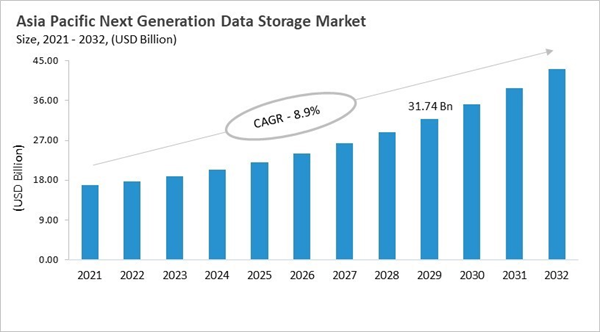
Over the past ten years, Asia Pacific's digital economy has changed quickly because of industrialization, more people using the internet, and faster adoption of cloud computing. Governments and businesses are starting to see data as a valuable economic resource, which is why they are spending a lot of money on digital infrastructure like cloud platforms, broadband networks, and data centers. This change has made the need for next-generation data storage solutions that can handle huge amounts of data growth while still providing high performance, scalability, security, and compliance with regulations even stronger. Modern workloads like AI, IoT, analytics, and cloud-native apps are no longer supported by old disk-based systems. Instead, all-flash arrays, NVMe-based systems, software-defined storage, and cloud-integrated platforms are taking their place.
Different regulatory frameworks in the region that stress data sovereignty and privacy are also helping growth by encouraging the use of hybrid and locally hosted storage architectures. Leading OEMs like Dell Technologies, HPE, NetApp, IBM, Fujitsu, and Huawei are responding with cloud-connected, software-driven, and energy-efficient storage portfolios. These are backed by partnerships with regional cloud providers and system integrators. Performance, security, hybrid cloud integration, sustainability, and compliance readiness are becoming more and more important for businesses to stand out from the competition. Overall, next-generation data storage in the Asia Pacific region is becoming an important part of digital transformation, economic competitiveness, and strong digital infrastructure in both the public and private sectors.
Storage Technique Outlook
Based on Storage Technique, the market is segmented into Magnetic Storage, SSD, and Hybrid Flash Array. With a compound annual growth rate (CAGR) of 7.4% over the projection period, the Magnetic Storage Market, dominate the China Next Generation Data Storage Market by Storage Technique in 2024 and would be a prominent market until 2032. The Hybrid Flash Array market is expected to witness a CAGR of 8.7% during 2025-2032.Storage Type Outlook
Based on Storage Type, the market is segmented into Local (on-premise), Remote (Cloud), and Hybrid. The Local (on-premise) market segment dominated the Singapore Next Generation Data Storage Market by Storage Type is expected to grow at a CAGR of 10.9 % during the forecast period thereby continuing its dominance until 2032. Also, The Hybrid market is anticipated to grow as a CAGR of 12.3 % during the forecast period during 2025-2032.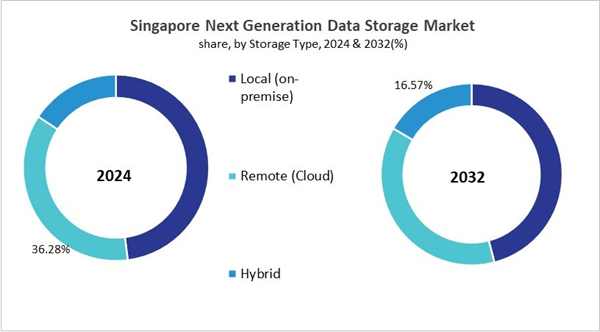
Country Outlook
The market for China's next-generation data storage is growing quickly because of the huge amounts of data being generated by cloud computing, AI, analytics, industrial IoT, and digital services. More and more businesses and cloud providers are using advanced storage systems like all-flash arrays, software-defined storage, hyperconverged infrastructure, and hybrid cloud platforms to meet the need for high performance, scalability, and low latency. Strong domestic cloud ecosystems led by Alibaba Cloud, Tencent Cloud, and Huawei Cloud are speeding up the rollout of large-scale storage solutions that work with the cloud. A big reason for the rise in demand for storage that works well with unstructured data, high I/O throughput, and analytics workloads is the rise of AI. Hybrid cloud strategies also allow for flexibility and compliance with regulations. Data sovereignty, cybersecurity, and governance rules also affect investment choices, making secure and compliant storage platforms even more important. Overall, the market is very competitive. Both domestic and international OEMs are coming up with new ideas to provide scalable, secure, and cloud-ready storage solutions that help China's digital transformation continue.List of Key Companies Profiled
- Dell Technologies, Inc.
- Hewlett Packard Enterprise Company
- NetApp, Inc.
- Huawei Technologies Co., Ltd. (Huawei Investment & Holding Co., Ltd.)
- IBM Corporation
- Micron Technology, Inc.
- Fujitsu Limited
- Western Digital Corporation
- Pure storage Inc.
- Hitachi, Ltd.
Market Report Segmentation
By End-use- Business
- Cloud Service Providers
- Healthcare
- BFSI
- Telecom Companies
- Government Bodies
- Retail
- Other Business Type
- Home
- Magnetic Storage
- SSD
- Hybrid Flash Array
- Local (on-premise)
- Remote (Cloud)
- Hybrid
- Direct-Attached Storage
- Storage Area Network
- Network-Attached Storage
- Other Storage System
- China
- Japan
- India
- South Korea
- Singapore
- Malaysia
- Rest of Asia Pacific
Table of Contents
Chapter 1. Market Scope & Methodology
Chapter 2. Market at a Glance
Chapter 3. Market Overview
Chapter 10. Competition Analysis - Global
Chapter 11. Asia Pacific Next Generation Data Storage Market by End-use
Chapter 12. Asia Pacific Next Generation Data Storage Market by Storage Technique
Chapter 13. Asia Pacific Next Generation Data Storage Market by Storage Type
Chapter 14. Asia Pacific Next Generation Data Storage Market by Storage System
Chapter 15. Asia Pacific Next Generation Data Storage Market by Country
Chapter 16. Company Profiles
Companies Mentioned
- Dell Technologies, Inc.
- Hewlett Packard Enterprise Company
- NetApp, Inc.
- Huawei Technologies Co., Ltd. (Huawei Investment & Holding Co., Ltd.)
- IBM Corporation
- Micron Technology, Inc.
- Fujitsu Limited
- Western Digital Corporation
- Pure storage Inc.
- Hitachi, Ltd.


