



The Latin America, Middle East and Africa Next Generation Data Storage Market is expected to reach $7.08 billion by 2028 and is expected to witness market growth of 11.4% CAGR during the forecast period (2025-2032).
The Brazil market dominated the LAMEA Next Generation Data Storage Market by country in 2024, and is expected to continue to be a dominant market till 2032; thereby, achieving a market value of $2.33 billion by 2032. The Argentina market is showcasing a CAGR of 12.1% during 2025-2032. Additionally, the UAE market would register a CAGR of 10.6% during 2025-2032. The Brazil and UAE led the LAMEA Next Generation Data Storage Market by Country with a market share of 23.9% and 19.6% in 2024. The Nigeria market is expected to witness a CAGR of 12.5% during throughout the forecast period.
The rapid growth of digital data in businesses and governments has led to the development of next-generation data storage. This has led to a shift from traditional, localized storage systems to scalable, networked, and software-defined architectures. Modern storage platforms focus on security, resilience, interoperability, and being ready for cloud, analytics, and AI workloads. They are based on public technology frameworks like those from NIST and supported by government digital strategies. OEM-led innovation, especially from global leaders like Dell Technologies and Hewlett Packard Enterprise, has sped up this change by making flash, NVMe, hybrid cloud, and AI-optimized storage solutions more popular. In the LAMEA region, these global progress are supported by regional goals like data sovereignty, building more data centers, and improving digital public services.
Some of the most important trends in the market are the use of AI in storage platforms, the widespread use of hybrid cloud and software-defined storage, and the merging of storage with other data management and automation tools. Top OEMs have made their strategies fit with AI-ready data platforms, cloud-like consumption models, and solutions that work in specific regions to meet regulatory and infrastructure needs. Innovation in performance, scalability, and platform integration, as well as recognition from independent technology assessments, are what set companies apart in LAMEA. As digital transformation speeds up in Latin America, the Middle East, and Africa, vendors who are both technologically advanced and very involved in their regions are in a good position to keep growing and staying competitive.
The Brazil market dominated the LAMEA Next Generation Data Storage Market by country in 2024, and is expected to continue to be a dominant market till 2032; thereby, achieving a market value of $2.33 billion by 2032. The Argentina market is showcasing a CAGR of 12.1% during 2025-2032. Additionally, the UAE market would register a CAGR of 10.6% during 2025-2032. The Brazil and UAE led the LAMEA Next Generation Data Storage Market by Country with a market share of 23.9% and 19.6% in 2024. The Nigeria market is expected to witness a CAGR of 12.5% during throughout the forecast period.
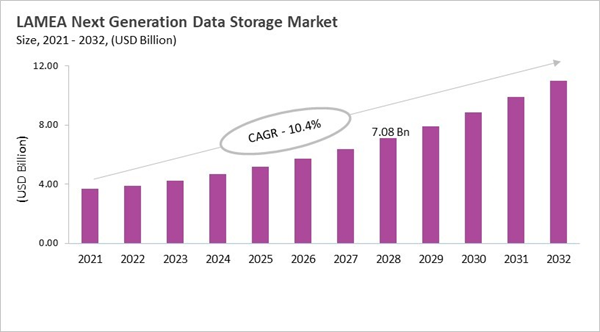
The rapid growth of digital data in businesses and governments has led to the development of next-generation data storage. This has led to a shift from traditional, localized storage systems to scalable, networked, and software-defined architectures. Modern storage platforms focus on security, resilience, interoperability, and being ready for cloud, analytics, and AI workloads. They are based on public technology frameworks like those from NIST and supported by government digital strategies. OEM-led innovation, especially from global leaders like Dell Technologies and Hewlett Packard Enterprise, has sped up this change by making flash, NVMe, hybrid cloud, and AI-optimized storage solutions more popular. In the LAMEA region, these global progress are supported by regional goals like data sovereignty, building more data centers, and improving digital public services.
Some of the most important trends in the market are the use of AI in storage platforms, the widespread use of hybrid cloud and software-defined storage, and the merging of storage with other data management and automation tools. Top OEMs have made their strategies fit with AI-ready data platforms, cloud-like consumption models, and solutions that work in specific regions to meet regulatory and infrastructure needs. Innovation in performance, scalability, and platform integration, as well as recognition from independent technology assessments, are what set companies apart in LAMEA. As digital transformation speeds up in Latin America, the Middle East, and Africa, vendors who are both technologically advanced and very involved in their regions are in a good position to keep growing and staying competitive.
Storage Technique Outlook
Based on Storage Technique, the market is segmented into Magnetic Storage, SSD, and Hybrid Flash Array. The Magnetic Storage market segment dominated the South Africa Next Generation Data Storage Market by Storage Technique is expected to grow at a CAGR of 11.6 % during the forecast period thereby continuing its dominance until 2032. Also, The Hybrid Flash Array market is anticipated to grow as a CAGR of 13 % during the forecast period during 2025-2032.Storage System Outlook
Based on Storage System, the market is segmented into Direct-Attached Storage, Storage Area Network, Network-Attached Storage, and Other Storage System. Among various Brazil Next Generation Data Storage Market by Storage System; The Direct-Attached Storage market achieved a market size of USD $389 Million in 2024 and is expected to grow at a CAGR of 9.1 % during the forecast period. The Network-Attached Storage market is predicted to experience a CAGR of 10.5% throughout the forecast period from (2025-2032).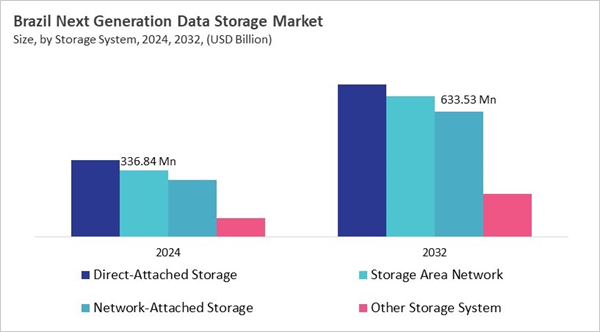
Country Outlook
As businesses and government agencies update their IT systems to handle the huge amounts of structured and unstructured data that are coming in, Brazil's next-generation data storage market is growing. Digital transformation, the use of cloud and hybrid cloud, and data-heavy workloads in industries like banking, telecom, healthcare, and e-commerce are all pushing companies to move away from old systems and toward storage platforms that can grow and perform well. Global OEMs like Hewlett Packard Enterprise and Dell Technologies are important because they offer enterprise storage solutions that work with hybrid cloud environments and advanced automation. As more and more people use analytics, AI, and machine learning, the need for high-throughput, low-latency storage architectures like flash and NVMe-based systems is growing even faster. Regulatory compliance, data security, and governance requirements also have a big impact on investment decisions, especially in industries that are heavily regulated. In general, the market is very competitive, with a focus on performance, scalability, security, and cloud integration to help Brazil's digital economy grow.List of Key Companies Profiled
- Dell Technologies, Inc.
- Hewlett Packard Enterprise Company
- NetApp, Inc.
- Huawei Technologies Co., Ltd. (Huawei Investment & Holding Co., Ltd.)
- IBM Corporation
- Micron Technology, Inc.
- Fujitsu Limited
- Western Digital Corporation
- Pure storage Inc.
- Hitachi, Ltd.
Market Report Segmentation
By End-use- Business
- Cloud Service Providers
- Healthcare
- BFSI
- Telecom Companies
- Government Bodies
- Retail
- Other Business Type
- Home
- Magnetic Storage
- SSD
- Hybrid Flash Array
- Local (on-premise)
- Remote (Cloud)
- Hybrid
- Direct-Attached Storage
- Storage Area Network
- Network-Attached Storage
- Other Storage System
- Brazil
- Argentina
- UAE
- Saudi Arabia
- South Africa
- Nigeria
- Rest of LAMEA
Table of Contents
Chapter 1. Market Scope & Methodology
Chapter 2. Market at a Glance
Chapter 3. Market Overview
Chapter 10. Competition Analysis - Global
Chapter 11. LAMEA Next Generation Data Storage Market by End-use
Chapter 12. LAMEA Next Generation Data Storage Market by Storage Technique
Chapter 13. LAMEA Next Generation Data Storage Market by Storage Type
Chapter 14. LAMEA Next Generation Data Storage Market by Storage System
Chapter 15. LAMEA Next Generation Data Storage Market by Country
Chapter 16. Company Profiles
Companies Mentioned
- Dell Technologies, Inc.
- Hewlett Packard Enterprise Company
- NetApp, Inc.
- Huawei Technologies Co., Ltd. (Huawei Investment & Holding Co., Ltd.)
- IBM Corporation
- Micron Technology, Inc.
- Fujitsu Limited
- Western Digital Corporation
- Pure storage Inc.
- Hitachi, Ltd.


