



The Global Parcel Sortation Systems Market size is expected to reach at $2.89 billion in 2025 and is expected to reach $4.31 billion by 2032, rising at a market growth of 5.9% CAGR during the forecast period (2025-2032).
Parcel sortation systems are a critical component of modern logistics, allowing fast, accurate, and scalable parcel handling across e-commerce fulfilment centers, postal services, third-party logistic providers, and airports. Developing from manual mail sorting to highly automated platforms, these systems now integrate barcode, conveyors, and OCR scanners, machine vision, robotics, and intelligent control software to process thousands of parcel per hour. The rapid growth of global e-commerce industry surged by shifting consumer expectations from next-day delivery-has been a significant element supporting adoption. National postal operators like the UPS have played a crucial role in advancing automation through the deployment of next generation sorter such as ADUS, SIPS, and MaRS, while major carrier including FedEx, UPS, DHL, and Amazon continue to invest heavily in high-throughput automated facilities to enhance speed, reliability, and labor efficiency.
The parcel sortation systems market is shaped by rising integration of IoT, AI, robotics, and modular automation, enabling systems to scale flexibility with demand and handle diverse parcel profiles. Major OEMs like Vanderlande, Honeywell, Dematic, BEUMER Group, and Daifuku compete on technology sophistication, customization, software integration, and lifecycle services. Further, sustainability has also developed as a key design priority, with optimized layouts gaining importance, and energy-efficient components, especially in North America and Europe. Continued innovation, adaptability, and automation are reshaping parcel sortation systems as a crucial enabler of high-speed global supply chains.
The leading players in the market are competing with diverse innovative offerings to remain competitive in the market. The above illustration shows the percentage of revenue shared by some of the leading companies in the market. The leading players of the market are adopting various strategies to cater demand coming from the different industries. The key developmental strategies in the market are Acquisitions, and Partnerships & Collaborations.
In Asia Pacific and LAMEA regions, the parcel sortation systems market is anticipated to grow at a significant rate. The market is propelled by online retail, significant logistics infrastructure investment, and rapid urbanization, particularly in India, China, South Korea, and Japan. Government-supported modernization initiatives, high parcel volumes surge in adoption of advanced sortation technologies, including robotics, AI, and modular conveyors across mega-fulfillment hubs. Moreover, the LAMEA parcel sortation systems market is expanding rapidly as regional nations are largely investing in automated sortation to support rising e-commerce. Also, the Middle East & Africa are expanding logistics infrastructure, backed by retail distribution upgrades and airport cargo automation. The LAMEA parcel sortation systems market is witnessing increased demand with improvements in supply chain modernization and digital commerce.
Key Market Trends & Insights:
- The Asia Pacific Parcel Sortation Systems market dominated the Global Market in 2024, accounting for a 42.65% revenue share in 2024.
- The US Parcel Sortation Systems market is expected to continue its dominance in North America region thereby reaching a market size of 828.46 million by 2032.
- Among the various type segments, the Cross-Belt Sorters dominated the global market contributing a revenue share of 36.49% in 2024.
- In terms of the Offering segmentation, the Hardware segment is projected to dominate the global market with the projected revenue share of 60.44% in 2032.
- 15,000-30,000 pph led the Throughput Capacity in 2024, capturing a 34.42% revenue share and is projected to continue its dominance during projected period.
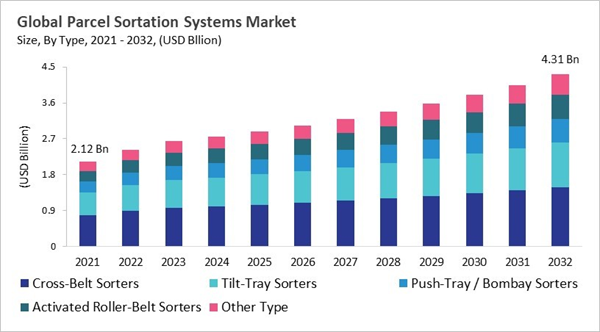
Parcel sortation systems are a critical component of modern logistics, allowing fast, accurate, and scalable parcel handling across e-commerce fulfilment centers, postal services, third-party logistic providers, and airports. Developing from manual mail sorting to highly automated platforms, these systems now integrate barcode, conveyors, and OCR scanners, machine vision, robotics, and intelligent control software to process thousands of parcel per hour. The rapid growth of global e-commerce industry surged by shifting consumer expectations from next-day delivery-has been a significant element supporting adoption. National postal operators like the UPS have played a crucial role in advancing automation through the deployment of next generation sorter such as ADUS, SIPS, and MaRS, while major carrier including FedEx, UPS, DHL, and Amazon continue to invest heavily in high-throughput automated facilities to enhance speed, reliability, and labor efficiency.
The parcel sortation systems market is shaped by rising integration of IoT, AI, robotics, and modular automation, enabling systems to scale flexibility with demand and handle diverse parcel profiles. Major OEMs like Vanderlande, Honeywell, Dematic, BEUMER Group, and Daifuku compete on technology sophistication, customization, software integration, and lifecycle services. Further, sustainability has also developed as a key design priority, with optimized layouts gaining importance, and energy-efficient components, especially in North America and Europe. Continued innovation, adaptability, and automation are reshaping parcel sortation systems as a crucial enabler of high-speed global supply chains.
COVID-19 Impact Analysis
The COVID-19 pandemic had a big effect on the Parcel Sortation Systems Market. Lockdowns, travel bans, and factory closures caused shortages in the supply chain and delays in the production of important parts. Logistics companies had to wait to install systems and make capital investments because of problems with their workforce and delays in getting raw materials. At first, courier and e-commerce companies weren't sure what to do, so they put off automation projects, especially those of small and medium-sized businesses, to stay in business. Social distancing rules, workers not showing up for work, and limited access to the site all influenced warehouse operations, making them less efficient and causing the system to be down more often. During the peak of the pandemic, international trade disruptions and changing parcel volumes made things more unstable, making it hard to plan for the long term and causing order intake and revenue pressure to slow down. Thus, the COVID-19 pandemic had a negative impact on the market.Driving and Restraining Factors
Drivers- Rapid Growth of Global E-Commerce and Digital Retail
- Automation To Address Labor Constraints and Operational Efficiency
- Modernization Of Postal and National Logistics Infrastructure
- Technological Advancements in Automation, Software, And System Integration
- High Initial Capital Costs and Total Cost of Ownership
- Integration Complexity with Legacy Infrastructure and Technology
- Technical And Operational Constraints in Handling Diverse Parcel Mixes
- Expansion Of Automation in Emerging Markets
- Integration Of Advanced Technologies (AI, Machine Vision, Robotics)
- Sustainability And Energy Efficiency Initiatives
- Skilled Workforce Gap and Technical Expertise Requirements
- Regulatory And Safety Compliance Across Diverse Global Jurisdictions
- Cybersecurity And Data Vulnerabilities in Connected Sortation Systems
Market Share Analysis
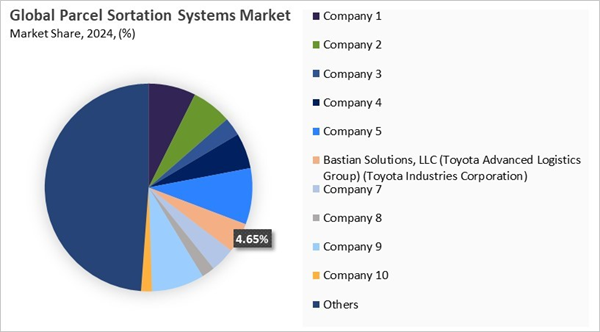
The leading players in the market are competing with diverse innovative offerings to remain competitive in the market. The above illustration shows the percentage of revenue shared by some of the leading companies in the market. The leading players of the market are adopting various strategies to cater demand coming from the different industries. The key developmental strategies in the market are Acquisitions, and Partnerships & Collaborations.
Type Outlook
Based on Type, the Parcel Sortation Systems Market is segmented into Cross-Belt Sorters, Tilt-Tray Sorters, Push-Tray / Bombay Sorters, Activated Roller-Belt Sorters, and Other Type. The Tilt-Tray Sorters segment attained 26% revenue share in the market in 2024. Tilt-tray sorters are engineered to efficiently manage parcel flow using trays that tilt to discharge items into assigned chutes. Each tray securely carries a single parcel, ensuring controlled movement throughout the sorting process. This type of system is valued for its ability to maintain consistent spacing and reduce the risk of collisions or mis-sorts during high-speed operations.Application Outlook
Based on Application, the Parcel Sortation Systems Market is segmented into E-commerce Fulfilment Centres, CEP Hubs, 3PL & Contract Logistics, Grocery & Food Distribution, Airports & Air-Cargo Terminals, and Other Application. The CEP Hubs segment attained 17% revenue share in the market in 2024. Courier, express, and parcel hubs depend heavily on parcel sortation systems to manage continuous parcel inflow and outflow across regional and national networks. These hubs operate under strict time constraints, requiring automated solutions that can handle diverse parcel dimensions while maintaining high accuracy.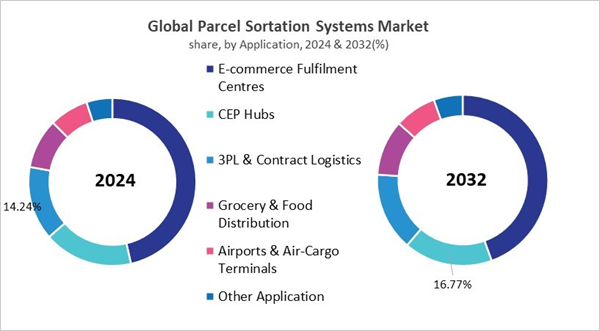
Regional Outlook
Region-wise, the Parcel Sortation Systems Market is analyzed across North America, Europe, Asia Pacific, and LAMEA. The Asia Pacific segment recorded 43% revenue share in the market in 2024. The parcel sortation systems market is projected to capture prominent share in North America and Europe region. This is due to advanced logistics infrastructure, widespread automation adoption across postal networks and distribution centers, and high e-commerce penetration. The region experiences significant investment toward robotics, AI-enabled sortation, and high-speed conveyors to meet next-day delivery expectations, supported by major carriers and fulfilment vendors upgrading both retrofitting existing hubs and new facilities. Furthermore, Europe parcel sortation systems market holds noticeable share in the upcoming years. The market is driven by sustainability regulations, dense cross-border e-commerce flows, and established supply chain networks in nations like France, Germany, and the UK. European carriers and fulfilment centers are largely investing in modular platforms, and energy-efficient sortation systems to meet environmental targets, improve accuracy, and support omni-channel delivery models.In Asia Pacific and LAMEA regions, the parcel sortation systems market is anticipated to grow at a significant rate. The market is propelled by online retail, significant logistics infrastructure investment, and rapid urbanization, particularly in India, China, South Korea, and Japan. Government-supported modernization initiatives, high parcel volumes surge in adoption of advanced sortation technologies, including robotics, AI, and modular conveyors across mega-fulfillment hubs. Moreover, the LAMEA parcel sortation systems market is expanding rapidly as regional nations are largely investing in automated sortation to support rising e-commerce. Also, the Middle East & Africa are expanding logistics infrastructure, backed by retail distribution upgrades and airport cargo automation. The LAMEA parcel sortation systems market is witnessing increased demand with improvements in supply chain modernization and digital commerce.
Recent Strategies Deployed in the Market
- Jun-2023: BEUMER Group GmbH & Co. KG acquired The Hendrik Group Inc., a U.S. leader in air supported belt conveyors, to enhance its bulk material handling portfolio. This move supports BEUMER’s sustainability goals, expands capabilities in the cement and mining sectors, and strengthens its position with eco-friendly, low-maintenance, and efficient transport technologies.
- Jul-2022: BEUMER Group GmbH & Co. KG unveiled the BG Line Sorter and BG Pouch System in North America, offering scalable, flexible solutions for mid-volume e-commerce operations. The systems optimize space, reduce maintenance, and enhance sortation efficiency using advanced technologies, supporting omnichannel fulfillment while lowering energy use and operational costs.
- Feb-2022: Korber AG acquired Siemens Logistics, a subsidiary of Siemens AG specializing in global mail and parcel services. The deal aimed to strengthen Körber’s logistics portfolio and expand its capabilities in the parcel automation and supply chain technology sectors.
- Mar-2021: Interroll Group unveiled the Split Tray Sorter, a compact, modular system ideal for e-commerce and omnichannel logistics. Supporting goods up to 12 kg, it ensures fast ROI, easy integration, and predictive maintenance. With rapid delivery and automation options, it boosts efficiency in fashion, pharma, and parcel distribution centers.
- Feb-2021: Daifuku Co., Limited teamed up with Germany-based AFT Industries AG, a manufacturer of material handling and parcel sortation systems. The collaboration aimed to leverage AFT’s parcel sortation technology to enhance automation solutions within the automotive industry, strengthening Daifuku’s position in that sector.
List of Key Companies Profiled
- BEUMER Group GmbH & Co. KG
- Interroll Group
- SSI Schaefer Group
- Daifuku Co., Limited
- KION GROUP AG
- Bastian Solutions, LLC (Toyota Advanced Logistics Group) (Toyota Industries Corporation)
- Korber AG
- SOLYSTIC SAS
- Honeywell International, Inc.
- Murata Machinery, Ltd.
Market Report Segmentation
By Type- Cross-Belt Sorters
- Tilt-Tray Sorters
- Push-Tray / Bombay Sorters
- Activated Roller-Belt Sorters
- Other Type
- E-commerce Fulfilment Centres
- CEP Hubs
- 3PL & Contract Logistics
- Grocery & Food Distribution
- Airports & Air-Cargo Terminals
- Other Application
- 15,000-30,000 pph
- > 30,000 pph
- 5,000-15,000 pph
- < 5,000 pph
- Hardware
- Software
- Services
- North America
- US
- Canada
- Mexico
- Rest of North America
- Europe
- Germany
- UK
- France
- Russia
- Spain
- Italy
- Rest of Europe
- Asia Pacific
- China
- Japan
- India
- South Korea
- Singapore
- Malaysia
- Rest of Asia Pacific
- LAMEA
- Brazil
- Argentina
- UAE
- Saudi Arabia
- South Africa
- Nigeria
- Rest of LAMEA
Table of Contents
Chapter 1. Market Scope & Methodology
Chapter 2. Market at a Glance
Chapter 3. Market Overview
Chapter 9. Competition Analysis - Global
Chapter 11. Global Parcel Sortation Systems Market by Type
Chapter 12. Global Parcel Sortation Systems Market by Application
Chapter 13. Global Parcel Sortation Systems Market by Throughput Capacity
Chapter 14. Global Parcel Sortation Systems Market by Offering
Chapter 15. Global Parcel Sortation Systems Market by Region
Chapter 16. Company Profiles
Companies Mentioned
- BEUMER Group GmbH & Co. KG
- Interroll Group
- SSI Schaefer Group
- Daifuku Co., Limited
- KION GROUP AG
- Bastian Solutions, LLC (Toyota Advanced Logistics Group) (Toyota Industries Corporation)
- Korber AG
- SOLYSTIC SAS
- Honeywell International, Inc.
- Murata Machinery, Ltd.


