



The Asia Pacific Payment Security Market is expected to witness market growth of 17.5% CAGR during the forecast period (2025-2032).
The China market dominated the Asia Pacific Payment Security Market by country in 2024, and is expected to continue to be a dominant market till 2032; thereby, achieving a market value of $7.45 billion by 2032. The Japan market is showcasing a CAGR of 16.7% during 2025-2032. Additionally, the India market would register a CAGR of 18.2% during 2025-2032. The China and India led the Asia Pacific Payment Security Market by Country with a market share of 31.9% and 18.4% in 2024.The Singapore market is expected to witness a CAGR of 19.4% during throughout the forecast period.
The Asia Pacific Payment Security Market has changed as digitalization has sped up, different rules have been put in place, and both developed and developing economies have started using electronic and mobile payments. In the 2000s, the market grew from focusing on card security and bank-led controls to include e-commerce and cross-border fraud risks. This was done through stronger regulatory oversight and network-level authentication tools. In the 2010s, mobile wallets and real-time payments became more popular, which led governments to include security in their national digital payment plans. By the early 2020s, APAC had grown into a complex system of rules, real-time risk management, and cutting-edge security technologies.
To protect high-volume, instant transactions, current trends focus on mobile-first and biometric authentication, widespread tokenization, and AI-driven fraud detection. Increasingly, payment processors are using adaptive, intelligent-led security models to find a balance between speed and ease of use. There are a lot of different players in the market, including global networks, banks, fintechs, and domestic platforms that are all competing on advanced fraud prevention, smooth user experience, and scalability. Overall, APAC is a payment security market that is growing quickly but is also getting more complex because of new ideas and cooperation between regulators.
The China market dominated the Asia Pacific Payment Security Market by country in 2024, and is expected to continue to be a dominant market till 2032; thereby, achieving a market value of $7.45 billion by 2032. The Japan market is showcasing a CAGR of 16.7% during 2025-2032. Additionally, the India market would register a CAGR of 18.2% during 2025-2032. The China and India led the Asia Pacific Payment Security Market by Country with a market share of 31.9% and 18.4% in 2024.The Singapore market is expected to witness a CAGR of 19.4% during throughout the forecast period.
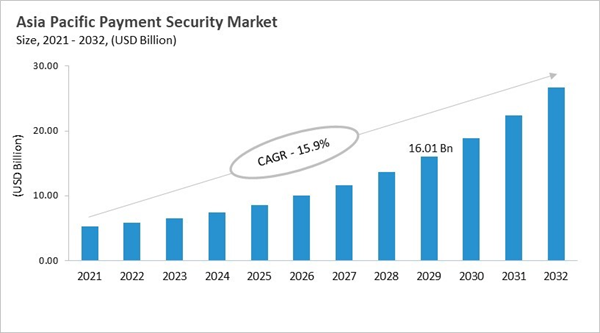
The Asia Pacific Payment Security Market has changed as digitalization has sped up, different rules have been put in place, and both developed and developing economies have started using electronic and mobile payments. In the 2000s, the market grew from focusing on card security and bank-led controls to include e-commerce and cross-border fraud risks. This was done through stronger regulatory oversight and network-level authentication tools. In the 2010s, mobile wallets and real-time payments became more popular, which led governments to include security in their national digital payment plans. By the early 2020s, APAC had grown into a complex system of rules, real-time risk management, and cutting-edge security technologies.
To protect high-volume, instant transactions, current trends focus on mobile-first and biometric authentication, widespread tokenization, and AI-driven fraud detection. Increasingly, payment processors are using adaptive, intelligent-led security models to find a balance between speed and ease of use. There are a lot of different players in the market, including global networks, banks, fintechs, and domestic platforms that are all competing on advanced fraud prevention, smooth user experience, and scalability. Overall, APAC is a payment security market that is growing quickly but is also getting more complex because of new ideas and cooperation between regulators.
End-User Industry Outlook
Based on End-User Industry, the market is segmented into Retail & E-commerce, BFSI (Banking & Financial Services), Healthcare, IT & Telecom, Travel & Hospitality, Government, and Other End-User Industry. Among various China Payment Security Market by End-User Industry; The Retail & E-commerce market achieved a market size of USD $837 Million in 2024 and is expected to grow at a CAGR of 14.1 % during the forecast period. The Government market is predicted to experience a CAGR of 18.2% throughout the forecast period from (2025-2032).Platform Outlook
Based on Platform, the market is segmented into Web-Based, Mobile-Based, and In-Store / POS. The Web-Based market segment dominated the Singapore Payment Security Market by Platform is expected to grow at a CAGR of 18.9 % during the forecast period thereby continuing its dominance until 2032. Also, The In-Store / POS market is anticipated to grow as a CAGR of 20.1 % during the forecast period during 2025-2032.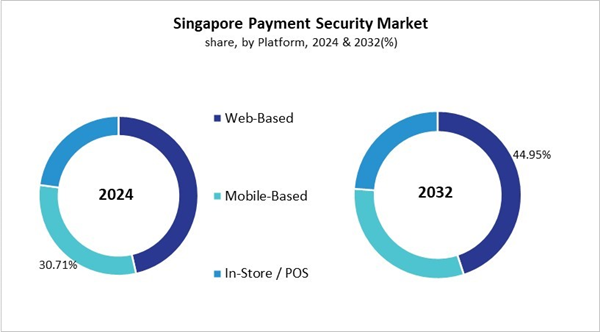
Country Outlook
China's payment security market is one of the most advanced in APAC because a lot of people use mobile wallets, QR codes, and online platforms. As the country moves toward a cashless economy, strong security is more important than ever for keeping customers' trust and the system's resilience. Multi-layered protection, such as encryption, real-time risk monitoring, tokenization, and behavioral analytics, is what keeps payments safe. To fight fraud and unauthorized access, businesses and government agencies put a lot of emphasis on secure architectures and making sure users are aware of them. Market trends show that authentication technologies and AI-driven fraud detection are changing quickly. Strong domestic platforms and global networks are competing to offer end-to-end security and interoperability. In general, payment security is still a key part of China's national digital payment plan.List of Key Companies Profiled
- U.S. Bancorp
- Ingenico (Apollo Global Management, Inc.)
- Utimaco Management GmbH (SGT Capital)
- SHIFT4 PAYMENTS, INC.
- Mastercard Inc.
- American Express Company
- Thales Group S.A.
- PayPal Holdings, Inc.
- Bluefin Payment Systems LLC
- Visa Inc.
Market Report Segmentation
By Organization Size- Large Enterprises
- SMEs (Small & Medium)
- Web-Based
- Mobile-Based
- In-Store / POS
- Fraud Detection & Prevention
- Encryption
- Tokenization
- Other Solution Type
- Retail & E-commerce
- BFSI (Banking & Financial Services)
- Healthcare
- IT & Telecom
- Travel & Hospitality
- Government
- Other End-User Industry
- China
- Japan
- India
- South Korea
- Singapore
- Malaysia
- Rest of Asia Pacific
Table of Contents
Chapter 1. Market Scope & Methodology
Chapter 2. Market at a Glance
Chapter 3. Market Overview
Chapter 10. Competition Analysis - Global
Chapter 11. Asia Pacific Payment Security Market by Organization Size
Chapter 12. Asia Pacific Payment Security Market by Platform
Chapter 13. Asia Pacific Payment Security Market by Solution Type
Chapter 14. Asia Pacific Payment Security Market by End-User Industry
Chapter 15. Asia Pacific Payment Security Market by Country
Chapter 16. Company Profiles
Companies Mentioned
- U.S. Bancorp
- Ingenico (Apollo Global Management, Inc.)
- Utimaco Management GmbH (SGT Capital)
- SHIFT4 PAYMENTS, INC.
- Mastercard Inc.
- American Express Company
- Thales Group S.A.
- PayPal Holdings, Inc.
- Bluefin Payment Systems LLC
- Visa Inc.


