



The Latin America, Middle East and Africa Perimeter Intrusion Detection Systems Market is expected to reach $2.84 billion by 2028 and is expected to witness market growth of 15.8% CAGR during the forecast period (2025-2032).
The Saudi Arabia market dominated the LAMEA Perimeter Intrusion Detection Systems Market by country in 2024, and is expected to continue to be a dominant market till 2032; thereby, achieving a market value of $994.5 million by 2032. The Argentina market is showcasing a CAGR of 16.6% during 2025-2032. Additionally, the UAE market would register a CAGR of 14.7% during 2025-2032. The Saudi Arabia and UAE led the LAMEA Perimeter Intrusion Detection Systems Market by Country with a market share of 21.8% and 15.6% in 2024. The Nigeria market is expected to witness a CAGR of 17.3% during throughout the forecast period.
As governments and asset owners deal with growing infrastructure, urbanization, and higher security risks, perimeter intrusion detection systems (PIDS) have become an important part of physical security across the LAMEA region. Perimeter security used to depend on physical barriers and people watching over them. Now, it has changed with the use of electronic detection technologies like sensors on fences, buried cables, and infrared systems. These solutions make it easier to find out about attempts to break in and speed up response times, especially for big buildings in the energy, transportation, industrial, and government sectors. As infrastructure projects get bigger and more complicated, the need for automated, continuous perimeter monitoring has grown.
Different environmental and security needs in Latin America, the Middle East, and Africa have affected how people in those regions have adopted the technology. The Middle East has caused a need for tough, long-range systems that can work in very hot or very cold weather and protect important and high-security assets. Latin America has focused on keeping transportation and industrial facilities safe in high-risk urban and logistics areas, while Africa has focused on keeping mining, utility, and infrastructure assets safe in remote areas with solutions that don't need much upkeep. PIDS in LAMEA are becoming more and more connected to video surveillance and centralized security platforms. This shows a move toward more complete and smart ways to protect the perimeter.
The Saudi Arabia market dominated the LAMEA Perimeter Intrusion Detection Systems Market by country in 2024, and is expected to continue to be a dominant market till 2032; thereby, achieving a market value of $994.5 million by 2032. The Argentina market is showcasing a CAGR of 16.6% during 2025-2032. Additionally, the UAE market would register a CAGR of 14.7% during 2025-2032. The Saudi Arabia and UAE led the LAMEA Perimeter Intrusion Detection Systems Market by Country with a market share of 21.8% and 15.6% in 2024. The Nigeria market is expected to witness a CAGR of 17.3% during throughout the forecast period.
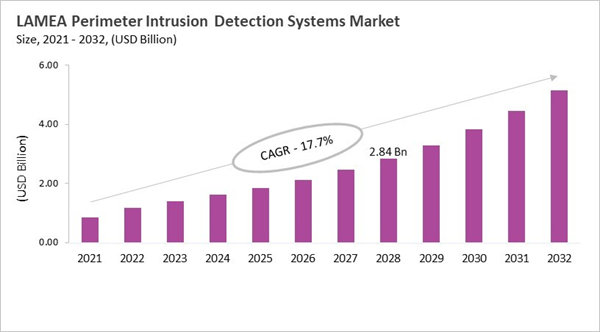
As governments and asset owners deal with growing infrastructure, urbanization, and higher security risks, perimeter intrusion detection systems (PIDS) have become an important part of physical security across the LAMEA region. Perimeter security used to depend on physical barriers and people watching over them. Now, it has changed with the use of electronic detection technologies like sensors on fences, buried cables, and infrared systems. These solutions make it easier to find out about attempts to break in and speed up response times, especially for big buildings in the energy, transportation, industrial, and government sectors. As infrastructure projects get bigger and more complicated, the need for automated, continuous perimeter monitoring has grown.
Different environmental and security needs in Latin America, the Middle East, and Africa have affected how people in those regions have adopted the technology. The Middle East has caused a need for tough, long-range systems that can work in very hot or very cold weather and protect important and high-security assets. Latin America has focused on keeping transportation and industrial facilities safe in high-risk urban and logistics areas, while Africa has focused on keeping mining, utility, and infrastructure assets safe in remote areas with solutions that don't need much upkeep. PIDS in LAMEA are becoming more and more connected to video surveillance and centralized security platforms. This shows a move toward more complete and smart ways to protect the perimeter.
Offering Outlook
Based on Offering, the market is segmented into Hardware, Software and Services. The Hardware market segment dominated the South Africa Perimeter Intrusion Detection Systems Market by Offering is expected to grow at a CAGR of 16.4 % during the forecast period thereby continuing its dominance until 2032. Also, The Services market is anticipated to grow as a CAGR of 17.8 % during the forecast period during 2025-2032.Deployment Type Outlook
Based on Deployment Type, the market is segmented into Fence-Mounted, Open Area and Buried. With a compound annual growth rate (CAGR) of 15.9% over the projection period, the Fence-Mounted Market, dominate the Brazil Perimeter Intrusion Detection Systems Market by Deployment Type in 2024 and would be a prominent market until 2032. The Open Area market is expected to witness a CAGR of 17% during 2025-2032.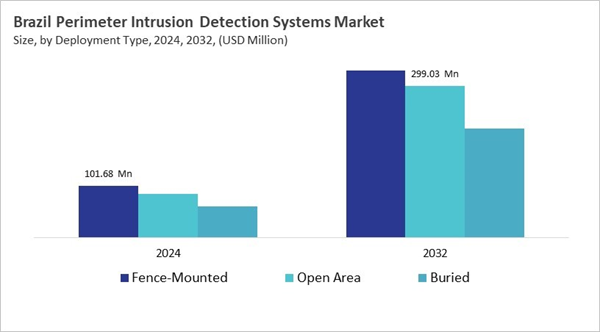
Country Outlook
The market for perimeter intrusion detection systems in Saudi Arabia is growing quickly because of big infrastructure projects and national security goals set by Vision 2030. Advanced solutions are needed to improve situational awareness and asset protection for important assets like oil and gas facilities, power plants, airports, industrial cities, and border zones. Infrastructure investments by the government, a wider range of industries, and strict security rules are speeding up adoption, especially for large and remote sites. More and more companies are using radar-based detection, fiber-optic fence sensors, and thermal imaging technologies, which are often linked to centralized security command platforms. AI-powered analytics and automation are becoming more popular in smart cities and industrial projects. There are both global OEMs and regional integrators in the competition. Reliability, environmental performance, and the ability to provide long-term service are some of the main things that set companies apart.List of Key Companies Profiled
- Advanced Perimeter Systems Limited
- Schneider Electric SE
- Johnson Controls International PLC
- Honeywell International, Inc.
- Teledyne FLIR LLC (Teledyne Technologies Incorporated)
- Axis Communications AB (Canon, Inc.)
- Optex Co. Ltd. (Optex Group Co., Ltd.)
- PureTech Systems, Inc.
- Senstar Technologies Ltd.
- Cias Elettronica Srl
Market Report Segmentation
By Offering- Hardware
- Software
- Services
- Fence-Mounted
- Open Area
- Buried
- Military & Defense
- Critical Infrastructure
- Government
- Industrial
- Transportation
- Commercial
- Other End-User Verticals
- Brazil
- Argentina
- UAE
- Saudi Arabia
- South Africa
- Nigeria
- Rest of LAMEA
Table of Contents
Chapter 1. Market Scope & Methodology
Chapter 2. Market at a Glance
Chapter 3. Market Overview
Chapter 10. Competition Analysis - Global
Chapter 11. LAMEA Perimeter Intrusion Detection Systems Market by Offering
Chapter 12. LAMEA Perimeter Intrusion Detection Systems Market by Deployment Type
Chapter 13. LAMEA Perimeter Intrusion Detection Systems Market by End-User Verticals
Chapter 14. LAMEA Perimeter Intrusion Detection Systems Market by Country
Chapter 15. Company Profiles
Companies Mentioned
- Advanced Perimeter Systems Limited
- Schneider Electric SE
- Johnson Controls International PLC
- Honeywell International, Inc.
- Teledyne FLIR LLC (Teledyne Technologies Incorporated)
- Axis Communications AB (Canon, Inc.)
- Optex Co. Ltd. (Optex Group Co., Ltd.)
- PureTech Systems, Inc.
- Senstar Technologies Ltd.
- Cias Elettronica Srl


