



The Asia Pacific Contactless Payment Market is expected to reach $31.01 billion by 2029 and is expected to witness market growth of 19.7% CAGR during the forecast period (2025-2032).
The China market dominated the Asia Pacific Contactless Payment Market by country in 2024, and is expected to continue to be a dominant market till 2032; thereby, achieving a market value of $13.84 billion by 2032. The Japan market is registering a CAGR of 18.8% during 2025-2032. Additionally, the India market is expected to showcase a CAGR of 20.4% during 2025-2032. The China and Japan led the Asia Pacific Contactless Payment Market by Country with a market share of 29.5% and 17.7% in 2024. The Malaysia market is expected to witness a CAGR of 22.5% during throughout the forecast period.
The Asia Pacific contactless payment market has changed from the early use of NFC-enabled cards in developed countries like Japan and South Korea to a fast-changing and diverse digital payments ecosystem. The move to mobile wallets, QR-based systems, and tokenized transactions was made possible by the rapid spread of smartphones, better internet access, and new ideas in fintech. These changes made things much easier and safer. Regulatory support for cashless economies and higher demand for clean, touch-free transactions during the COVID-19 pandemic helped the market grow even faster. The rise of super-app ecosystems and efforts to include everyone in the financial system have changed how people do business every day in countries like China and India. The area is now a mature but diverse landscape with strong infrastructure, changing consumer behavior, and strong regulatory frameworks that encourage trust and data security.
The market is always changing, and three major trends are driving this change: the rapid growth of mobile commerce, new rules that make it easier to do business, and a greater focus on security and fraud prevention. Market leaders are using cutting-edge technologies like AI-driven risk management, biometric authentication, and cloud-based platforms. They are also forming strategic partnerships to grow their merchant networks and improve their service offerings. Localization is still very important because different regions have different needs. This lets companies make solutions that work well in all markets. The competition is very strong. Global companies have a lot of resources and advanced technology, while regional companies are better at being flexible and understanding the local market. This interaction encourages ongoing innovation, with ecosystem integration, user experience, and trust being the main factors that set companies apart. This keeps growth and competition going in the Asia Pacific contactless payment market.
The China market dominated the Asia Pacific Contactless Payment Market by country in 2024, and is expected to continue to be a dominant market till 2032; thereby, achieving a market value of $13.84 billion by 2032. The Japan market is registering a CAGR of 18.8% during 2025-2032. Additionally, the India market is expected to showcase a CAGR of 20.4% during 2025-2032. The China and Japan led the Asia Pacific Contactless Payment Market by Country with a market share of 29.5% and 17.7% in 2024. The Malaysia market is expected to witness a CAGR of 22.5% during throughout the forecast period.
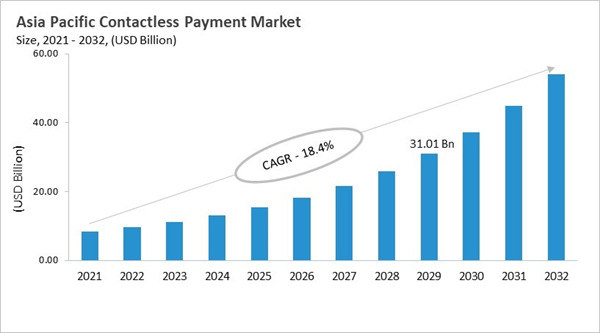
The Asia Pacific contactless payment market has changed from the early use of NFC-enabled cards in developed countries like Japan and South Korea to a fast-changing and diverse digital payments ecosystem. The move to mobile wallets, QR-based systems, and tokenized transactions was made possible by the rapid spread of smartphones, better internet access, and new ideas in fintech. These changes made things much easier and safer. Regulatory support for cashless economies and higher demand for clean, touch-free transactions during the COVID-19 pandemic helped the market grow even faster. The rise of super-app ecosystems and efforts to include everyone in the financial system have changed how people do business every day in countries like China and India. The area is now a mature but diverse landscape with strong infrastructure, changing consumer behavior, and strong regulatory frameworks that encourage trust and data security.
The market is always changing, and three major trends are driving this change: the rapid growth of mobile commerce, new rules that make it easier to do business, and a greater focus on security and fraud prevention. Market leaders are using cutting-edge technologies like AI-driven risk management, biometric authentication, and cloud-based platforms. They are also forming strategic partnerships to grow their merchant networks and improve their service offerings. Localization is still very important because different regions have different needs. This lets companies make solutions that work well in all markets. The competition is very strong. Global companies have a lot of resources and advanced technology, while regional companies are better at being flexible and understanding the local market. This interaction encourages ongoing innovation, with ecosystem integration, user experience, and trust being the main factors that set companies apart. This keeps growth and competition going in the Asia Pacific contactless payment market.
Type Outlook
Based on Type, the market is segmented into Card Based Payments, and Smartphone Based Payments. The Card Based Payments market segment dominated the Singapore Contactless Payment Market by Type is expected to grow at a CAGR of 20.2 % during the forecast period thereby continuing its dominance until 2032. Also, The Smartphone Based Payments market is anticipated to grow as a CAGR of 23.3 % during the forecast period during 2025-2032.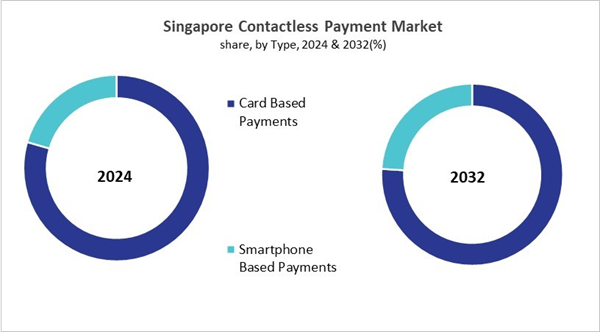
Application Outlook
Based on Application, the market is segmented into Retail, Transportation, Hospitality, Healthcare, and Other Application. With a compound annual growth rate (CAGR) of 17% over the projection period, the Retail Market, dominate the China Contactless Payment Market by Application in 2024 and would be a prominent market until 2032. The Healthcare market is expected to witness a CAGR of 19.8% during 2025-2032.Country Outlook
In the early 2010s, China's contactless payment market began to grow. This was because smartphones became more popular and QR code-based payments became more common. These payments made digital transactions cheaper and helped more people access financial services. Over time, the market became a very advanced ecosystem with technologies like NFC, biometrics, and facial recognition. This was made possible by strong rules and more people accepting the technology. QR payments are becoming more popular, biometric authentication is becoming more common to improve security, and payment platforms are growing to include both financial and lifestyle services. Market leaders stay on top by constantly coming up with new ideas, forming strategic partnerships, and carefully moving into lower-tier and rural markets. The competition is still fierce, with big tech companies in the US using their size, ecosystem integration, and localized strategies to stay on top. They also have to balance innovation with cost-effectiveness to meet the needs of a wide range of customers.List of Key Companies Profiled
- Visa Inc.
- Mastercard Inc.
- PayPal Holdings, Inc.
- American Express Company
- Apple, Inc.
- Google LLC (Alphabet Inc.)
- Samsung Electronics Co., Ltd. (Samsung Group)
- Amazon.com, Inc.
- Barclays PLC
- Tencent Holdings Ltd.
Market Report Segmentation
By Type- Card Based Payments
- Credit Cards
- Debit Cards
- Other Card Based Payments Type
- Smartphone Based Payments
- Retail
- Consumer Electronics
- Fashion & Garments
- Other Retail Type
- Transportation
- Hospitality
- Healthcare
- Other Application
- China
- Japan
- India
- South Korea
- Singapore
- Malaysia
- Rest of Asia Pacific
Table of Contents
Chapter 1. Market Scope & Methodology
Chapter 2. Market at a Glance
Chapter 3. Market Overview
Chapter 4. Market Trends - Asia Pacific Contactless Payment Market
Chapter 5. State of Competition - Asia Pacific Contactless Payment Market
Chapter 6. Market Consolidation - Asia Pacific Contactless Payment Market
Chapter 7. Key Costumer Criteria - Asia Pacific Contactless Payment Market
Chapter 8. Product Life Cycle - Asia Pacific Contactless Payment Market
Chapter 10. Competition Analysis - Global
Chapter 11. Asia Pacific Contactless Payment Market by Type
Chapter 12. Asia Pacific Contactless Payment Market by Application
Chapter 13. Asia Pacific Contactless Payment Market by Country
Chapter 14. Company Profiles
Companies Mentioned
- Visa Inc.
- Mastercard Inc.
- PayPal Holdings, Inc.
- American Express Company
- Apple, Inc.
- Google LLC (Alphabet Inc.)
- Samsung Electronics Co., Ltd. (Samsung Group)
- Amazon.com, Inc.
- Barclays PLC
- Tencent Holdings Ltd.


