



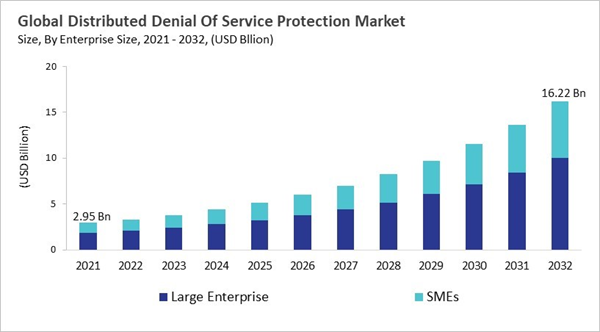
The Global Distributed Denial Of Service Protection Market size is estimated at $5.12 billion in 2025 and is expected to reach $16.22 billion by 2032, rising at a market growth of 17.9% CAGR during the forecast period (2025-2032). The strong growth of the Distributed Denial of Service (DDoS) Protection Market is driven by the rising frequency and sophistication of cyberattacks targeting enterprises, governments, and digital platforms. Increasing adoption of cloud computing, IoT, and online services has intensified the need for advanced security solutions, boosting demand for scalable and automated DDoS protection technologies globally.
The Distributed Denial of Service (DDoS) protection market has evolved as a response to rising demand to defend networks, servers, and applications from complex and frequent cyberattacks. With threat actors adopting more advanced multi-vector and application-layer attack strategies, the DDoS market has developed to incorporate sophisticated solutions like machine learning-based anomaly detection, behavioural analytics, and hybrid mitigation models combining cloud-based and on-premises defenses. The integration of automated threat intelligence sharing and the growth of scalable, cloud-native solutions have shifted the market into one focused on AI-powered mitigation, real-time analysis, and proactive threat management, shifting from reactive to predictive and adaptive security approaches.
The DDoS protection market is driven by key trends, including rising adoption of machine learning and AI to reduce response times, enhance detection accuracy, and minimize false positives in largely complex attack environments. The expansion of DDoS protection models has further improved scalability and flexibility by integrating cloud-based scrubbing with on-premises systems. Moreover, strict regulations surrounding data protection and cybersecurity have driven enterprises to invest in compliance-ready security platforms and advanced mitigation solutions. The market’s competitive landscape is shaped by strategic partnerships with cloud providers, strong innovation focus, and investments in cloud-native and edge computing capabilities.
The major strategies followed by the market participants are Product Launches as the key developmental strategy to keep pace with the changing demands of end users. In March, 2025, Fastly, Inc. unveiled enhanced DDoS Attack Insights to provide users with greater visibility and transparency into DDoS threats. The initiative focuses on improving threat detection and reporting, enabling businesses to strengthen their security posture. This move supports growing demands for real-time security analytics in the DDoS protection landscape. Additionally, In February, 2025, Fortinet, Inc. unveiled advanced solutions that unify security and network performance, enhancing protection against DDoS and other cyber threats while optimizing operational efficiency. This development supports scalable threat mitigation for enterprises facing increasingly sophisticated distributed denial-of-service attacks.
Based on the Analysis presented in the KBV Cardinal matrix; Amazon Web Services, Inc. is the forerunner in the Distributed Denial Of Service Protection Market. Companies such as Imperva, Inc., Fortinet, Inc., and F5, Inc. are some of the key innovators in Distributed Denial Of Service Protection Market. In June, 2025, Amazon Web Services, Inc. unveiled enhanced DDoS protection through AWS WAF, introducing new capabilities to identify and mitigate application-layer attacks. These features provide real-time visibility, automated mitigation, and greater customization, supporting organizations in improving web application resilience against sophisticated DDoS threats. This strengthens AWS’s role in the evolving DDoS Protection Market.
The leading players in the market are competing with diverse innovative offerings to remain competitive in the market. The above illustration shows the percentage of revenue shared by some of the leading companies in the market. The leading players of the market are adopting various strategies in order to cater demand coming from the different industries. The key developmental strategies in the market are Acquisitions, and Partnerships & Collaborations.
In the Asia Pacific and LAMEA regions, the Distributed Denial of Service (DDoS) protection market is estimated to experience prominent growth. The market is propelled by expanding cloud infrastructure, rapid digital transformation, and rising cyberattack frequency across developing nations like China, India, and Southeast Asia. Enterprises and governments are investing largely in cloud-based and AI-driven mitigation solutions to secure telecom, e-commerce, and financial ecosystems. Additionally, the DDoS protection market is expected to offer lucrative opportunities in the LAMEA region. This is due to increasing awareness of cybersecurity risks, digitalization initiatives, and rising attack volumes, especially in government sectors.
The Distributed Denial of Service (DDoS) Protection Market is characterized by intense competition due to the rising frequency and complexity of cyberattacks and the increasing dependence of organizations on digital infrastructure. Vendors compete by developing advanced protection technologies, including AI-driven threat detection, automated mitigation, and scalable cloud-based security solutions. Continuous innovation, service reliability, and the ability to manage large-scale attacks are key competitive factors. Additionally, growing demand from enterprises adopting cloud computing, IoT, and digital platforms is encouraging new market entrants and strengthening overall competitive dynamics.
Key Market Trends & Insights:
- The North America market dominated Global Distributed Denial Of Service Protection Market in 2024, accounting for a 36.40% revenue share in 2024.
- The U.S. market is projected to maintain its leadership in North America, reaching a market size of USD 4.36 billion by 2032.
- Among the various End Use Industry, the IT & Telecommunications segment dominated the global market, contributing a revenue share of 23.13% in 2024.
- In terms of Application, Network Security segment is expected to lead the global market, with a projected revenue share of 35.93% by 2032.
- Software emerged as the leading Component in 2024, capturing a 35.78% revenue share, and is projected to retain its dominance during the forecast period.
The Distributed Denial of Service (DDoS) protection market has evolved as a response to rising demand to defend networks, servers, and applications from complex and frequent cyberattacks. With threat actors adopting more advanced multi-vector and application-layer attack strategies, the DDoS market has developed to incorporate sophisticated solutions like machine learning-based anomaly detection, behavioural analytics, and hybrid mitigation models combining cloud-based and on-premises defenses. The integration of automated threat intelligence sharing and the growth of scalable, cloud-native solutions have shifted the market into one focused on AI-powered mitigation, real-time analysis, and proactive threat management, shifting from reactive to predictive and adaptive security approaches.
The DDoS protection market is driven by key trends, including rising adoption of machine learning and AI to reduce response times, enhance detection accuracy, and minimize false positives in largely complex attack environments. The expansion of DDoS protection models has further improved scalability and flexibility by integrating cloud-based scrubbing with on-premises systems. Moreover, strict regulations surrounding data protection and cybersecurity have driven enterprises to invest in compliance-ready security platforms and advanced mitigation solutions. The market’s competitive landscape is shaped by strategic partnerships with cloud providers, strong innovation focus, and investments in cloud-native and edge computing capabilities.
The major strategies followed by the market participants are Product Launches as the key developmental strategy to keep pace with the changing demands of end users. In March, 2025, Fastly, Inc. unveiled enhanced DDoS Attack Insights to provide users with greater visibility and transparency into DDoS threats. The initiative focuses on improving threat detection and reporting, enabling businesses to strengthen their security posture. This move supports growing demands for real-time security analytics in the DDoS protection landscape. Additionally, In February, 2025, Fortinet, Inc. unveiled advanced solutions that unify security and network performance, enhancing protection against DDoS and other cyber threats while optimizing operational efficiency. This development supports scalable threat mitigation for enterprises facing increasingly sophisticated distributed denial-of-service attacks.
KBV Cardinal Matrix - Market Competition Analysis
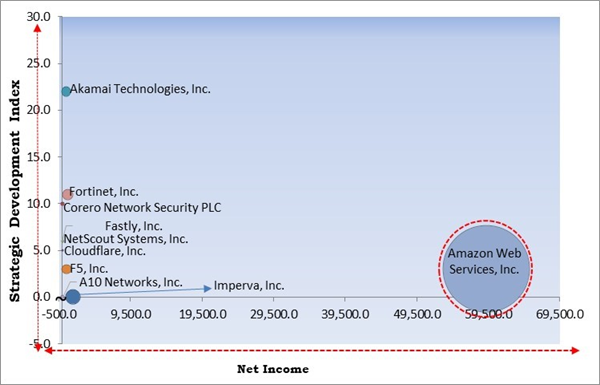
Based on the Analysis presented in the KBV Cardinal matrix; Amazon Web Services, Inc. is the forerunner in the Distributed Denial Of Service Protection Market. Companies such as Imperva, Inc., Fortinet, Inc., and F5, Inc. are some of the key innovators in Distributed Denial Of Service Protection Market. In June, 2025, Amazon Web Services, Inc. unveiled enhanced DDoS protection through AWS WAF, introducing new capabilities to identify and mitigate application-layer attacks. These features provide real-time visibility, automated mitigation, and greater customization, supporting organizations in improving web application resilience against sophisticated DDoS threats. This strengthens AWS’s role in the evolving DDoS Protection Market.
COVID-19 Impact Analysis
Before the COVID-19 pandemic, the Distributed Denial of Service (DDoS) Protection Market was gradually expanding due to increasing digital connectivity and rising cybersecurity awareness. During the pandemic, global lockdowns disrupted supply chains and delayed the deployment of hardware-based mitigation solutions. Cybersecurity teams also faced operational challenges while adapting to remote work, which impacted response coordination. Economic uncertainty caused some enterprises to postpone investments in DDoS protection services. However, rapid digitalization and remote connectivity increased the attack surface, raising awareness about DDoS threats. This led to innovation in scalable cloud-based protection and AI-driven threat detection. After the pandemic, the market recovered with renewed investments and stronger focus on resilient, automated cybersecurity infrastructures. Thus, the COVID-19 pandemic had positive impact on the Distributed Denial Of Service Protection Market, accelerating innovation while disrupting traditional operations.Driving and Restraining Factors
Drivers- Rapid Proliferation of IoT Devices Increasing Attack Surfaces and DDoS Vulnerabilities
- Escalation in Volume and Sophistication of DDoS Attacks
- Growing Awareness of Cybersecurity Risks and Regulatory Compliance Requirements
- Expansion of Cloud Infrastructure and Data Center Services
- High Cost and Complexity of Advanced DDoS Protection Solutions
- Regulatory and Compliance Challenges Hindering Market Development
- Technical Limitations and Infrastructure Gaps Affecting Solution Effectiveness
- Adaptive AI-Driven DDoS Mitigation Solutions
- Expansion of Cloud-Native and Edge-Based DDoS Defense Architectures
- Regulatory and Policy-Driven Demand for Enhanced DDoS Protections
- Escalating Complexity of DDoS Attack Vectors
- High-Cost Barriers and Resource-Intensive Infrastructure Demands
- Regulatory and Privacy Compliance Complexities Impacting Solution Deployment
Market Share Analysis
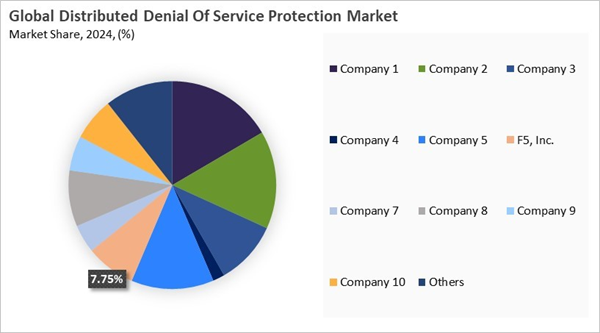
The leading players in the market are competing with diverse innovative offerings to remain competitive in the market. The above illustration shows the percentage of revenue shared by some of the leading companies in the market. The leading players of the market are adopting various strategies in order to cater demand coming from the different industries. The key developmental strategies in the market are Acquisitions, and Partnerships & Collaborations.
Enterprise size Outlook
Based on enterprise size, the Distributed Denial of Service Protection market is characterized into Large Enterprise and SMEs. The SMEs segment attained 36.39% revenue share in the Distributed Denial of Service Protection market in 2024. This segment is witnessing strong demand driven by increasing cyberattack exposure and growing digitalization among small businesses. Cost-effective cloud-based solutions are enabling wider adoption. Government initiatives and awareness programs are also supporting cybersecurity investments in this segment.Deployment Outlook
Based on deployment, the Distributed Denial of Service Protection market is characterized into Cloud and On-premises. The On-premises segment garnered 37.22% revenue share in the Distributed Denial of Service Protection market in 2024. This segment is witnessing considerable demand due to data control, privacy, and compliance requirements. Enterprises with legacy systems and strict regulatory needs prefer on-premises solutions. However, higher operational costs limit faster adoption compared to cloud deployment.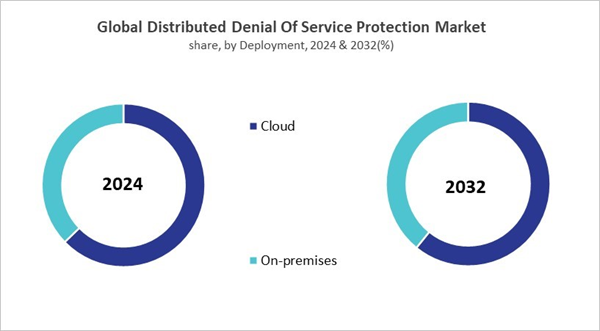
Regional Outlook
Region-wise, the Distributed Denial Of Service Protection market is analyzed across North America, Europe, Asia Pacific, and LAMEA. The North America segment recorded the largest revenue share of 36.70% in the Distributed Denial Of Service Protection market. The Distributed Denial of Service (DDoS) protection market is predicted to grow at a significant rate in North America and Europe. The market is driven by high cloud adoption, advanced digital infrastructure, and the strong presence of leading cybersecurity vendors. The region further benefits from frequent large-scale attacks targeting industries like healthcare, finance, and government, alongside strict regulatory frameworks that mandate robust cybersecurity practices. Organizations largely adopt cloud-native and hybrid mitigation solutions, focusing not only on prevention but also on recovery, resilience, and compliance. Furthermore, LAMEA’s market is expanding at a steady pace. The market is fueled by stringent regulatory initiatives like network security directives and data protection. Regional nations prioritize localized data handling and in-region mitigation capabilities because of data sovereignty concerns. Also, strong demand from telecom, BFSI, and public sector enterprises continues to drive the adoption of advanced DDoS protection solutions.In the Asia Pacific and LAMEA regions, the Distributed Denial of Service (DDoS) protection market is estimated to experience prominent growth. The market is propelled by expanding cloud infrastructure, rapid digital transformation, and rising cyberattack frequency across developing nations like China, India, and Southeast Asia. Enterprises and governments are investing largely in cloud-based and AI-driven mitigation solutions to secure telecom, e-commerce, and financial ecosystems. Additionally, the DDoS protection market is expected to offer lucrative opportunities in the LAMEA region. This is due to increasing awareness of cybersecurity risks, digitalization initiatives, and rising attack volumes, especially in government sectors.
Market Competition and Attributes
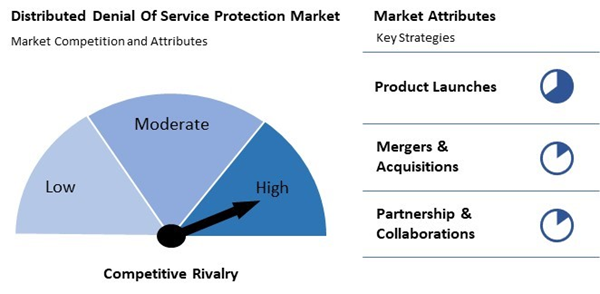
The Distributed Denial of Service (DDoS) Protection Market is characterized by intense competition due to the rising frequency and complexity of cyberattacks and the increasing dependence of organizations on digital infrastructure. Vendors compete by developing advanced protection technologies, including AI-driven threat detection, automated mitigation, and scalable cloud-based security solutions. Continuous innovation, service reliability, and the ability to manage large-scale attacks are key competitive factors. Additionally, growing demand from enterprises adopting cloud computing, IoT, and digital platforms is encouraging new market entrants and strengthening overall competitive dynamics.
Recent Strategies Deployed in the Market
- May-2025: Akamai Technologies, Inc. announced the partnership with P3M to enhance Zero Trust and Identity-Centric Access Management (ICAM) security for the UK’s government and defense sectors, strengthening resilience to cyber threats, including DDoS.
- May-2025: Corero Network Security PLC teamed up with Rocket Fiber to deploy real-time, automatic DDoS protection. This collaboration enhances Rocket Fiber’s infrastructure resilience, enabling secure and reliable connectivity for its customers. This collaboration highlights the growing demand for robust, scalable DDoS defense solutions in the broadband market.
- Apr-2025: Corero Network Security PLC teamed up with Juniper Networks, integrating Corero’s SmartWall Threat Defense into Juniper’s MX Series routers. This enables scalable, real-time DDoS mitigation at the network edge, delivering automated protection. The collaboration reflects rising enterprise interest in embedded DDoS defense across high-performance service provider infrastructure.
- Jan-2025: Fortinet, Inc. announced the acquisition of Perception Point enhances its threat detection capabilities, particularly against advanced threats including targeted DDoS campaigns. The integration of Perception Point's AI-driven technology strengthens Fortinet's end-to-end cybersecurity suite and underlines its focus on preemptive attack surface defense.
- Dec-2024: Akamai Technologies, Inc. announced that the acquisition of Select Edgio assets enhances its application and security portfolio, reinforcing its edge platform and strengthening DDoS protection capabilities across the global digital infrastructure.
List of Key Companies Profiled
- Cloudflare, Inc.
- Akamai Technologies, Inc.
- Imperva, Inc. (Thales Group S.A.)
- Corero Network Security PLC
- Amazon Web Services, Inc. (Amazon.com, Inc.)
- F5, Inc.
- A10 Networks, Inc.
- Fortinet, Inc.
- Fastly, Inc.
- NetScout Systems, Inc.
Market Report Segmentation
By Enterprise Size- Large Enterprise
- SMEs
- Cloud
- On-premises
- Software
- Services
- Hardware
- Network Security
- End-User Security
- Endpoint Security
- Database Security
- IT & Telecommunications
- BFSI
- Government & Public Sector
- Retail & E-commerce
- Manufacturing
- Healthcare
- Energy & Utilities
- Media & Entertainment
- Other End Use Industry
- North America
- US
- Canada
- Mexico
- Rest of North America
- Europe
- Germany
- UK
- France
- Russia
- Spain
- Italy
- Rest of Europe
- Asia Pacific
- China
- Japan
- India
- South Korea
- Singapore
- Malaysia
- Rest of Asia Pacific
- LAMEA
- Brazil
- Argentina
- UAE
- Saudi Arabia
- South Africa
- Nigeria
- Rest of LAMEA
Table of Contents
Chapter 1. Market Scope & Methodology
Chapter 2. Market at a Glance
Chapter 3. Market Overview
Chapter 4. Market Trends - Distributed Denial Of Service Protection Market
Chapter 5. State of Competition - Distributed Denial Of Service Protection Market
Chapter 6. Market Consolidation - Distributed Denial Of Service Protection Market
Chapter 7. Key Customer Criteria - Distributed Denial Of Service Protection Market
Chapter 8. Product Life Cycle - Distributed Denial Of Service Protection Market
Chapter 10. Competition Analysis - Global
Chapter 11. Global Distributed Denial Of Service Protection Market by Enterprise Size
Chapter 12. Global Distributed Denial Of Service Protection Market by Deployment
Chapter 13. Global Distributed Denial Of Service Protection Market by Component
Chapter 14. Global Distributed Denial Of Service Protection Market by Application
Chapter 15. Global Distributed Denial Of Service Protection Market by End Use Industry
Chapter 16. Global Distributed Denial Of Service Protection Market by Region
Chapter 17. Company Profiles
Companies Mentioned
- Cloudflare, Inc.
- Akamai Technologies, Inc.
- Imperva, Inc. (Thales Group S.A.)
- Corero Network Security PLC
- Amazon Web Services, Inc. (Amazon.com, Inc.)
- F5, Inc.
- A10 Networks, Inc.
- Fortinet, Inc.
- Fastly, Inc.
- NetScout Systems, Inc.


