



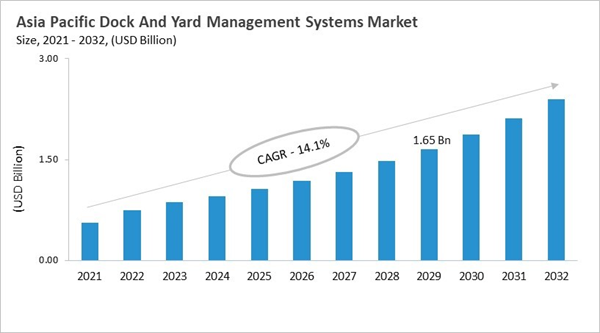
The Asia Pacific Dock And Yard Management Systems Market is expected to reach $1.65 billion by 2029 and is expected to witness market growth of 12.4% CAGR during the forecast period (2025-2032).
The China market dominated the Asia Pacific Dock And Yard Management Systems Market by country in 2024, and is expected to continue to be a dominant market till 2032; thereby, achieving a market value of $661.2 million by 2032. The Japan market is registering a CAGR of 11.6% during 2025-2032. Additionally, the India market is expected to showcase a CAGR of 13.1% during 2025-2032. The China and Japan led the Asia Pacific Dock And Yard Management Systems Market by Country with a market share of 31.5% and 17.7% in 2024. The Malaysia market is expected to witness a CAGR of 15.2% during throughout the forecast period.
The Asia Pacific Dock and Yard Management Systems Market has changed from manual, labor-intensive processes to highly advanced, technology-driven platforms that support complicated maritime logistics. At first, the market relied on simple record-keeping and early computerized systems for scheduling berths and handling cargo. As time went on, it adopted automation, real-time analytics, and connectivity solutions. The combination of IoT and cloud computing brought about a big change. It made it easier to see things, better use of resources, and better coordination between ports and yards. As trade volumes have grown, vessel capacities have increased, and regulatory requirements have become stricter; this evolution has continued. Today, the market is a mature ecosystem with integrated systems that support predictive maintenance, operational efficiency, and interoperability across the broader supply chain.
AI-driven automation, better real-time visibility, and a greater focus on sustainability and following the rules are some of the trends that are shaping the market right now. IoT-enabled systems make things clearer and let people make decisions ahead of time. Advanced analytics and automation technologies make handling cargo more efficient and lower operational risks. The push for environmentally friendly operations is also pushing dock and yard systems to include energy-efficient and emission-monitoring solutions. Market leaders are solidifying their positions by investing in cybersecurity and system interoperability, as well as through innovation, strategic partnerships, and localization strategies. The competitive landscape is still changing, with global companies using their technological know-how and regional companies focusing on customization and cost efficiency. Together, these companies are driving innovation and resilience in the Asia Pacific maritime logistics sector.
The China market dominated the Asia Pacific Dock And Yard Management Systems Market by country in 2024, and is expected to continue to be a dominant market till 2032; thereby, achieving a market value of $661.2 million by 2032. The Japan market is registering a CAGR of 11.6% during 2025-2032. Additionally, the India market is expected to showcase a CAGR of 13.1% during 2025-2032. The China and Japan led the Asia Pacific Dock And Yard Management Systems Market by Country with a market share of 31.5% and 17.7% in 2024. The Malaysia market is expected to witness a CAGR of 15.2% during throughout the forecast period.
The Asia Pacific Dock and Yard Management Systems Market has changed from manual, labor-intensive processes to highly advanced, technology-driven platforms that support complicated maritime logistics. At first, the market relied on simple record-keeping and early computerized systems for scheduling berths and handling cargo. As time went on, it adopted automation, real-time analytics, and connectivity solutions. The combination of IoT and cloud computing brought about a big change. It made it easier to see things, better use of resources, and better coordination between ports and yards. As trade volumes have grown, vessel capacities have increased, and regulatory requirements have become stricter; this evolution has continued. Today, the market is a mature ecosystem with integrated systems that support predictive maintenance, operational efficiency, and interoperability across the broader supply chain.
AI-driven automation, better real-time visibility, and a greater focus on sustainability and following the rules are some of the trends that are shaping the market right now. IoT-enabled systems make things clearer and let people make decisions ahead of time. Advanced analytics and automation technologies make handling cargo more efficient and lower operational risks. The push for environmentally friendly operations is also pushing dock and yard systems to include energy-efficient and emission-monitoring solutions. Market leaders are solidifying their positions by investing in cybersecurity and system interoperability, as well as through innovation, strategic partnerships, and localization strategies. The competitive landscape is still changing, with global companies using their technological know-how and regional companies focusing on customization and cost efficiency. Together, these companies are driving innovation and resilience in the Asia Pacific maritime logistics sector.
Component Outlook
Based on Component, the market is segmented into Software, Hardware and Services. With a compound annual growth rate (CAGR) of 10% over the projection period, the Software Market, dominate the China Dock And Yard Management Systems Market by Component in 2024 and would be a prominent market until 2032. The Services market is expected to witness a CAGR of 11.2% during 2025-2032.Deployment Mode Outlook
Based on Deployment Mode, the market is segmented into Cloud, On-Premises and Hybrid. The Cloud market segment dominated the Singapore Dock And Yard Management Systems Market by Deployment Mode is expected to grow at a CAGR of 14.1 % during the forecast period thereby continuing its dominance until 2032. Also, The Hybrid market is anticipated to grow as a CAGR of 14.9 % during the forecast period during 2025-2032.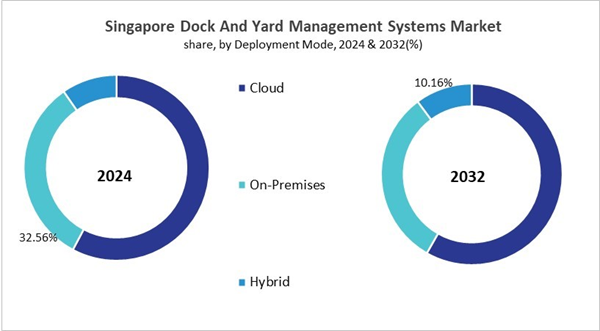
Country Outlook
The market for dock and yard management systems in China has changed from simple manual and digital operations to highly integrated, AI-driven platforms that can handle complicated port and logistics settings. The growth has been driven by more cargo being shipped, better automation, and the use of new technologies like IoT, 5G, and real-time tracking systems, which have made things more efficient, safer, and better use of resources. Some important trends are the quick adoption of AI-powered automation, a greater focus on sustainability and energy efficiency, and more digital integration across supply chains to improve coordination and resilience. Market leaders stress the importance of new ideas, strategic partnerships, and solutions that are specific to each port's infrastructure and regulatory needs. There is still a lot of competition between regional and global players, which is pushing the market to improve technology, make operations more efficient, and offer personalized services.List of Key Companies Profiled
- Zebra Technologies Corporation
- Oracle Corporation
- Informatica Inc.
- SAP SE
- Epicor Software Corporation
- Conduit, Inc.
- Manhattan Associates, Inc.
- Blue Yonder Group, Inc. (Panasonic Holdings Corporation)
- The Descartes Systems Group, Inc.
- Kaleris
Market Report Segmentation
By Component- Software
- Hardware
- Services
- Cloud
- On-Premises
- Hybrid
- Retail & E-commerce
- Manufacturing & 3PL
- Food & Beverages
- Automotive
- Pharmaceutical & Healthcare
- Other Industry Vertical
- China
- Japan
- India
- South Korea
- Singapore
- Malaysia
- Rest of Asia Pacific
Table of Contents
Chapter 1. Market Scope & Methodology
Chapter 2. Market at a Glance
Chapter 3. Market Overview
Chapter 4. Market Trends - Asia Pacific Dock and Yard Management Systems Market
Chapter 5. State of Competition - Asia Pacific Dock and Yard Management Systems Market
Chapter 6. Market Consolidation - Asia Pacific Dock and Yard Management Systems Market
Chapter 7. Key Customer Criteria - Asia Pacific Dock and Yard Management Systems Market
Chapter 8. Product Life Cycle - Asia Pacific Dock And yard Management Systems Market
Chapter 10. Competition Analysis - Global
Chapter 11. Asia Pacific Dock And Yard Management Systems Market by Component
Chapter 12. Asia Pacific Dock And Yard Management Systems Market by Deployment Mode
Chapter 13. Asia Pacific Dock And Yard Management Systems Market by Industry Vertical
Chapter 14. Asia Pacific Dock And Yard Management Systems Market by Country
Chapter 15. Company Profiles
Companies Mentioned
- Zebra Technologies Corporation
- Oracle Corporation
- Informatica Inc.
- SAP SE
- Epicor Software Corporation
- Conduit, Inc.
- Manhattan Associates, Inc.
- Blue Yonder Group, Inc. (Panasonic Holdings Corporation)
- The Descartes Systems Group, Inc.
- Kaleris


