



The Global Electric Boat Market size is estimated at $7.82 billion in 2025 and is expected to reach $18.75 billion by 2032, rising at a market growth of 13.3% CAGR during the forecast period (2025-2032). This growth is due to stricter environmental rules, more people using zero-emission marine transport, and improvements in battery technology and more people want to go boating for fun, the government is giving incentives, and the electric propulsion infrastructure is getting bigger.
The electric boat market has developed from early experimental efforts into a commercially viable industry driven by environmental priorities and technology innovation. Advancements in lithium-ion battery technology, power electronics and electric propulsion systems substantially enhanced performance, allowing faster charging, longer range, and greater reliability. Strict emissions regulations and rising environmental awareness further surged the transformation from combustion-powered boats to electric alternatives across both commercial and recreational sectors. The electric boat market is characterized by integrated software systems, scalable modular designs, and diversified applications across multiple vessel types.
The electric boat market is driven by key trends, including the adoption of high-voltage propulsion systems, which improve operational efficiency and power output, making electric boats more beneficial for commercial operators. The integration of vehicle-to-grid technologies and smart energy management is also transitioning energy utilization by allowing optimized charging and cost savings. Furthermore, the electric boat market is expanding into specialized segments like high-performance boats, widening consumer demand. The market seems to be intensively competitive, shaped by strategic partnerships, strong innovation, and geographical expansion, with companies focusing on collaborations, proprietary technologies, and infrastructure development.
The leading players in the market are competing with diverse innovative offerings to remain competitive in the market. The above illustration shows the percentage of revenue shared by some of the leading companies in the market. The leading players of the market are adopting various strategies in order to cater demand coming from the different industries. The key developmental strategies in the market are Acquisitions, and Partnerships & Collaborations.
The electric boat market is expected to witness noticeable expansion in the Asia Pacific and LAMEA regions. The market is driven by increasing marine tourism, rising urbanization, and supportive government initiatives in nations such as Japan, China, and Australia aimed at reducing fuel dependency and water pollution. Expanding domestic demand and cost-effective manufacturing capabilities are further strengthening the region’s market position. Additionally, the LAMEA region is also offering lucrative opportunities in the electric boat market. This is because of selective government initiatives and tourism-focused economies in the Middle East and Latin America. Marine electrification and rising investments in sustainable tourism are anticipated to support market expansion across the region.
Key Market Trends & Insights:
- The North America market dominated Global Electric Boat Market in 2024, accounting for a 38.90% revenue share in 2024.
- The U.S. market is projected to maintain its leadership in North America, reaching a market size of USD 4.93 billion by 2032.
- Among the Boat Type, the New Installation segment dominated the Europe market, contributing a revenue share of 59.88% in 2024.
- In terms of Battery Type, Lithium-Ion segment are expected to lead the Asia Pacific market, with a projected revenue share of 52.34% by 2032.
- The Passenger market emerged as the leading Application Type in 2024, capturing a 45.82% revenue share, and is projected to retain its dominance during the forecast period.
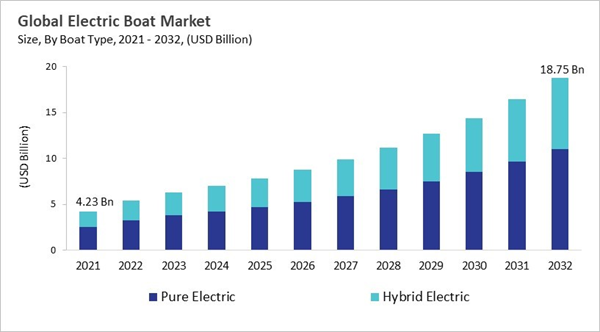
The electric boat market has developed from early experimental efforts into a commercially viable industry driven by environmental priorities and technology innovation. Advancements in lithium-ion battery technology, power electronics and electric propulsion systems substantially enhanced performance, allowing faster charging, longer range, and greater reliability. Strict emissions regulations and rising environmental awareness further surged the transformation from combustion-powered boats to electric alternatives across both commercial and recreational sectors. The electric boat market is characterized by integrated software systems, scalable modular designs, and diversified applications across multiple vessel types.
The electric boat market is driven by key trends, including the adoption of high-voltage propulsion systems, which improve operational efficiency and power output, making electric boats more beneficial for commercial operators. The integration of vehicle-to-grid technologies and smart energy management is also transitioning energy utilization by allowing optimized charging and cost savings. Furthermore, the electric boat market is expanding into specialized segments like high-performance boats, widening consumer demand. The market seems to be intensively competitive, shaped by strategic partnerships, strong innovation, and geographical expansion, with companies focusing on collaborations, proprietary technologies, and infrastructure development.
Driving and Restraining Factors
Drivers- Advancements In Battery Technology Enhancing Electric Boat Performance And Range
- Stringent Environmental Regulations Stimulating Shift To Electric Propulsion In Marine Sector
- Integration Of Smart Energy Management And V2G Technologies In Electric Marine Fleets
- Consumer Demand For Sustainable And Quiet Recreational Boating Experiences
- High Initial Investment And Operational Costs
- Regulatory And Certification Challenges
- Insufficient Charging Infrastructure And Energy Grid Limitations
- Grid-Integrated Electric Boats As Dual-Use Energy Assets
- Expansion Through Electrified Commercial Shuttle Services And Urban Water Transport
- Leveraging Advanced Manufacturing And Material Innovations For Performance And Cost Optimization
- High Capital Investment And Long Development Cycles
- Limited Charging Infrastructure And Range Constraints
- Battery Performance, Lifecycle, And Environmental Concerns
Market Share Analysis
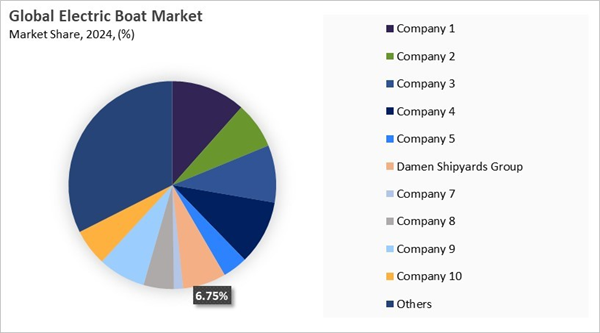
The leading players in the market are competing with diverse innovative offerings to remain competitive in the market. The above illustration shows the percentage of revenue shared by some of the leading companies in the market. The leading players of the market are adopting various strategies in order to cater demand coming from the different industries. The key developmental strategies in the market are Acquisitions, and Partnerships & Collaborations.
COVID-19 Impact Analysis
Before the COVID-19 pandemic, the electric boat market was growing steadily because of environmental rules and a growing interest in eco-friendly marine transport. The pandemic slowed down this progress by causing delays in the supply chain, limiting the workforce, and lowering demand for both leisure and business activities. This caused production to slow down and projects to be put on hold. But it also sped up the use of digital tools and remote monitoring technologies, which made design and maintenance more efficient. As more people wanted to boat in a way that was good for them and the environment, electric propulsion systems kept getting better. As the economy recovered, demand rose along with investments in green technologies and stronger supply chains. The pandemic had an adverse impact overall, even though it led to long-term improvements in technology and structure. In conclusion, the COVID-19 pandemic had a negative impact on the electric boat market.Boat Type Outlook
Based on Boat Type, the market is segmented into Pure Electric, and Hybrid Electric. The Hybrid Electric segment witnessed 40.18% revenue share in the Electric Boat Market. Hybrid electric boats offer a balanced approach by combining conventional fuel systems with electric propulsion, making them suitable for longer journeys and varied marine conditions. The flexibility, improved fuel efficiency, and reduced emissions associated with hybrid systems are driving their adoption.Battery Type Outlook
Based on Battery Type, the market is segmented into Lithium-Ion, Lead Acid, and Nickel-Based. The Lead Acid segment witnessed 27.09% revenue share in the Electric Boat Market. Lead acid batteries continue to be used due to their cost-effectiveness and established presence in the marine industry. They are particularly suitable for smaller vessels and applications where cost considerations are critical. However, ongoing improvements in battery performance and increasing demand for affordable energy storage solutions are supporting the steady usage of this segment.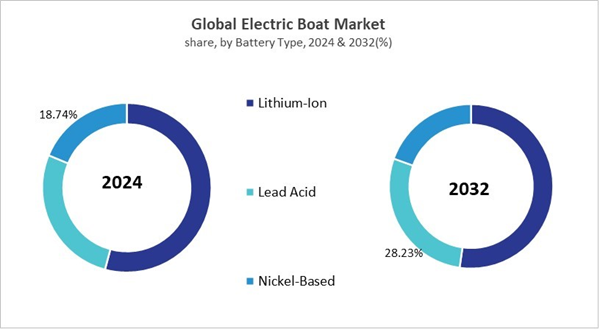
Regional Outlook
Region-wise, the Electric Boat Market is analyzed across North America, Europe, Asia Pacific, and LAMEA. The North America segment recorded 38.90% revenue share in the Electric Boat Market. In North America and Europe, the electric boat market is estimated to experience significant growth during the forecast period. The market is propelled by environmental awareness, strong regulatory frameworks, and well-established marine sectors. In North America, growth is driven by increasing recreational boating activities, rising investments in sustainable marine transport, and government incentives promoting zero-emission technologies. Early adoption of electric mobility solutions and the presence of advanced infrastructure have allowed faster commercialization of electric boats across commercial and leisure applications. Furthermore, Europe electric boat market is projected to capture prominent growth. Regional nations are leading in electrification because of strict emission norms and strong policy backing for clean waterways. The region’s emphasis on decarbonizing maritime transport, along with high consumer demand for luxury electric boats, continues to surge in deployment and innovation.The electric boat market is expected to witness noticeable expansion in the Asia Pacific and LAMEA regions. The market is driven by increasing marine tourism, rising urbanization, and supportive government initiatives in nations such as Japan, China, and Australia aimed at reducing fuel dependency and water pollution. Expanding domestic demand and cost-effective manufacturing capabilities are further strengthening the region’s market position. Additionally, the LAMEA region is also offering lucrative opportunities in the electric boat market. This is because of selective government initiatives and tourism-focused economies in the Middle East and Latin America. Marine electrification and rising investments in sustainable tourism are anticipated to support market expansion across the region.
Recent Strategies Deployed in the Market
- Jun-2024: Vision Marine Technologies Inc. teamed up with JetRide Holding, a revolutionary company that is on the cutting edge of the ride sharing industry to integrate E-Motion electric propulsion across 17 U.S. rental locations. This collaboration expands Vision’s presence in the shared-use marine market, promoting electric boating as an accessible, lifestyle-driven experience for recreational customers.
- Jan-2024: Yamaha Motor Co. Ltd. acquired Torqeedo, a German leader in electric marine propulsion. This acquisition supports Yamaha’s Marine CASE strategy, boosting its electric-vehicle capabilities for boats and reinforcing its carbon reduction goals within the growing clean and sustainable marine sector.
- Nov-2023: Wartsila Corporation announced the partnership with San Francisco’s WETA, a media company to supply battery-powered ferries under the REEF program. The five zero-emission vessels, including 150- and 300-passenger capacities, aim to enter service by 2025, advancing sustainable water transit in the United States.
- Mar-2023: Sanlorenzo S.p.A. acquired Sea Energy, Specializing in electrical systems for yachts, the investment enhances Sanlorenzo’s vertical integration and technological edge in electric and hybrid propulsion innovation, supporting future-ready marine solutions.
- Oct-2022: Yamaha Motor Co., Ltd. unveiled HARMO in Japan, an electric joystick-based boat-control system for eco-friendly, low-speed cruises. Targeted at sightseeing vessels, it enhances maneuverability while reducing emissions. Domestic trials are ongoing, and a European rollout is scheduled for spring 2022 as part of Yamaha’s clean marine strategy.
- Dec-2021: Navier Boats teamed up with Lyman-Morse to construct its first production hydrofoil, the Navier 27. The collaboration leverages Maine-based carbon-composite expertise, enabling domestic manufacturing and pushing forward electric, high-performance hydrofoil development in the U.S.
List of Key Companies Profiled
- Yamaha Motor Co., Ltd.
- HD Hyundai Heavy Industries Co., Ltd.
- Wartsila Corporation
- Brunswick Corporation
- Vision Marine Technologies Inc.
- Damen Shipyards Group
- Navier Boats
- Sanlorenzo S.p.A.
- Torqeedo GmbH
- General Dynamics Corporation (General Dynamics Electric Boat)
Market Report Segmentation
By Boat Type- Pure Electric
- Hybrid Electric
- Lithium-Ion
- Lead Acid
- Nickel-Based
- Passenger
- Cargo
- Other Application Type
- North America
- US
- Canada
- Mexico
- Rest of North America
- Europe
- Germany
- UK
- France
- Russia
- Spain
- Italy
- Rest of Europe
- Asia Pacific
- China
- Japan
- India
- South Korea
- Singapore
- Malaysia
- Rest of Asia Pacific
- LAMEA
- Brazil
- Argentina
- UAE
- Saudi Arabia
- South Africa
- Nigeria
- Rest of LAMEA
Table of Contents
Chapter 1. Market Scope & Methodology
Chapter 2. Market at a Glance
Chapter 3. Market Overview
Chapter 4. Market Trends - Electric Boat Market
Chapter 5. State of Competition - Electric Boat Market
Chapter 6. Market Consolidation - Electric Boat Market
Chapter 7. Key Customer Criteria - Electric Boat Market
Chapter 8. Product Life Cycle - Electric Boat Market
Chapter 10. Competition Analysis - Global
Chapter 11. Global Electric Boat Market by Boat Type
Chapter 12. Global Electric Boat Market by Battery Type
Chapter 13. Global Electric Boat Market by Application Type
Chapter 14. Global Electric Boat Market by Region
Chapter 15. Company Profiles
Companies Mentioned
- Yamaha Motor Co., Ltd.
- HD Hyundai Heavy Industries Co., Ltd.
- Wartsila Corporation
- Brunswick Corporation
- Vision Marine Technologies Inc.
- Damen Shipyards Group
- Navier Boats
- Sanlorenzo S.p.A.
- Torqeedo GmbH
- General Dynamics Corporation (General Dynamics Electric Boat)


