



The North America Glass-reinforced Substrate Market is expected to reach $256.02 million by 2027and is expected to witness market growth of 3.1% CAGR during the forecast period (2025-2032).
The US market dominated the North America Glass-reinforced Substrate Market by country in 2024, and is expected to continue to be a dominant market till 2032; thereby, achieving a market value of $199.7 million by 2032. The Canada market is experiencing a CAGR of 5.4% during 2025-2032. Additionally, the Mexico market is expected to exhibit a CAGR of 4.1% during 2025-2032. The US and Canada led the North America Glass-reinforced Substrate Market by Country with a market share of 72% and 11.8% in 2024.
The North America glass-reinforced substrate market grew to make substrates used in electronics and industrial applications stronger, more stable at high temperatures, and better at conducting electricity. Early innovations were about putting glass fibers into polymer matrices to make stronger composite materials that could replace brittle substrates that were used before. As time went on, better fiber technology and resin chemistry made things stick better, last longer, and work better. The market changed quickly as automotive electronics, electric vehicles, and advanced semiconductor packaging grew. Thin, stable substrates are needed for small, fast electronic devices.
Three big trends are shaping the market right now: the rise of high-frequency electronic packaging driven by 5G and AI computing, the growing use of environmentally friendly materials, and the need for highly reliable substrates as Industry 4.0 and IoT technologies come together. Key players work on innovation, partnerships, and making things locally to make themselves more competitive and lower the risks in the supply chain. Companies also spend money on new resin systems and advanced fabrication technologies to make their products work better with electricity and heat. Overall, competition strikes a balance between new technology and low costs while also broadening the use of technology in electronics, aerospace, and consumer devices.
The US market dominated the North America Glass-reinforced Substrate Market by country in 2024, and is expected to continue to be a dominant market till 2032; thereby, achieving a market value of $199.7 million by 2032. The Canada market is experiencing a CAGR of 5.4% during 2025-2032. Additionally, the Mexico market is expected to exhibit a CAGR of 4.1% during 2025-2032. The US and Canada led the North America Glass-reinforced Substrate Market by Country with a market share of 72% and 11.8% in 2024.
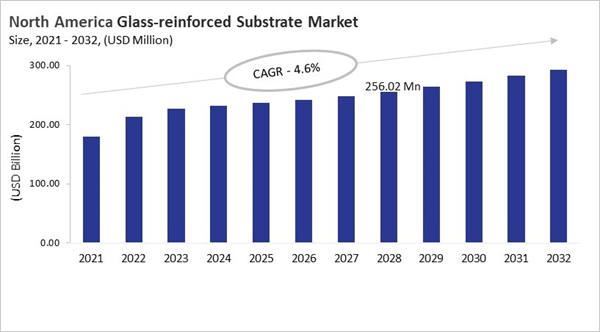
The North America glass-reinforced substrate market grew to make substrates used in electronics and industrial applications stronger, more stable at high temperatures, and better at conducting electricity. Early innovations were about putting glass fibers into polymer matrices to make stronger composite materials that could replace brittle substrates that were used before. As time went on, better fiber technology and resin chemistry made things stick better, last longer, and work better. The market changed quickly as automotive electronics, electric vehicles, and advanced semiconductor packaging grew. Thin, stable substrates are needed for small, fast electronic devices.
Three big trends are shaping the market right now: the rise of high-frequency electronic packaging driven by 5G and AI computing, the growing use of environmentally friendly materials, and the need for highly reliable substrates as Industry 4.0 and IoT technologies come together. Key players work on innovation, partnerships, and making things locally to make themselves more competitive and lower the risks in the supply chain. Companies also spend money on new resin systems and advanced fabrication technologies to make their products work better with electricity and heat. Overall, competition strikes a balance between new technology and low costs while also broadening the use of technology in electronics, aerospace, and consumer devices.
Substrate Type Outlook
Based on Substrate Type, the market is segmented into Glass-Reinforced Epoxy Laminates (FR-4), Glass-Reinforced BT Resin, Glass-Reinforced Polyimide, Glass-Reinforced Cyanate Ester, Glass-Reinforced PTFE and Other Substrate Type. Among various US Glass-reinforced Substrate Market by Substrate Type; The Glass-Reinforced Epoxy Laminates (FR-4) market achieved a market size of USD $73.4 Million in 2024 and is expected to grow at a CAGR of 1.8 % during the forecast period. The Glass-Reinforced Cyanate Ester market is predicted to experience a CAGR of 3.9% throughout the forecast period from (2025-2032).End-Use Industry Outlook
Based on End-Use Industry, the market is segmented into Consumer Electronics, Automotive, Telecommunications, Aerospace & Defense and Other End-Use Industry. With a compound annual growth rate (CAGR) of 4.7% over the projection period, the Consumer Electronics Market, dominate the Canada Glass-reinforced Substrate Market by End-Use Industry in 2024 and would be a prominent market until 2032. The Aerospace & Defense market is expected to witness a CAGR of 6.1% during 2025-2032.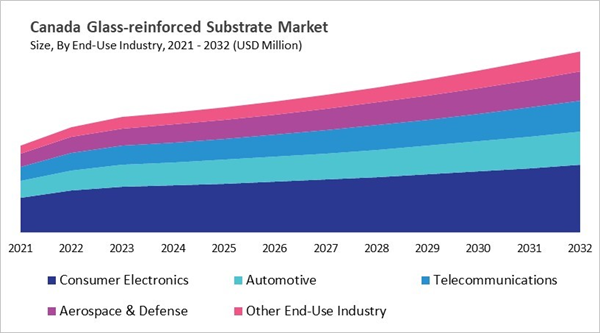
Country Outlook
The US glass-reinforced substrate market started when people tried to make semiconductor substrates work better than traditional organic materials could. Glass-reinforced substrates became more important because they are better at insulating, stronger, and more stable in size, especially as semiconductor designs got more complicated. Improvements in the production of ultra-thin glass wafers and fine patterning methods made it easier for advanced packaging technologies like EMIB and CoWoS to be used more widely for AI and high-performance computing chips. The market is changing because more people want high-density semiconductor packaging, more companies are using Industry 4.0 and IoT devices, and materials that are better for the environment are becoming more popular. To make sure they have enough supplies, top companies focus on research and development, forming strategic partnerships with semiconductor makers, and expanding their own production capacity. Investing in automation and smart manufacturing is also making things work better and making products of higher quality. Innovation in material formulations, precision manufacturing, and the ability to create custom substrate solutions for new chip architectures are what drive competition.List of Key Companies Profiled
- Corning Incorporated
- Schott AG (Carl-Zeiss-Stiftung)
- Nippon Express Co., Ltd.
- AGC, Inc.
- Saint-Gobain Group
- Hoya Corporation
- Ohara Inc.
- Shenzhen Laibao High Tech Co., Ltd.
- PLANOPTIK AG
- BOE Technology Group Co., Ltd.
Market Report Segmentation
By Application- Printed Circuit Boards (PCBs)
- IC Packaging Substrates
- RF & Microwave Components
- Automotive Electronic Modules
- Other Application
- Glass-Reinforced Epoxy Laminates (FR-4)
- Glass-Reinforced BT Resin
- Glass-Reinforced Polyimide
- Glass-Reinforced Cyanate Ester
- Glass-Reinforced PTFE
- Other Substrate Type
- Consumer Electronics
- Automotive
- Telecommunications
- Aerospace & Defense
- Other End-Use Industry
- mm - 0.5 mm
- 0.5 mm - 1 mm
- ≤ 0.1 mm
- ≥ 1 mm
- US
- Canada
- Mexico
- Rest of North America
Table of Contents
Chapter 1. Market Scope & Methodology
Chapter 2. Market at a Glance
Chapter 3. Market Overview
Chapter 4. Market Trends - North America Glass-reinforced Substrate Market
Chapter 5. State of Competition - North America Glass-reinforced Substrate Market
Chapter 6. Market Consolidation - North America Glass-reinforced Substrate Market
Chapter 7. Key Customer Criteria - North America Glass-reinforced Substrate Market
Chapter 8. Product Life Cycle - North America Glass-reinforced Substrate Market
Chapter 10. Competition Analysis - Global
Chapter 11. North America Glass-reinforced Substrate Market by Application
Chapter 12. North America Glass-reinforced Substrate Market by Substrate Type
Chapter 13. North America Glass-reinforced Substrate Market by End-Use Industry
Chapter 14. North America Glass-reinforced Substrate Market by Thickness
Chapter 15. North America Glass-reinforced Substrate Market by Country
Chapter 16. Company Profiles
Companies Mentioned
- Corning Incorporated
- Schott AG (Carl-Zeiss-Stiftung)
- Nippon Express Co., Ltd.
- AGC, Inc.
- Saint-Gobain Group
- Hoya Corporation
- Ohara Inc.
- Shenzhen Laibao High Tech Co., Ltd.
- PLANOPTIK AG
- BOE Technology Group Co., Ltd.


