



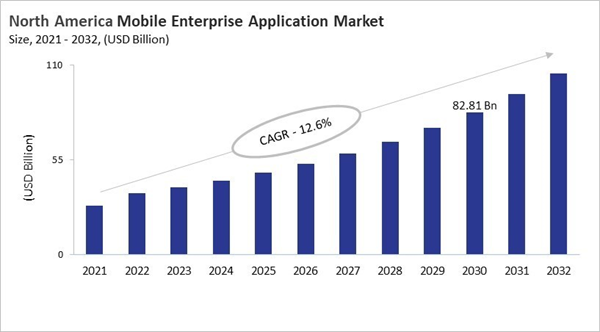
The North America Mobile Enterprise Application Market is expected to reach $82.81 billion by 2030 and is expected to witness market growth of 12.0% CAGR during the forecast period (2025-2032).
The US market dominated the North America Mobile Enterprise Application Market by country in 2024, and is expected to continue to be a dominant market till 2032; thereby, achieving a market value of $82.57 billion by 2032. The Canada market is experiencing a CAGR of 15.3% during 2025-2032. Additionally, the Mexico market is expected to exhibit a CAGR of 13.7% during 2025-2032. The US and Canada led the North America Mobile Enterprise Application Market by Country with a market share of 82.2% and 8% in 2024.
The North American Mobile Enterprise Application Market has come a long way since its beginnings in the early 2000s, when companies first experimented with basic mobile features, such as email and productivity tools. The switch from 3G to 4G networks, combined with advancements in mobile hardware, enabled the creation of more complex, purpose-built apps that support tasks such as field service, supply chain management, and customer engagement. The widespread use of smartphones, tablets, and Bring Your Own Device (BYOD) policies made enterprise mobility even faster. Cloud computing made it easier to scale and be flexible. The market changed over time from basic mobile communication to fully integrated, process-driven solutions. Today, it boasts a mature ecosystem that focuses on secure, compliant, and highly customizable apps, which boost productivity across a wide range of industries.
Key trends are currently shaping the market. For example, there is a growing focus on digital identity and advanced authentication methods. This is happening due to increased concerns about cybersecurity and regulatory pressures. Super apps are making business operations more efficient and user-friendly by combining many functions into a single platform. Additionally, the rollout of 5G technology is enabling the processing of data in real-time and its utilization for advanced applications, such as augmented reality and remote diagnostics. Market leaders are responding by developing new ideas in AI, biometrics, and strategic partnerships. They are also ensuring that they follow the rules and develop solutions that work in specific areas. The competitive landscape is always changing, with global innovation capabilities and regional expertise balancing each other out. Success depends on providing secure, scalable, and cost-effective solutions that meet the changing needs of businesses.
The US market dominated the North America Mobile Enterprise Application Market by country in 2024, and is expected to continue to be a dominant market till 2032; thereby, achieving a market value of $82.57 billion by 2032. The Canada market is experiencing a CAGR of 15.3% during 2025-2032. Additionally, the Mexico market is expected to exhibit a CAGR of 13.7% during 2025-2032. The US and Canada led the North America Mobile Enterprise Application Market by Country with a market share of 82.2% and 8% in 2024.
The North American Mobile Enterprise Application Market has come a long way since its beginnings in the early 2000s, when companies first experimented with basic mobile features, such as email and productivity tools. The switch from 3G to 4G networks, combined with advancements in mobile hardware, enabled the creation of more complex, purpose-built apps that support tasks such as field service, supply chain management, and customer engagement. The widespread use of smartphones, tablets, and Bring Your Own Device (BYOD) policies made enterprise mobility even faster. Cloud computing made it easier to scale and be flexible. The market changed over time from basic mobile communication to fully integrated, process-driven solutions. Today, it boasts a mature ecosystem that focuses on secure, compliant, and highly customizable apps, which boost productivity across a wide range of industries.
Key trends are currently shaping the market. For example, there is a growing focus on digital identity and advanced authentication methods. This is happening due to increased concerns about cybersecurity and regulatory pressures. Super apps are making business operations more efficient and user-friendly by combining many functions into a single platform. Additionally, the rollout of 5G technology is enabling the processing of data in real-time and its utilization for advanced applications, such as augmented reality and remote diagnostics. Market leaders are responding by developing new ideas in AI, biometrics, and strategic partnerships. They are also ensuring that they follow the rules and develop solutions that work in specific areas. The competitive landscape is always changing, with global innovation capabilities and regional expertise balancing each other out. Success depends on providing secure, scalable, and cost-effective solutions that meet the changing needs of businesses.
Type Outlook
Based on Type, the market is segmented into Native Apps, Hybrid Apps, and Web Apps. Among various US Mobile Enterprise Application Market by Type; The Native Apps market achieved a market size of USD $14.09 billion in 2024 and is expected to grow at a CAGR of 10.8 % during the forecast period. The Web Apps market is predicted to experience a CAGR of 11.7% throughout the forecast period from (2025-2032).Deployment Outlook
Based on Deployment, the market is segmented into Cloud-based, and On-premise. The Cloud-based market segment dominated the Canada Mobile Enterprise Application Market by Deployment is expected to grow at a CAGR of 14.9 % during the forecast period thereby continuing its dominance until 2032. Also, The On-premise market is anticipated to grow as a CAGR of 16.4 % during the forecast period during 2025-2032.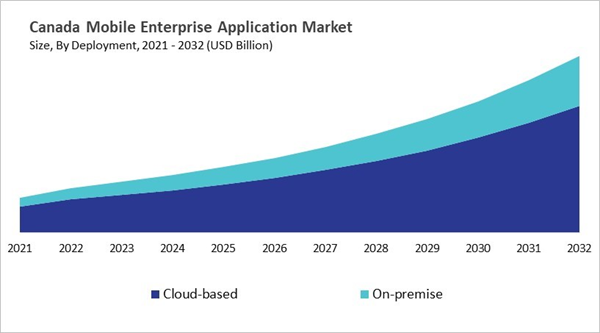
Country Outlook
In the early 2000s, the U.S. mobile enterprise application market was limited to basic communication and task-oriented mobile tools. Now, improvements in smartphones, cloud computing, and high-speed networks have created a complex ecosystem. Cross-platform frameworks and cloud technologies enable scalable, secure, feature-rich applications that handle complex business tasks and provide real-time data access. Key trends include the rise of cloud-native apps, increased use of AI and machine learning for analytics and automation, and a strong focus on security and compliance. Leading companies stay competitive through innovation, strategic partnerships, and flexible development. The landscape balances global firms leveraging technology with regional companies offering specialized, compliance-driven solutions. Together, these companies foster continued creativity and growth.List of Key Companies Profiled
- IBM Corporation
- Microsoft Corporation
- Oracle Corporation
- Infosys Limited
- Capgemini SE
- Accenture PLC
- SAP SE
- Tata Consultancy Services Ltd.
- Apple Inc.
- AT&T Inc.
Market Report Segmentation
By Type- Native Apps
- Hybrid Apps
- Web Apps
- CRM
- ERP
- Collaboration Tools
- Analytics & Reporting
- Other Application
- Cloud-based
- On-premise
- IT & Telecom
- BFSI
- Retail & E-commerce
- Healthcare
- Manufacturing
- Other Industry
- US
- Canada
- Mexico
- Rest of North America
Table of Contents
Chapter 1. Market Scope & Methodology
Chapter 2. Market at a Glance
Chapter 3. Market Overview
Chapter 4. Market Trends - North America Mobile Enterprise Application Market
Chapter 5. State of Competition - North America Mobile Enterprise Application Market
Chapter 6. Market Consolidation - North America Mobile Enterprise Application Market
Chapter 7. Key Customer Criteria - North America Mobile Enterprise Application Market
Chapter 8. Product Life Cycle - North America Mobile Enterprise Application Market
Chapter 9. Value Chain Analysis of Mobile Enterprise Application Market
Chapter 10. Competition Analysis - Global
Chapter 11. North America Mobile Enterprise Application Market by Type
Chapter 12. North America Mobile Enterprise Application Market by Application
Chapter 13. North America Mobile Enterprise Application Market by Deployment
Chapter 14. North America Mobile Enterprise Application Market by Industry
Chapter 15. North America Mobile Enterprise Application Market by Country
Chapter 16. Company Profiles
Companies Mentioned
- IBM Corporation
- Microsoft Corporation
- Oracle Corporation
- Infosys Limited
- Capgemini SE
- Accenture PLC
- SAP SE
- Tata Consultancy Services Ltd.
- Apple Inc.
- AT&T Inc.


