



The Asia Pacific Mobile Enterprise Application Market is expected to reach $44.21 billion by 2027 and is expected to witness market growth of 13.2% CAGR during the forecast period (2025-2032).
The China market dominated the Asia Pacific Mobile Enterprise Application Market by country in 2024, and is expected to continue to be a dominant market till 2032; thereby, achieving a market value of $23.79 billion by 2032. The Japan market is registering a CAGR of 12.4% during 2025-2032. Additionally, the India market is expected to showcase a CAGR of 13.9% during 2025-2032. The China and Japan led the Asia Pacific Mobile Enterprise Application Market by Country with a market share of 32.4% and 17.4% in 2024. The Malaysia market is expected to witness a CAGR of 15.9% during throughout the forecast period.
Since it was first introduced in the late 2000s, the Asia Pacific Mobile Enterprise Application Market has changed a lot. It has gone from simple communication and data collection tools to more advanced, integrated digital solutions. Early adoption was limited by the fact that not many people had smartphones, and there were proprietary systems. However, the rapid growth of telecom infrastructure and cheap devices sped up enterprise mobility. With the rise of cloud computing and fast networks like 4G and 5G, it became possible to create scalable, high-performance applications that could handle complicated tasks like real-time collaboration, customer relationship management (CRM), and supply chain management. AI and data analytics made these apps even smarter by turning them into intelligent platforms that could automate tasks and give users personalized experiences. The region's varied levels of digital maturity and regulatory environment also encouraged localized innovation, which created a market ecosystem that is always changing and adapting.
Some of the most important trends that are driving the market right now are AI-powered automation, more 5G connectivity, and a greater focus on data security and compliance. Companies are using machine learning and real-time data to boost productivity and operational efficiency. At the same time, 5G is making new uses possible, like IoT integration and remote operations. To strengthen their presence in the market, top players are using strategies based on cloud-native architectures, strategic partnerships, and localization. Competitive dynamics show a balance between global companies that offer advanced technology and regional companies that offer cheap, tailored solutions. This interaction, along with constant innovation and changes in the law, makes sure that mobile enterprise applications will continue to grow and become more important in many different industries in the Asia Pacific region.
The China market dominated the Asia Pacific Mobile Enterprise Application Market by country in 2024, and is expected to continue to be a dominant market till 2032; thereby, achieving a market value of $23.79 billion by 2032. The Japan market is registering a CAGR of 12.4% during 2025-2032. Additionally, the India market is expected to showcase a CAGR of 13.9% during 2025-2032. The China and Japan led the Asia Pacific Mobile Enterprise Application Market by Country with a market share of 32.4% and 17.4% in 2024. The Malaysia market is expected to witness a CAGR of 15.9% during throughout the forecast period.
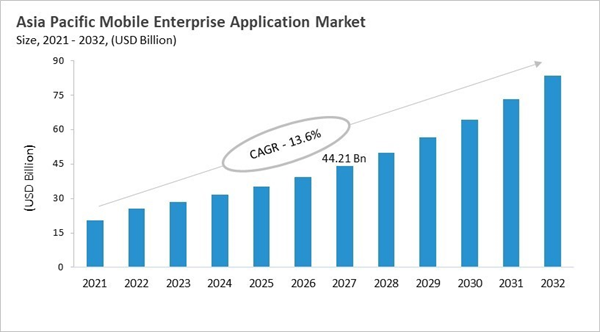
Since it was first introduced in the late 2000s, the Asia Pacific Mobile Enterprise Application Market has changed a lot. It has gone from simple communication and data collection tools to more advanced, integrated digital solutions. Early adoption was limited by the fact that not many people had smartphones, and there were proprietary systems. However, the rapid growth of telecom infrastructure and cheap devices sped up enterprise mobility. With the rise of cloud computing and fast networks like 4G and 5G, it became possible to create scalable, high-performance applications that could handle complicated tasks like real-time collaboration, customer relationship management (CRM), and supply chain management. AI and data analytics made these apps even smarter by turning them into intelligent platforms that could automate tasks and give users personalized experiences. The region's varied levels of digital maturity and regulatory environment also encouraged localized innovation, which created a market ecosystem that is always changing and adapting.
Some of the most important trends that are driving the market right now are AI-powered automation, more 5G connectivity, and a greater focus on data security and compliance. Companies are using machine learning and real-time data to boost productivity and operational efficiency. At the same time, 5G is making new uses possible, like IoT integration and remote operations. To strengthen their presence in the market, top players are using strategies based on cloud-native architectures, strategic partnerships, and localization. Competitive dynamics show a balance between global companies that offer advanced technology and regional companies that offer cheap, tailored solutions. This interaction, along with constant innovation and changes in the law, makes sure that mobile enterprise applications will continue to grow and become more important in many different industries in the Asia Pacific region.
Application Outlook
Based on Application, the market is segmented into CRM, ERP, Collaboration Tools, Analytics & Reporting, and Other Application. Among various China Mobile Enterprise Application Market by Application; The CRM market achieved a market size of USD $2.61 billion in 2024 and is expected to grow at a CAGR of 10.2 % during the forecast period. The Analytics & Reporting market is predicted to experience a CAGR of 12.4% throughout the forecast period from (2025-2032).Deployment Outlook
Based on Deployment, the market is segmented into Cloud-based, and On-premise. The Cloud-based market segment dominated the Singapore Mobile Enterprise Application Market by Deployment is expected to grow at a CAGR of 14.8 % during the forecast period thereby continuing its dominance until 2032. Also, The On-premise market is anticipated to grow as a CAGR of 16.3 % during the forecast period during 2025-2032.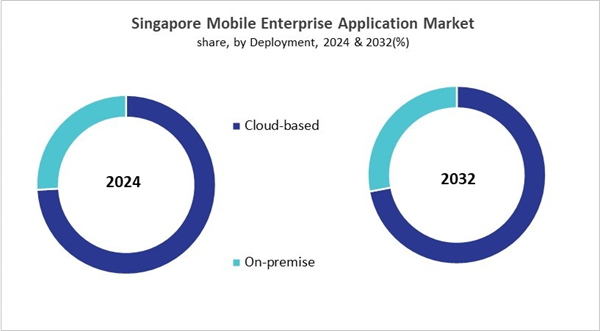
Country Outlook
The China Mobile Enterprise Application Market has come a long way since its beginnings in the early 2000s. Back then, it was limited by a lack of awareness, a low number of smartphones, and basic functionality. Now, it is a very advanced ecosystem thanks to the widespread use of 4G and 5G networks, cloud computing, and AI integration. Key trends that are shaping the market today include the use of AI-powered autonomous systems to improve operational efficiency, the growth of superapps that allow for integrated enterprise workflows, and strict data localization rules that encourage secure and compliant solutions. Leading companies stay competitive by making smart investments in AI, forming partnerships across industries, and using strong localization strategies that take into account cultural and regulatory needs. Domestic companies with regulatory advantages are the most competitive, while global companies only work with a few others. In this fast-changing and dynamic field, market leadership is defined by innovation, compliance, and ecosystem integration.List of Key Companies Profiled
- IBM Corporation
- Microsoft Corporation
- Oracle Corporation
- Infosys Limited
- Capgemini SE
- Accenture PLC
- SAP SE
- Tata Consultancy Services Ltd.
- Apple Inc.
- AT&T Inc.
Market Report Segmentation
By Type- Native Apps
- Hybrid Apps
- Web Apps
- CRM
- ERP
- Collaboration Tools
- Analytics & Reporting
- Other Application
- Cloud-based
- On-premise
- IT & Telecom
- BFSI
- Retail & E-commerce
- Healthcare
- Manufacturing
- Other Industry
- China
- Japan
- India
- South Korea
- Singapore
- Malaysia
- Rest of Asia Pacific
Table of Contents
Chapter 1. Market Scope & Methodology
Chapter 2. Market at a Glance
Chapter 3. Market Overview
Chapter 4. Market Trends - Asia Pacific Mobile Enterprise Application Market
Chapter 5. State of Competition - Asia Pacific Mobile Enterprise Application Market
Chapter 6. Market Consolidation - Asia Pacific Mobile Enterprise Application Market
Chapter 7. Key Customer Criteria - Asia Pacific Mobile Enterprise Application Market
Chapter 8. Product Life Cycle - Mobile Enterprise Application Market
Chapter 9. Value Chain Analysis of Mobile Enterprise Application Market
Chapter 10. Competition Analysis - Global
Chapter 11. Asia Pacific Mobile Enterprise Application Market by Type
Chapter 12. Asia Pacific Mobile Enterprise Application Market by Application
Chapter 13. Asia Pacific Mobile Enterprise Application Market by Deployment
Chapter 14. Asia Pacific Mobile Enterprise Application Market by Industry
Chapter 15. Asia Pacific Mobile Enterprise Application Market by Country
Chapter 16. Company Profiles
Companies Mentioned
- IBM Corporation
- Microsoft Corporation
- Oracle Corporation
- Infosys Limited
- Capgemini SE
- Accenture PLC
- SAP SE
- Tata Consultancy Services Ltd.
- Apple Inc.
- AT&T Inc.


