



The Latin America, Middle East and Africa Mobile Enterprise Application Market is expected to reach $17.27 billion by 2028 and is expected to witness market growth of 14.2% CAGR during the forecast period (2025-2032).
The Brazil market dominated the LAMEA Mobile Enterprise Application Market by country in 2024, and is expected to continue to be a dominant market till 2032; thereby, achieving a market value of $7.30 billion by 2032. The Argentina market is showcasing a CAGR of 15.5% during 2025-2032. Additionally, the UAE market would register a CAGR of 12.8% during 2025-2032. The Brazil and Saudi Arabia led the LAMEA Mobile Enterprise Application Market by Country with a market share of 26.9% and 13.3% in 2024. The Nigeria market is expected to witness a CAGR of 15.6% during throughout the forecast period.
The LAMEA Mobile Enterprise Application Market has changed a lot since it started out as a simple set of tools for field operations that let people talk to each other and get data. Now, it supports all of the functions of an enterprise. The growth of mobile network infrastructure, the rise in smartphone use, and the development of technologies like cloud computing and high-speed connectivity have all contributed to this change. The addition of artificial intelligence has been a major turning point because it allows for real-time analytics, automation, and smart decision-making on mobile platforms. Digitalization efforts in areas like logistics, retail, and financial services have also sped up the use of mobile enterprise apps. These apps are now a key part of business agility and operational efficiency in a wide range of economic settings.
Some important trends in the market are the increasing use of AI and machine learning, the growing focus on secure mobile platforms, and the growth of localized cloud services to meet data sovereignty needs. Vendors are putting more and more emphasis on innovation by offering modular, customizable solutions and forming strategic partnerships with telecom operators and cloud providers to make their products more adaptable to different regions. The competitive landscape is a mix of global technology leaders who offer advanced features and scalability, and regional players who use their knowledge of the local market and regulations to their advantage. This dynamic encourages constant innovation, with security, customization, and integration capabilities being the main ways to stand out. This makes sure that businesses can easily meet changing operational and compliance needs.
The Brazil market dominated the LAMEA Mobile Enterprise Application Market by country in 2024, and is expected to continue to be a dominant market till 2032; thereby, achieving a market value of $7.30 billion by 2032. The Argentina market is showcasing a CAGR of 15.5% during 2025-2032. Additionally, the UAE market would register a CAGR of 12.8% during 2025-2032. The Brazil and Saudi Arabia led the LAMEA Mobile Enterprise Application Market by Country with a market share of 26.9% and 13.3% in 2024. The Nigeria market is expected to witness a CAGR of 15.6% during throughout the forecast period.
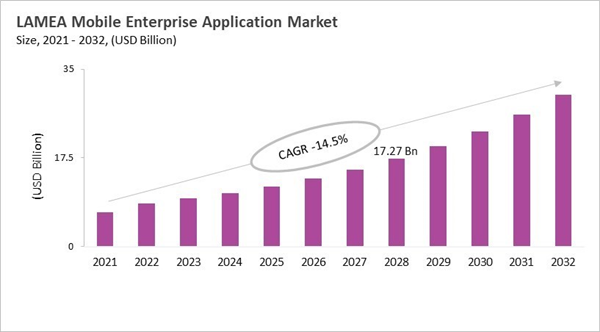
The LAMEA Mobile Enterprise Application Market has changed a lot since it started out as a simple set of tools for field operations that let people talk to each other and get data. Now, it supports all of the functions of an enterprise. The growth of mobile network infrastructure, the rise in smartphone use, and the development of technologies like cloud computing and high-speed connectivity have all contributed to this change. The addition of artificial intelligence has been a major turning point because it allows for real-time analytics, automation, and smart decision-making on mobile platforms. Digitalization efforts in areas like logistics, retail, and financial services have also sped up the use of mobile enterprise apps. These apps are now a key part of business agility and operational efficiency in a wide range of economic settings.
Some important trends in the market are the increasing use of AI and machine learning, the growing focus on secure mobile platforms, and the growth of localized cloud services to meet data sovereignty needs. Vendors are putting more and more emphasis on innovation by offering modular, customizable solutions and forming strategic partnerships with telecom operators and cloud providers to make their products more adaptable to different regions. The competitive landscape is a mix of global technology leaders who offer advanced features and scalability, and regional players who use their knowledge of the local market and regulations to their advantage. This dynamic encourages constant innovation, with security, customization, and integration capabilities being the main ways to stand out. This makes sure that businesses can easily meet changing operational and compliance needs.
Type Outlook
Based on Type, the market is segmented into Native Apps, Hybrid Apps, and Web Apps. The Native Apps market segment dominated the South Africa Mobile Enterprise Application Market by Type is expected to grow at a CAGR of 14.8 % during the forecast period thereby continuing its dominance until 2032. Also, The Web Apps market is anticipated to grow as a CAGR of 15.8 % during the forecast period during 2025-2032.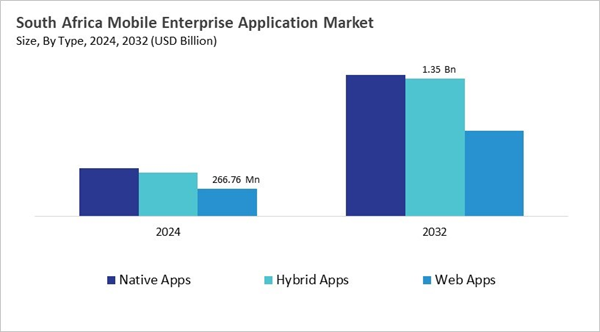
Application Outlook
Based on Application, the market is segmented into CRM, ERP, Collaboration Tools, Analytics & Reporting, and Other Application. Among various Argentina Mobile Enterprise Application Market by Application; The CRM market achieved a market size of USD $254 Million in 2024 and is expected to grow at a CAGR of 14.4 % during the forecast period. The Analytics & Reporting market is predicted to experience a CAGR of 16.7% throughout the forecast period from (2025-2032).Country Outlook
The Brazilian Mobile Enterprise Application Market has changed along with the country's digital transformation. At first, it was driven by more people using mobile devices and more people getting online. Later, it sped up because of improvements in 3G and 4G infrastructure. The market has changed from simple enterprise access solutions to complex, cloud-based apps that use AI, IoT, and advanced security features. These apps are now essential for digitizing businesses in many important sectors. Real-time analytics integration, strict regulatory compliance requirements, and the move toward cloud-native architectures are all changing how applications work and how they are deployed. While investing in new technologies like 5G and biometrics, industry leaders are focusing on innovation, strategic partnerships, and expanding into new areas. The competitive landscape shows a balance between global scalability and local customization. Both multinational and regional companies compete by offering different products and pricing strategies. Overall, the market is made up of mobile solutions that are safe, scalable, and very flexible, which is in line with Brazil's changing rules and technology.List of Key Companies Profiled
- IBM Corporation
- Microsoft Corporation
- Oracle Corporation
- Infosys Limited
- Capgemini SE
- Accenture PLC
- SAP SE
- Tata Consultancy Services Ltd.
- Apple Inc.
- AT&T Inc.
Market Report Segmentation
By Type- Native Apps
- Hybrid Apps
- Web Apps
- CRM
- ERP
- Collaboration Tools
- Analytics & Reporting
- Other Application
- Cloud-based
- On-premise
- IT & Telecom
- BFSI
- Retail & E-commerce
- Healthcare
- Manufacturing
- Other Industry
- Brazil
- Argentina
- UAE
- Saudi Arabia
- South Africa
- Nigeria
- Rest of LAMEA
Table of Contents
Chapter 1. Market Scope & Methodology
Chapter 2. Market at a Glance
Chapter 3. Market Overview
Chapter 4. Market Trends - LAMEA Mobile Enterprise Application Market
Chapter 6. State of Competition - LAMEA Mobile Enterprise Application Market
Chapter 7. Market Consolidation - LAMEA Mobile Enterprise Application Market
Chapter 8. Key Customer Criteria - LAMEA Mobile Enterprise Application Market
Chapter 9. Product Life Cycle - LAMEA Mobile Enterprise Application Market
Chapter 10. Value Chain Analysis of Mobile Enterprise Application Market
Chapter 11. Competition Analysis - Global
Chapter 12. LAMEA Mobile Enterprise Application Market by Type
Chapter 13. LAMEA Mobile Enterprise Application Market by Application
Chapter 14. LAMEA Mobile Enterprise Application Market by Deployment
Chapter 15. LAMEA Mobile Enterprise Application Market by Industry
Chapter 16. LAMEA Mobile Enterprise Application Market by Country
Chapter 17. Company Profiles
Companies Mentioned
- IBM Corporation
- Microsoft Corporation
- Oracle Corporation
- Infosys Limited
- Capgemini SE
- Accenture PLC
- SAP SE
- Tata Consultancy Services Ltd.
- Apple Inc.
- AT&T Inc.


