



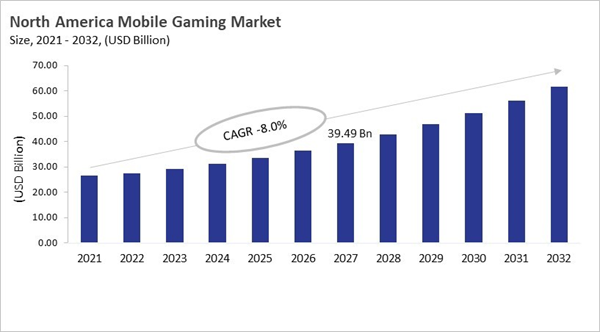
The North America Mobile Gaming Market is expected to reach $39.49 billion by 2027 and is expected to witness market growth of 9.1% CAGR during the forecast period (2025-2032).
The US market dominated the North America Mobile Gaming Market by country in 2024, and is expected to continue to be a dominant market till 2032; thereby, achieving a market value of $48.97 billion by 2032. The Canada market is experiencing a CAGR of 12.2% during 2025-2032. Additionally, the Mexico market is expected to exhibit a CAGR of 10.9% during 2025-2032. The US and Canada led the North America Mobile Gaming Market by Country with a market share of 83.2% and 8% in 2024.
The North American mobile gaming market has undergone significant changes. It has evolved from simple, casual games to a complex, tech-driven ecosystem that is growing as more people use smartphones, access high-speed internet like 4G and 5G, and seek more digital entertainment that is easy to access. The integration of cutting-edge technologies, such as cloud gaming, augmented reality, and social connectivity, has significantly enhanced user experiences, making gaming more immersive and accessible to a broader audience. Additionally, the rise of flexible ways to earn money, such as in-app purchases and subscription services, has made it easier to generate revenue and engage users more effectively. Government programs that help build digital infrastructure and OEMs that continually improve their devices have further fueled market growth. Mobile gaming has become a significant component of the broader digital entertainment industry.
Some of the most significant trends in the market include the rapid growth of cloud gaming, the increasing popularity of social and multiplayer games, and the rise of mobile esports. All of these things make users more interested and help the market grow. Leading companies are utilizing innovative, partnership-based, and data-driven marketing strategies to expand their content portfolios and increase revenue. They are also utilizing hybrid monetization frameworks to reach a broader audience and generate more revenue. The competitive landscape remains dynamic, characterized by fierce competition between established companies and emerging developers, ongoing product innovation, and strategic partnerships. Additionally, following the rules and protecting people's privacy have become crucial for building brand trust and achieving long-term success. This demonstrates the importance of being flexible and prioritizing the user to sustain growth in the North American mobile gaming ecosystem.
The US market dominated the North America Mobile Gaming Market by country in 2024, and is expected to continue to be a dominant market till 2032; thereby, achieving a market value of $48.97 billion by 2032. The Canada market is experiencing a CAGR of 12.2% during 2025-2032. Additionally, the Mexico market is expected to exhibit a CAGR of 10.9% during 2025-2032. The US and Canada led the North America Mobile Gaming Market by Country with a market share of 83.2% and 8% in 2024.
The North American mobile gaming market has undergone significant changes. It has evolved from simple, casual games to a complex, tech-driven ecosystem that is growing as more people use smartphones, access high-speed internet like 4G and 5G, and seek more digital entertainment that is easy to access. The integration of cutting-edge technologies, such as cloud gaming, augmented reality, and social connectivity, has significantly enhanced user experiences, making gaming more immersive and accessible to a broader audience. Additionally, the rise of flexible ways to earn money, such as in-app purchases and subscription services, has made it easier to generate revenue and engage users more effectively. Government programs that help build digital infrastructure and OEMs that continually improve their devices have further fueled market growth. Mobile gaming has become a significant component of the broader digital entertainment industry.
Some of the most significant trends in the market include the rapid growth of cloud gaming, the increasing popularity of social and multiplayer games, and the rise of mobile esports. All of these things make users more interested and help the market grow. Leading companies are utilizing innovative, partnership-based, and data-driven marketing strategies to expand their content portfolios and increase revenue. They are also utilizing hybrid monetization frameworks to reach a broader audience and generate more revenue. The competitive landscape remains dynamic, characterized by fierce competition between established companies and emerging developers, ongoing product innovation, and strategic partnerships. Additionally, following the rules and protecting people's privacy have become crucial for building brand trust and achieving long-term success. This demonstrates the importance of being flexible and prioritizing the user to sustain growth in the North American mobile gaming ecosystem.
End-User Outlook
Based on End-User, the market is segmented into Male, and Female. With a compound annual growth rate (CAGR) of 11.9% over the projection period, the Male Market, dominate the Canada Mobile Gaming Market by End-User in 2024 and would be a prominent market until 2032. The Female market is expected to witness a CAGR of 12.6% during 2025-2032.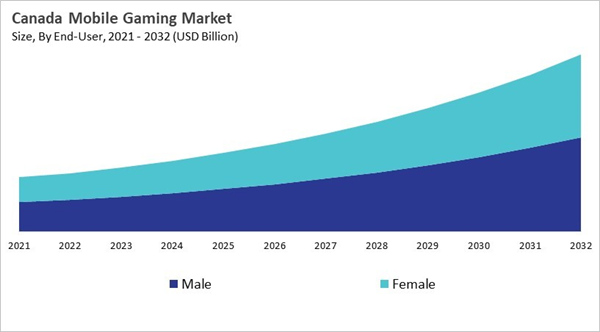
Business Model Outlook
Based on Business Model, the market is segmented into In-App Purchases, Advertising, and Paid Purchases. The In-App Purchases market segment dominated the US Mobile Gaming Market by Business Model is expected to grow at a CAGR of 8 % during the forecast period thereby continuing its dominance until 2032. Also, The Paid Purchases market is anticipated to grow as a CAGR of 10 % during the forecast period during 2025-2032.Country Outlook
The US mobile gaming market has rapidly evolved from basic, casual games to sophisticated, immersive experiences. This transformation is driven by widespread smartphone adoption, advances in mobile technology, and robust app distribution platforms. Game development constantly progresses, introducing features such as real-time multiplayer, AI-powered personalization, and high-fidelity graphics. These advancements have deepened player engagement and expanded the gaming audience. Emerging trends like cloud gaming, AR/VR integration, and social connectivity are reshaping user interaction and monetization models, including subscriptions and in-app purchases. Market leaders leverage data analytics, strategic alliances, and diverse revenue streams to maintain competitiveness and long-term user retention. Despite relatively low entry barriers, the market remains intensely competitive. To stay ahead, companies must innovate, foster community engagement, and adapt to regulatory shifts. Overall, the sector is a vibrant and forward-thinking segment of the US entertainment industry.List of Key Companies Profiled
- Apple, Inc.
- Hulu, LLC (The Walt Disney Company)
- Electronic Arts, Inc.
- Microsoft Corporation
- Nintendo Co., Ltd.
- Sony Corporation
- Tencent Holdings Ltd.
- Google LLC (Alphabet Inc.)
- Take-Two Interactive Software, Inc.
- Rovio Entertainment Corporation
Market Report Segmentation
By End-User- Male
- Female
- In-App Purchases
- Advertising
- Paid Purchases
- Android
- iOS
- Other Platform
- Role Playing (RPG)
- Action
- Shooter
- Puzzle
- Strategy
- Simulation
- Other Game Type
- US
- Canada
- Mexico
- Rest of North America
Table of Contents
Chapter 1. Market Scope & Methodology
Chapter 2. Market at a Glance
Chapter 3. Market Overview
Chapter 4. Market Trends
Chapter 5. State of Competition
Chapter 6. Market Consolidation
Chapter 7. Key Customer Criteria
Chapter 8. Product Life Cycle
Chapter 10. Competition Analysis - Global
Chapter 11. North America Mobile Gaming Market by End-User
Chapter 12. North America Mobile Gaming Market by Business Model
Chapter 13. North America Mobile Gaming Market by Platform
Chapter 14. North America Mobile Gaming Market by Game Type
Chapter 15. North America Mobile Gaming Market by Country
Chapter 16. Company Profiles
Companies Mentioned
- Apple, Inc.
- Hulu, LLC (The Walt Disney Company)
- Electronic Arts, Inc.
- Microsoft Corporation
- Nintendo Co., Ltd.
- Sony Corporation
- Tencent Holdings Ltd.
- Google LLC (Alphabet Inc.)
- Take-Two Interactive Software, Inc.
- Rovio Entertainment Corporation


