



The Europe Mobile Gaming Market is expected to reach $47.38 billion by 2031 and is expected to witness market growth of 9.6% CAGR during the forecast period (2025-2032).
The Germany market dominated the Europe Mobile Gaming Market by country in 2024, and is expected to continue to be a dominant market till 2032; thereby, achieving a market value of $9.96 billion by 2032. The UK market is exhibiting a CAGR of 8.6% during 2025-2032. Additionally, the France market is expected to experience a CAGR of 10.4% during 2025-2032. The Germany and UK led the Europe Mobile Gaming Market by Country with a market share of 21.3% and 18.8% in 2024. The Italy market is expected to witness a CAGR of 10.3% during throughout the forecast period.
The European mobile gaming market has grown from simple apps for feature phones to a very complex ecosystem driven by smartphones and supported by widespread 3G, 4G, and new 5G connectivity. This new technology has made it possible for multiplayer gaming to happen without any problems, for people to interact with each other in real time, and for cloud-based gaming services to become more popular. All of these things have greatly increased user engagement in the area. Mobile gaming has become a major form of entertainment because so many people are using smartphones and tablets. At the same time, strict European rules, especially about data protection and content standards, have forced developers to focus on following the rules and building trust with users. Europe's cultural diversity has also led to strong localization strategies, which have led to a wide range of gaming content that is specific to each region. Technologies like artificial intelligence, augmented reality, and virtual reality are always changing, which is making mobile gaming even more exciting and pushing the limits of what is possible.
Hyper-casual games are growing quickly because they are easy to play and have the potential to go viral. At the same time, cloud technologies are making cross-platform gaming experiences more popular. Sustainable monetization strategies are also becoming more popular. Companies are finding ways to make money from free-to-play games while still following the rules. Top companies are improving their market position by having a wide range of products, forming strategic partnerships, and putting money into new technologies like AI and 5G-enabled gaming. The competitive landscape is still very fluid, with global corporations, mid-sized companies, and startups all competing on innovation, user engagement, and following the rules. The market as a whole shows that it is technologically advanced and driven by new ideas. To keep growing, businesses need to be flexible, adapt to local conditions, and follow the rules.
The Germany market dominated the Europe Mobile Gaming Market by country in 2024, and is expected to continue to be a dominant market till 2032; thereby, achieving a market value of $9.96 billion by 2032. The UK market is exhibiting a CAGR of 8.6% during 2025-2032. Additionally, the France market is expected to experience a CAGR of 10.4% during 2025-2032. The Germany and UK led the Europe Mobile Gaming Market by Country with a market share of 21.3% and 18.8% in 2024. The Italy market is expected to witness a CAGR of 10.3% during throughout the forecast period.
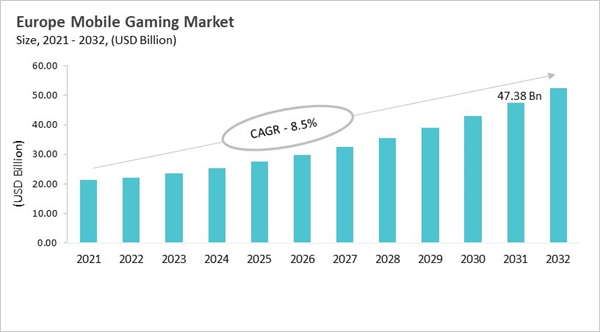
The European mobile gaming market has grown from simple apps for feature phones to a very complex ecosystem driven by smartphones and supported by widespread 3G, 4G, and new 5G connectivity. This new technology has made it possible for multiplayer gaming to happen without any problems, for people to interact with each other in real time, and for cloud-based gaming services to become more popular. All of these things have greatly increased user engagement in the area. Mobile gaming has become a major form of entertainment because so many people are using smartphones and tablets. At the same time, strict European rules, especially about data protection and content standards, have forced developers to focus on following the rules and building trust with users. Europe's cultural diversity has also led to strong localization strategies, which have led to a wide range of gaming content that is specific to each region. Technologies like artificial intelligence, augmented reality, and virtual reality are always changing, which is making mobile gaming even more exciting and pushing the limits of what is possible.
Hyper-casual games are growing quickly because they are easy to play and have the potential to go viral. At the same time, cloud technologies are making cross-platform gaming experiences more popular. Sustainable monetization strategies are also becoming more popular. Companies are finding ways to make money from free-to-play games while still following the rules. Top companies are improving their market position by having a wide range of products, forming strategic partnerships, and putting money into new technologies like AI and 5G-enabled gaming. The competitive landscape is still very fluid, with global corporations, mid-sized companies, and startups all competing on innovation, user engagement, and following the rules. The market as a whole shows that it is technologically advanced and driven by new ideas. To keep growing, businesses need to be flexible, adapt to local conditions, and follow the rules.
End-User Outlook
Based on End-User, the market is segmented into Male, and Female. With a compound annual growth rate (CAGR) of 7.8% over the projection period, the Male Market, dominate the Germany Mobile Gaming Market by End-User in 2024 and would be a prominent market until 2032. The Female market is expected to witness a CAGR of 8.4% during 2025-2032.Business Model Outlook
Based on Business Model, the market is segmented into In-App Purchases, Advertising, and Paid Purchases. Among various UK Mobile Gaming Market by Business Model; The In-App Purchases market achieved a market size of USD $3.05 billion in 2024 and is expected to grow at a CAGR of 8.2 % during the forecast period. The Paid Purchases market is predicted to experience a CAGR of 10.4% throughout the forecast period from (2025-2032).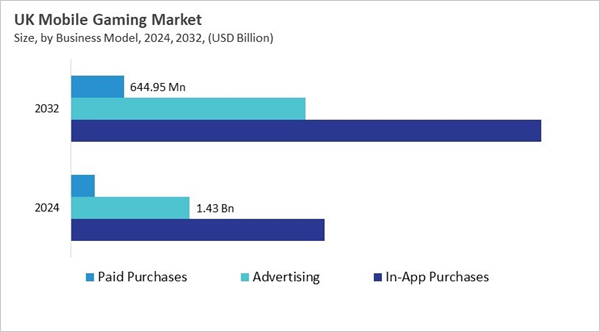
Country Outlook
The mobile gaming market in Germany has grown into a mature and dynamic ecosystem thanks to the widespread use of smartphones, advanced network infrastructure, and strong consumer demand for high-quality, immersive gaming experiences. There are many different types of content available in the market, thanks to both global developers and local studios. These include free-to-play games, subscriptions, and in-game purchases. Some important trends are personalized experiencesList of Key Companies Profiled
- Apple, Inc.
- Hulu, LLC (The Walt Disney Company)
- Electronic Arts, Inc.
- Microsoft Corporation
- Nintendo Co., Ltd.
- Sony Corporation
- Tencent Holdings Ltd.
- Google LLC (Alphabet Inc.)
- Take-Two Interactive Software, Inc.
- Rovio Entertainment Corporation
Market Report Segmentation
By End-User- Male
- Female
- In-App Purchases
- Advertising
- Paid Purchases
- Android
- iOS
- Other Platform
- Role Playing (RPG)
- Action
- Shooter
- Puzzle
- Strategy
- Simulation
- Other Game Type
- Germany
- UK
- France
- Russia
- Spain
- Italy
- Rest of Europe
Table of Contents
Chapter 1. Market Scope & Methodology
Chapter 2. Market at a Glance
Chapter 3. Market Overview
Chapter 4. Market Trends
Chapter 5. State of Competition
Chapter 6. Market Consolidation
Chapter 7. Key Customer Criteria
Chapter 8. Product Life Cycle
Chapter 10. Competition Analysis - Global
Chapter 11. Europe Mobile Gaming Market by End-User
Chapter 12. Europe Mobile Gaming Market by Business Model
Chapter 13. Europe Mobile Gaming Market by Platform
Chapter 14. Europe Mobile Gaming Market by Game Type
Chapter 15. Europe Mobile Gaming Market by Country
Chapter 16. Company Profiles
Companies Mentioned
- Apple, Inc.
- Hulu, LLC (The Walt Disney Company)
- Electronic Arts, Inc.
- Microsoft Corporation
- Nintendo Co., Ltd.
- Sony Corporation
- Tencent Holdings Ltd.
- Google LLC (Alphabet Inc.)
- Take-Two Interactive Software, Inc.
- Rovio Entertainment Corporation


