



The Asia Pacific Mobile Gaming Market is expected to reach $99.89 billion by 2029 and is expected to witness market growth of 10.2% CAGR during the forecast period (2025-2032).
The China market dominated the Asia Pacific Mobile Gaming Market by country in 2024, and is expected to continue to be a dominant market till 2032; thereby, achieving a market value of $52.52 billion by 2032. The Japan market is registering a CAGR of 9.5% during 2025-2032. Additionally, the India market is expected to showcase a CAGR of 11.3% during 2025-2032. The China and Japan led the Asia Pacific Mobile Gaming Market by Country with a market share of 42.5% and 19.7% in 2024. The Malaysia market is expected to witness a CAGR of 13.6% during throughout the forecast period.
The Asia Pacific mobile gaming market has become a very active and quickly growing part of the digital entertainment industry. This is because a lot of people have smartphones, internet connections have gotten better, and the population is young and tech-savvy. What started as a simple gaming environment has grown into a complex world with a wide range of genres, including multiplayer online battle arenas, role-playing games, and augmented reality experiences. The growth of 4G and 5G networks, along with government programs that support digital infrastructure, has made games much better and easier to access. Additionally, rising disposable incomes and the growing adoption of mobile payment systems have strengthened monetization through in-app purchases and subscription-based models, contributing to sustained market growth.
Cloud gaming, artificial intelligence, and machine learning are some of the advanced technologies that are changing the market by improving personalization, performance, and security. The fast growth of esports and competitive mobile gaming, thanks to sponsorships and media partnerships, has made the industry even more visible and engaged. Companies are using strategic partnerships, regional partnerships, and data-driven insights to grow their businesses and make their products more appealing to different cultural markets in the Asia Pacific. The competition is still fierce, with global and regional companies focusing on new ideas, localized content, and community-driven engagement strategies like social media integration and influencer marketing to stay strong in this changing ecosystem.
The China market dominated the Asia Pacific Mobile Gaming Market by country in 2024, and is expected to continue to be a dominant market till 2032; thereby, achieving a market value of $52.52 billion by 2032. The Japan market is registering a CAGR of 9.5% during 2025-2032. Additionally, the India market is expected to showcase a CAGR of 11.3% during 2025-2032. The China and Japan led the Asia Pacific Mobile Gaming Market by Country with a market share of 42.5% and 19.7% in 2024. The Malaysia market is expected to witness a CAGR of 13.6% during throughout the forecast period.
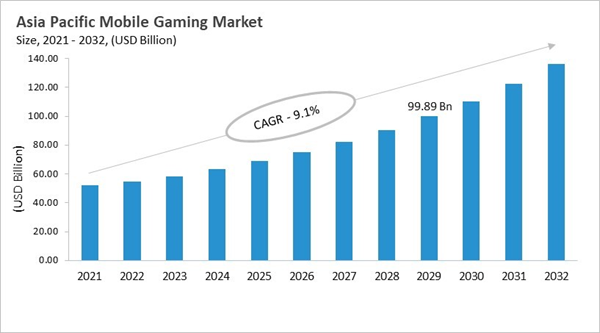
The Asia Pacific mobile gaming market has become a very active and quickly growing part of the digital entertainment industry. This is because a lot of people have smartphones, internet connections have gotten better, and the population is young and tech-savvy. What started as a simple gaming environment has grown into a complex world with a wide range of genres, including multiplayer online battle arenas, role-playing games, and augmented reality experiences. The growth of 4G and 5G networks, along with government programs that support digital infrastructure, has made games much better and easier to access. Additionally, rising disposable incomes and the growing adoption of mobile payment systems have strengthened monetization through in-app purchases and subscription-based models, contributing to sustained market growth.
Cloud gaming, artificial intelligence, and machine learning are some of the advanced technologies that are changing the market by improving personalization, performance, and security. The fast growth of esports and competitive mobile gaming, thanks to sponsorships and media partnerships, has made the industry even more visible and engaged. Companies are using strategic partnerships, regional partnerships, and data-driven insights to grow their businesses and make their products more appealing to different cultural markets in the Asia Pacific. The competition is still fierce, with global and regional companies focusing on new ideas, localized content, and community-driven engagement strategies like social media integration and influencer marketing to stay strong in this changing ecosystem.
Business Model Outlook
Based on Business Model, the market is segmented into In-App Purchases, Advertising, and Paid Purchases. With a compound annual growth rate (CAGR) of 8.4% over the projection period, the In-App Purchases Market, dominate the China Mobile Gaming Market by Business Model in 2024 and would be a prominent market until 2032. The Paid Purchases market is expected to witness a CAGR of 10.7% during 2025-2032.Platform Outlook
Based on Platform, the market is segmented into Android, iOS, and Other Platform. The Android market segment dominated the Singapore Mobile Gaming Market by Platform is expected to grow at a CAGR of 12.9 % during the forecast period thereby continuing its dominance until 2032. Also, The Other Platform market is anticipated to grow as a CAGR of 14.6 % during the forecast period during 2025-2032.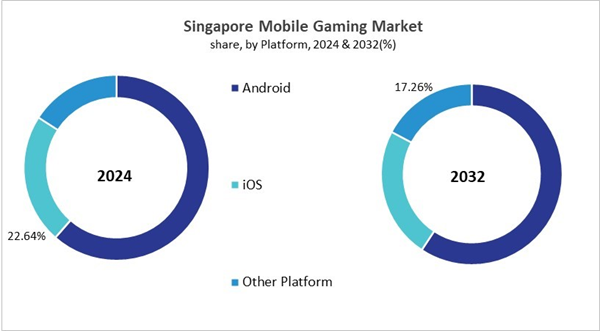
Country Outlook
The China Mobile Gaming Market has become a global leader thanks to the widespread use of smartphones, better mobile connectivity, and strong domestic development skills that make games that are both culturally relevant and technologically advanced. Regulatory frameworks that affect content and user engagement, especially among younger audiences, also shape the market's growth. Key trends like cross-platform integration, social and community-driven gameplay, and the use of cutting-edge technologies like AI, AR, and cloud gaming are changing how people play games and making them available to more people. Leading companies are using intellectual property development, data-driven personalization, and hybrid monetization models to stay ahead of the competition while following the rules. Also, the sector's plans for global growth and localized services show that it wants to go beyond its own borders. In general, the market is still very competitive and dynamic, with constant innovation, strategic partnerships, and the ability to adapt to changing technology and policy environments.List of Key Companies Profiled
- Apple, Inc.
- Hulu, LLC (The Walt Disney Company)
- Electronic Arts, Inc.
- Microsoft Corporation
- Nintendo Co., Ltd.
- Sony Corporation
- Tencent Holdings Ltd.
- Google LLC (Alphabet Inc.)
- Take-Two Interactive Software, Inc.
- Rovio Entertainment Corporation
Market Report Segmentation
By End-User- Male
- Female
- In-App Purchases
- Advertising
- Paid Purchases
- Android
- iOS
- Other Platform
- Role Playing (RPG)
- Action
- Shooter
- Puzzle
- Strategy
- Simulation
- Other Game Type
- China
- Japan
- India
- South Korea
- Singapore
- Malaysia
- Rest of Asia Pacific
Table of Contents
Chapter 1. Market Scope & Methodology
Chapter 2. Market at a Glance
Chapter 3. Market Overview
Chapter 4. Market Trends
Chapter 5. State of Competition
Chapter 6. Market Consolidation
Chapter 7. Key Customer Criteria
Chapter 8. Product Life Cycle
Chapter 10. Competition Analysis - Global
Chapter 11. Asia Pacific Mobile Gaming Market by End-User
Chapter 12. Asia Pacific Mobile Gaming Market by Business Model
Chapter 13. Asia Pacific Mobile Gaming Market by Platform
Chapter 14. Asia Pacific Mobile Gaming Market by Game Type
Chapter 15. Asia Pacific Mobile Gaming Market by Country
Chapter 16. Company Profiles
Companies Mentioned
- Apple, Inc.
- Hulu, LLC (The Walt Disney Company)
- Electronic Arts, Inc.
- Microsoft Corporation
- Nintendo Co., Ltd.
- Sony Corporation
- Tencent Holdings Ltd.
- Google LLC (Alphabet Inc.)
- Take-Two Interactive Software, Inc.
- Rovio Entertainment Corporation


