



The Latin America, Middle East and Africa Mobile Gaming Market is expected to reach $8.14 billion by 2028 and is expected to witness market growth of 12.1% CAGR during the forecast period (2025-2032).
The Brazil market dominated the LAMEA Mobile Gaming Market by country in 2024, and is expected to continue to be a dominant market till 2032; thereby, achieving a market value of $3.45 billion by 2032. The Argentina market is showcasing a CAGR of 12.8% during 2025-2032. Additionally, the UAE market would register a CAGR of 10.7% during 2025-2032. The Brazil and Saudi Arabia led the LAMEA Mobile Gaming Market by Country with a market share of 28.8% and 14.4% in 2024. The Nigeria market is expected to witness a CAGR of 13.8% during throughout the forecast period.
The mobile gaming market in LAMEA has changed quickly because more people are getting smartphones, telecom infrastructure is getting better, and digital inclusion programs are spreading across Latin America, the Middle East, and Africa. The market has changed a lot since it was limited by poor connectivity and access to devices. This is because cheap smartphones are now widely available, and 4G and 5G networks are getting better. Cloud gaming and other technological advances have made hardware less important, making it easier for more people to enjoy high-quality gaming. Also, the rise of digital payment systems has made monetization channels stronger, and the growing number of young people continues to drive demand for a wide range of interesting and fun games that are tailored to regional tastes.
Localization, social gaming, and strategic collaboration are very important to the market. More and more, developers are making content that is relevant to different cultures and using multiplayer, eSports, and community-driven features to keep users interested and coming back. Top companies are teaming up with local developers and telecom providers to make sure that their products are distributed in the best way possible and that they fit with the way the market works in each region. At the same time, there is still a lot of competition, with global companies bringing technical know-how and local developers coming up with new ideas that fit with their culture. The LAMEA mobile gaming ecosystem is still growing and coming up with new ideas because of the changing competitive landscape, data-driven marketing, and flexible monetization strategies.
The Brazil market dominated the LAMEA Mobile Gaming Market by country in 2024, and is expected to continue to be a dominant market till 2032; thereby, achieving a market value of $3.45 billion by 2032. The Argentina market is showcasing a CAGR of 12.8% during 2025-2032. Additionally, the UAE market would register a CAGR of 10.7% during 2025-2032. The Brazil and Saudi Arabia led the LAMEA Mobile Gaming Market by Country with a market share of 28.8% and 14.4% in 2024. The Nigeria market is expected to witness a CAGR of 13.8% during throughout the forecast period.
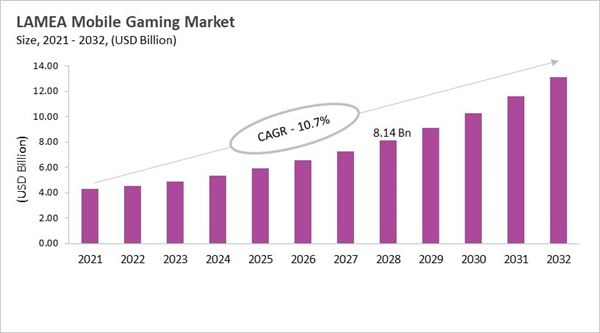
The mobile gaming market in LAMEA has changed quickly because more people are getting smartphones, telecom infrastructure is getting better, and digital inclusion programs are spreading across Latin America, the Middle East, and Africa. The market has changed a lot since it was limited by poor connectivity and access to devices. This is because cheap smartphones are now widely available, and 4G and 5G networks are getting better. Cloud gaming and other technological advances have made hardware less important, making it easier for more people to enjoy high-quality gaming. Also, the rise of digital payment systems has made monetization channels stronger, and the growing number of young people continues to drive demand for a wide range of interesting and fun games that are tailored to regional tastes.
Localization, social gaming, and strategic collaboration are very important to the market. More and more, developers are making content that is relevant to different cultures and using multiplayer, eSports, and community-driven features to keep users interested and coming back. Top companies are teaming up with local developers and telecom providers to make sure that their products are distributed in the best way possible and that they fit with the way the market works in each region. At the same time, there is still a lot of competition, with global companies bringing technical know-how and local developers coming up with new ideas that fit with their culture. The LAMEA mobile gaming ecosystem is still growing and coming up with new ideas because of the changing competitive landscape, data-driven marketing, and flexible monetization strategies.
End-User Outlook
Based on End-User, the market is segmented into Male, and Female. The Male market segment dominated the Brazil Mobile Gaming Market by End-User is expected to grow at a CAGR of 10.5 % during the forecast period thereby continuing its dominance until 2032. Also, The Female market is anticipated to grow as a CAGR of 11.1 % during the forecast period during 2025-2032.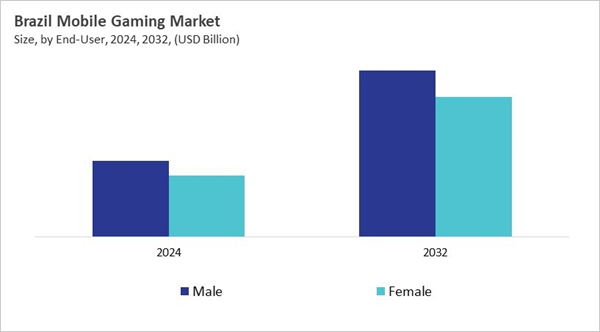
Business Model Outlook
Based on Business Model, the market is segmented into In-App Purchases, Advertising, and Paid Purchases. The In-App Purchases market segment dominated the South Africa Mobile Gaming Market by Business Model is expected to grow at a CAGR of 12.7 % during the forecast period thereby continuing its dominance until 2032. Also, The Paid Purchases market is anticipated to grow as a CAGR of 18.1 % during the forecast period during 2025-2032.Country Outlook
The mobile gaming market in Brazil has changed quickly because more people are using smartphones, the internet is getting better, and the population is young and digitally connected. It has changed from a place for casual games to a rich ecosystem with advanced genres, competitive multiplayer formats, and immersive experiences. Mobile esports are growing, advanced payment systems are making it easier to make money, and there is a growing focus on content that is relevant to local cultures. These are some of the main trends that are shaping the market. Market leaders are using partnerships, data analysis, and strategies to get people involved in their communities to keep users and grow their reach. Strong competition between global and domestic players continues to drive innovation and investment, even though there are problems with regulations and infrastructure. Overall, the market is still changing, and new technologies like 5G and cloud gaming will help it grow in the future.List of Key Companies Profiled
- Apple, Inc.
- Hulu, LLC (The Walt Disney Company)
- Electronic Arts, Inc.
- Microsoft Corporation
- Nintendo Co., Ltd.
- Sony Corporation
- Tencent Holdings Ltd.
- Google LLC (Alphabet Inc.)
- Take-Two Interactive Software, Inc.
- Rovio Entertainment Corporation
Market Report Segmentation
By End-User- Male
- Female
- In-App Purchases
- Advertising
- Paid Purchases
- Android
- iOS
- Other Platform
- Role Playing (RPG)
- Action
- Shooter
- Puzzle
- Strategy
- Simulation
- Other Game Type
- Brazil
- Argentina
- UAE
- Saudi Arabia
- South Africa
- Nigeria
- Rest of LAMEA
Table of Contents
Chapter 1. Market Scope & Methodology
Chapter 2. Market at a Glance
Chapter 3. Market Overview
Chapter 4. Market Trends - LAMEA Polyquaternium-7 Market
Chapter 5. State of Competition - LAMEA Polyquaternium-7 Market
Chapter 6. Market Consolidation - LAMEA Polyquaternium-7 Market
Chapter 7. Key Customer Criteria - LAMEA Polyquaternium-7 Market
Chapter 8. Product Life Cycle - LAMEA Polyquaternium-7 Market
Chapter 9. Value Chain Analysis of Polyquaternium-7 Market
Chapter 10. Competition Analysis - Global
Chapter 11. LAMEA Polyquaternium-7 Market by Form
Chapter 12. LAMEA Polyquaternium-7 Market by Application
Chapter 13. LAMEA Polyquaternium-7 Market by Distribution Channel
Chapter 14. LAMEA Polyquaternium-7 Market by End-Use Industry
Chapter 15. LAMEA Polyquaternium-7 Market by Country
Chapter 16. Company Profiles
Companies Mentioned
- AkzoNobel N.V.
- Ashland Inc.
- The Lubrizol Corporation (Berkshire Hathaway Inc.)
- BASF SE
- Clariant AG
- The Dow Chemical Company
- Evonik Industries AG (RAG-Stiftung)
- Solvay SA


