



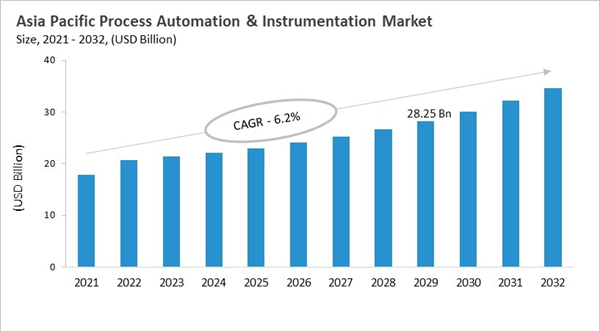
The Asia Pacific Process Automation & Instrumentation Market is expected to reach $28.25 billion by 2029 and is expected to witness market growth of 6.0% CAGR during the forecast period (2025-2032).
The China market dominated the Asia Pacific Process Automation & Instrumentation Market by country in 2024, and is expected to continue to be a dominant market till 2032; thereby, achieving a market value of $11.05 billion by 2032. The Japan market is showcasing a CAGR of 5.2% during 2025-2032. Additionally, the India market would register a CAGR of 6.8% during 2025-2032. The China and Japan led the Asia Pacific Process Automation & Instrumentation Market by Country with a market share of 35.9% and 14.2% in 2024. The Singapore market is expected to witness a CAGR of 8% during throughout the forecast period.
The Asia Pacific Process Automation & Instrumentation Market grew as Japan, South Korea, and China quickly industrialized. Early adopters used basic control tools and pneumatic systems to make manufacturing and energy sectors safer and more efficient. Digital control technologies, PLCs, and distributed control systems have greatly improved automation capabilities over time. Smart sensors, IIoT-enabled instruments, and advanced analytics that allow for real-time monitoring, predictive maintenance, and better operational efficiency across industries are what drive the market today.
Some important trends in the market are the quick adoption of IIoT frameworks to improve connectivity and data-driven process optimization, the growing need for energy-efficient and environmentally friendly automation solutions because of government rules, and the growing use of AI and machine learning for predictive analytics and asset management. Leading companies in emerging economies focus on new ideas, research and development (R&D) investments, strategic partnerships, and expanding into new regions. The competitive landscape includes global technology leaders and regional players who compete by offering advanced automation solutions, custom products, and low-cost pricing strategies.
The China market dominated the Asia Pacific Process Automation & Instrumentation Market by country in 2024, and is expected to continue to be a dominant market till 2032; thereby, achieving a market value of $11.05 billion by 2032. The Japan market is showcasing a CAGR of 5.2% during 2025-2032. Additionally, the India market would register a CAGR of 6.8% during 2025-2032. The China and Japan led the Asia Pacific Process Automation & Instrumentation Market by Country with a market share of 35.9% and 14.2% in 2024. The Singapore market is expected to witness a CAGR of 8% during throughout the forecast period.
The Asia Pacific Process Automation & Instrumentation Market grew as Japan, South Korea, and China quickly industrialized. Early adopters used basic control tools and pneumatic systems to make manufacturing and energy sectors safer and more efficient. Digital control technologies, PLCs, and distributed control systems have greatly improved automation capabilities over time. Smart sensors, IIoT-enabled instruments, and advanced analytics that allow for real-time monitoring, predictive maintenance, and better operational efficiency across industries are what drive the market today.
Some important trends in the market are the quick adoption of IIoT frameworks to improve connectivity and data-driven process optimization, the growing need for energy-efficient and environmentally friendly automation solutions because of government rules, and the growing use of AI and machine learning for predictive analytics and asset management. Leading companies in emerging economies focus on new ideas, research and development (R&D) investments, strategic partnerships, and expanding into new regions. The competitive landscape includes global technology leaders and regional players who compete by offering advanced automation solutions, custom products, and low-cost pricing strategies.
Instrument Type Outlook
Based on Instrument Type, the market is segmented into Field Instruments and Control Valves & Analyzers. With a compound annual growth rate (CAGR) of 7.7% over the projection period, the Field Instruments Market, dominate the Singapore Process Automation & Instrumentation Market by Instrument Type in 2024 and would be a prominent market until 2032. The Control Valves & Analyzers market is expected to witness a CAGR of 8.6% during 2025-2032.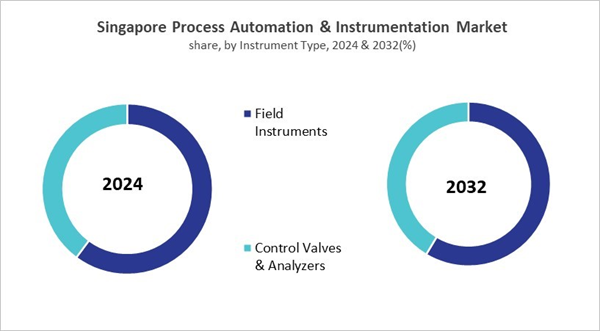
Solution Outlook
Based on Solution, the market is segmented into Distributed Control Systems (DCS), Programmable Logic Controllers (PLC), SCADA, Human Machine Interface, Manufacturing Execution Systems, Safety Instrumented Systems, Advanced Process and Control & Other. The Distributed Control Systems (DCS) market segment dominated the India Process Automation & Instrumentation Market by Solution is expected to grow at a CAGR of 5.6 % during the forecast period thereby continuing its dominance until 2032. Also, The Manufacturing Execution Systems market is anticipated to grow as a CAGR of 7.9 % during the forecast period during 2025-2032.Country Outlook
The China Process Automation & Instrumentation Market developed alongside the country’s rapid industrial modernization, initially serving heavy industries such as steel, petrochemicals, and manufacturing with basic analog control systems. Over time, advancements in digital electronics led to the adoption of PLCs, DCS, and smart instrumentation, enabling more efficient and scalable automation. Today, the market is driven by intelligent manufacturing, IoT-enabled devices, and AI-based process optimization that enhance productivity and operational efficiency. Key trends include the rise of smart factories, stricter environmental regulations driving demand for advanced monitoring instruments, and increasing adoption of decentralized control systems for greater reliability. Both domestic and multinational companies compete through innovation, localized solutions, and integrated automation platforms combining hardware, software, and analytics.List of Key Companies Profiled
- Emerson Electric Co.
- Siemens AG
- Robert Bosch GmbH
- Mitsubishi Electric Corporation
- Rockwell Automation, Inc.
- Honeywell International, Inc.
- Schneider Electric SE
- Omron Corporation
- Yokogawa Electric Corporation
- General Electric Company
Market Report Segmentation
By Solution- Distributed Control Systems (DCS)
- Programmable Logic Controllers (PLC)
- SCADA
- Human Machine Interface
- Manufacturing Execution Systems
- Safety Instrumented Systems
- Advanced Process Control & Other
- Field Instruments
- Control Valves & Analyzers
- Oil & Gas
- Chemical
- Energy & Utilities
- Automotive
- Pharmaceutical
- Food & Beverage
- Metals & Mining
- Pulp & Paper
- Other End-Use Industry
- China
- Japan
- India
- South Korea
- Singapore
- Malaysia
- Rest of Asia Pacific
Table of Contents
Chapter 1. Market Scope & Methodology
Chapter 2. Market at a Glance
Chapter 3. Market Overview
Chapter 4. Market Trends - Asia Pacific Process Automation & Instrumentation Market
Chapter 5. State of Competition - Asia Pacific Process Automation & Instrumentation Market
Chapter 6. Market Consolidation - Asia Pacific Process Automation & Instrumentation Market
Chapter 7. Key Customer Criteria - Asia Pacific Process Automation & Instrumentation Market
Chapter 8. Product Life Cycle - Asia Pacific Process Automation & Instrumentation Market
Chapter 10. Competition Analysis - Global
Chapter 11. Asia Pacific Process Automation & Instrumentation Market by Solution
Chapter 12. Asia Pacific Process Automation & Instrumentation Market by Instrument Type
Chapter 13. Asia Pacific Process Automation & Instrumentation Market by End-Use Industry
Chapter 14. Asia Pacific Process Automation & Instrumentation Market by Country
Chapter 15. Company Profiles
Companies Mentioned
- Emerson Electric Co.
- Siemens AG
- Robert Bosch GmbH
- Mitsubishi Electric Corporation
- Rockwell Automation, Inc.
- Honeywell International, Inc.
- Schneider Electric SE
- Omron Corporation
- Yokogawa Electric Corporation
- General Electric Company


