



The Latin America, Middle East and Africa Tele-monitoring Services Market is expected to reach $5.18 billion by 2028 and is expected to witness market growth of 18.8% CAGR during the forecast period (2025-2032).
The Brazil market dominated the LAMEA Tele-monitoring Services Market by country in 2024, and is expected to continue to be a dominant market till 2032; thereby, achieving a market value of $2.56 billion by 2032. The Argentina market is showcasing a CAGR of 20% during 2025-2032. Additionally, the UAE market would register a CAGR of 17.6% during 2025-2032. The Brazil and Argentina led the LAMEA Tele-monitoring Services Market by Country with a market share of 26.8% and 11.6% in 2024. The South Africa market is expected to witness a CAGR of 20.1% during throughout the forecast period.
The LAMEA Tele-monitoring Services Market has changed a lot since it started with simple, sporadic patient data collection. Now, thanks to better digital communication, mobile connectivity, and internet access, it has advanced to real-time remote monitoring systems. The increasing number of chronic diseases like heart disease, diabetes, and respiratory problems has made the need for continuous, easy-to-access healthcare solutions even greater in Latin America, the Middle East, and Africa. Government programs, support for healthcare policy, and investments in digital infrastructure have all sped up adoption even more, especially in areas that don't have many resources or are hard to reach. Wearable devices, wireless systems, and data analytics platforms are just a few examples of how technology has made tele-monitoring services more reliable, efficient, and affordable. Because of this, the market is moving toward integrated, patient-centered ecosystems that focus on proactive disease management and better health outcomes.
Some of the most important trends in the market are the use of artificial intelligence and machine learning for predictive analytics and real-time clinical decision support, as well as the rapid growth of mobile health solutions that help patients be more involved in their own care and manage their own health. To improve their market position, industry leaders are using strategies like strategic partnerships, research and development investments, and digital transformation through the Internet of Things (IoT), cloud computing, and artificial intelligence (AI). Flexible pricing models and efforts to make things more local also help more people use them in a wider range of economic situations. The competitive landscape is still changing, with global companies, regional companies, and startups all making contributions through new ideas, niche specialization, and cost-effective solutions. Focus on following the rules, making systems work together, and keeping data safe continues to set companies apart from each other, leading to long-term growth and technological progress in the area.
The Brazil market dominated the LAMEA Tele-monitoring Services Market by country in 2024, and is expected to continue to be a dominant market till 2032; thereby, achieving a market value of $2.56 billion by 2032. The Argentina market is showcasing a CAGR of 20% during 2025-2032. Additionally, the UAE market would register a CAGR of 17.6% during 2025-2032. The Brazil and Argentina led the LAMEA Tele-monitoring Services Market by Country with a market share of 26.8% and 11.6% in 2024. The South Africa market is expected to witness a CAGR of 20.1% during throughout the forecast period.
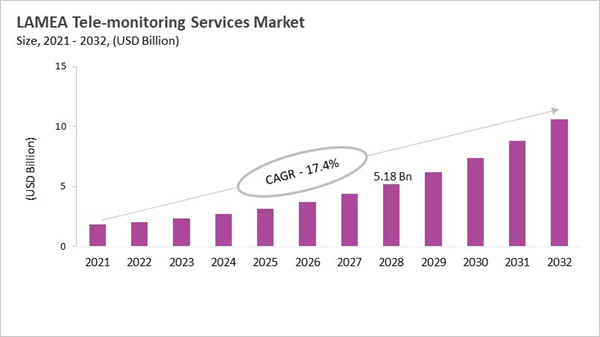
The LAMEA Tele-monitoring Services Market has changed a lot since it started with simple, sporadic patient data collection. Now, thanks to better digital communication, mobile connectivity, and internet access, it has advanced to real-time remote monitoring systems. The increasing number of chronic diseases like heart disease, diabetes, and respiratory problems has made the need for continuous, easy-to-access healthcare solutions even greater in Latin America, the Middle East, and Africa. Government programs, support for healthcare policy, and investments in digital infrastructure have all sped up adoption even more, especially in areas that don't have many resources or are hard to reach. Wearable devices, wireless systems, and data analytics platforms are just a few examples of how technology has made tele-monitoring services more reliable, efficient, and affordable. Because of this, the market is moving toward integrated, patient-centered ecosystems that focus on proactive disease management and better health outcomes.
Some of the most important trends in the market are the use of artificial intelligence and machine learning for predictive analytics and real-time clinical decision support, as well as the rapid growth of mobile health solutions that help patients be more involved in their own care and manage their own health. To improve their market position, industry leaders are using strategies like strategic partnerships, research and development investments, and digital transformation through the Internet of Things (IoT), cloud computing, and artificial intelligence (AI). Flexible pricing models and efforts to make things more local also help more people use them in a wider range of economic situations. The competitive landscape is still changing, with global companies, regional companies, and startups all making contributions through new ideas, niche specialization, and cost-effective solutions. Focus on following the rules, making systems work together, and keeping data safe continues to set companies apart from each other, leading to long-term growth and technological progress in the area.
Payment Model Outlook
Based on Payment Model, the market is segmented into Insurance Reimbursement, Self-Pay (Out-of-Pocket), Employer-Sponsored and Other Payment Model. Among various Argentina Tele-monitoring Services Market by Payment Model; The Insurance Reimbursement market achieved a market size of USD $107.7 Million in 2024 and is expected to grow at a CAGR of 19.1 % during the forecast period. The Self-Pay (Out-of-Pocket) market is predicted to experience a CAGR of 20.2% throughout the forecast period from (2025-2032).End Use Outlook
Based on End Use, the market is segmented into Providers, Patients, Payers and Other End Use. The Providers market segment dominated the South Africa Tele-monitoring Services Market by End Use is expected to grow at a CAGR of 19.3 % during the forecast period thereby continuing its dominance until 2032. Also, The Payers market is anticipated to grow as a CAGR of 20.9 % during the forecast period during 2025-2032.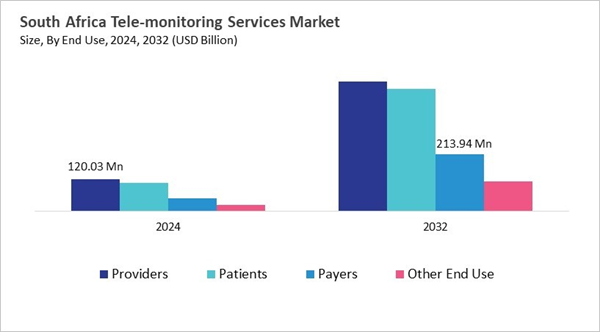
Country Outlook
The Brazilian tele-monitoring services market has changed a lot from having only a few remote monitoring options to having a full, technology-driven healthcare model. This is thanks to the growth of digital infrastructure and the public healthcare system (SUS). The rising number of people with chronic diseases and the growing use of smartphones and wearable devices have sped up the need for continuous remote care. The market is changing in important ways, such as the use of IoT for real-time data exchange, AI for predictive analytics and personalized care, and the growth of applications beyond chronic conditions to include post-acute and elderly care. Government support, good rules, and the COVID-19 pandemic have all helped adoption and investment grow even more. Market players are using partnerships, new ideas, and service models that can grow to make things easier to get to and more efficient, especially in areas that don't get enough of them. Overall, strong competition, new technologies, and a focus on patient-centered, data-driven care are still driving growth and change in the market.List of Key Companies Profiled
- OMRON HEALTHCARE Co., Ltd. (Omron Corporation)
- Koninklijke Philips N.V.
- Teladoc Health, Inc.
- Twilio, Inc.
- Medtronic PLC
- GE HealthCare Technologies, Inc.
- American Well Corporation (Amwell)
- Athenahealth, Inc.
- Abbott Laboratories
- MDLive, Inc.
Market Report Segmentation
By Device- Wearables / Remote Sensors
- Mobile Devices
- Remote Patient Monitoring (RPM)
- Chronic Disease Management
- Post-Operative Monitoring
- Insurance Reimbursement
- Self-Pay (Out-of-Pocket)
- Employer-Sponsored
- Other Payment Model
- Providers
- Patients
- Payers
- Other End Use
- Primary Care
- Cardiology
- Mental Health
- Dermatology
- Other Application
- Tele-Hospitals
- Tele-Home
- Brazil
- Argentina
- UAE
- Saudi Arabia
- South Africa
- Nigeria
- Rest of LAMEA
Table of Contents
Chapter 1. Market Scope & Methodology
Chapter 2. Market at a Glance
Chapter 3. Market Overview
Chapter 4. Market Trends
Chapter 5. State Of Competition
Chapter 6. Market Consolidation
Chapter 7. Key Customer Criteria
Chapter 8. Product Life Cycle
Chapter 9. Value Chain Analysis of Tele-monitoring Services Market
Chapter 10. Competition Analysis - Global
Chapter 11. LAMEA Tele-monitoring Services Market by Device
Chapter 12. LAMEA Tele-monitoring Services Market by Service
Chapter 13. LAMEA Tele-monitoring Services Market by Payment Model
Chapter 14. LAMEA Tele-monitoring Services Market by End Use
Chapter 15. LAMEA Tele-monitoring Services Market by Application
Chapter 16. LAMEA Tele-monitoring Services Market by Facility
Chapter 17. LAMEA Tele-monitoring Services Market by Country
Chapter 18. Company Profiles
Companies Mentioned
- OMRON HEALTHCARE Co., Ltd. (Omron Corporation)
- Koninklijke Philips N.V.
- Teladoc Health, Inc.
- Twilio, Inc.
- Medtronic PLC
- GE HealthCare Technologies, Inc.
- American Well Corporation (Amwell)
- Athenahealth, Inc.
- Abbott Laboratories
- MDLive, Inc.


