



The Latin America, Middle East and Africa AI And Machine Learning Operationalization Software Market is expected to reach $509.31 million by 2028 and is expected to witness market growth of 37.2% CAGR during the forecast period (2025-2032).
The Brazil market dominated the LAMEA AI And Machine Learning Operationalization Software Market by country in 2024, and is expected to continue to be a dominant market till 2032; thereby, achieving a market value of $380 million by 2032. The Argentina market is showcasing a CAGR of 37.8% during 2025-2032. Additionally, the UAE market would register a CAGR of 36.1% during 2025-2032. The Brazil and UAE led the LAMEA AI And Machine Learning Operationalization Software Market by Country with a market share of 22.8% and 17.3% in 2024. The South Africa market is expected to witness a CAGR of 38.3% during throughout the forecast period.
The market for AI and machine learning operationalization software in the LAMEA region has grown along with national innovation strategies and digital transformation programs. Research institutions and government-led digital programs that focused on building skills, innovation ecosystems, and pilot projects were the main reasons why Latin America, the Middle East, and Africa started using artificial intelligence early on. But a lot of early AI projects had trouble growing beyond the testing stage because there weren't any structured ways to put models into production and manage them. This problem showed how important machine learning operationalization (MLOps) software is. MLOps software lets businesses deploy, monitor, and manage AI systems throughout their life cycle. As governments and businesses use AI more and more in areas like public administration, healthcare, financial services, energy, and smart cities, the need for an AI infrastructure that is reliable, clear, and can grow quickly has grown.
The market has grown since then, as cloud computing, governance frameworks, and enterprise software ecosystems started to include MLOps features. Cloud-based operationalization platforms are becoming very popular. They let businesses use and grow AI solutions without having to spend a lot of money on infrastructure, and they make monitoring and lifecycle management easier. At the same time, LAMEA policy frameworks have put more emphasis on responsible AI principles like fairness, transparency, and accountability. This has led to a rise in demand for platforms that can explain themselves, find bias, and do audits. Leading OEMs respond with cloud-first strategies, automated deployment pipelines, and working with governments to make sure their solutions follow national AI policies. Global tech companies, regional vendors, and open-source ecosystems all play a role in shaping competition in the market. Differentiation is becoming more focused on scalability, governance capabilities, interoperability, and the ability to reliably operationalize AI in a variety of regulatory and economic settings.
The Brazil market dominated the LAMEA AI And Machine Learning Operationalization Software Market by country in 2024, and is expected to continue to be a dominant market till 2032; thereby, achieving a market value of $380 million by 2032. The Argentina market is showcasing a CAGR of 37.8% during 2025-2032. Additionally, the UAE market would register a CAGR of 36.1% during 2025-2032. The Brazil and UAE led the LAMEA AI And Machine Learning Operationalization Software Market by Country with a market share of 22.8% and 17.3% in 2024. The South Africa market is expected to witness a CAGR of 38.3% during throughout the forecast period.
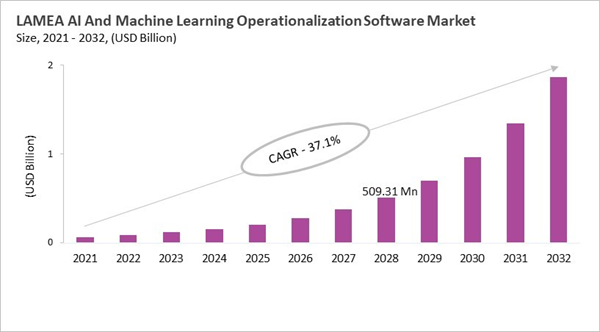
The market for AI and machine learning operationalization software in the LAMEA region has grown along with national innovation strategies and digital transformation programs. Research institutions and government-led digital programs that focused on building skills, innovation ecosystems, and pilot projects were the main reasons why Latin America, the Middle East, and Africa started using artificial intelligence early on. But a lot of early AI projects had trouble growing beyond the testing stage because there weren't any structured ways to put models into production and manage them. This problem showed how important machine learning operationalization (MLOps) software is. MLOps software lets businesses deploy, monitor, and manage AI systems throughout their life cycle. As governments and businesses use AI more and more in areas like public administration, healthcare, financial services, energy, and smart cities, the need for an AI infrastructure that is reliable, clear, and can grow quickly has grown.
The market has grown since then, as cloud computing, governance frameworks, and enterprise software ecosystems started to include MLOps features. Cloud-based operationalization platforms are becoming very popular. They let businesses use and grow AI solutions without having to spend a lot of money on infrastructure, and they make monitoring and lifecycle management easier. At the same time, LAMEA policy frameworks have put more emphasis on responsible AI principles like fairness, transparency, and accountability. This has led to a rise in demand for platforms that can explain themselves, find bias, and do audits. Leading OEMs respond with cloud-first strategies, automated deployment pipelines, and working with governments to make sure their solutions follow national AI policies. Global tech companies, regional vendors, and open-source ecosystems all play a role in shaping competition in the market. Differentiation is becoming more focused on scalability, governance capabilities, interoperability, and the ability to reliably operationalize AI in a variety of regulatory and economic settings.
Deployment Outlook
Based on Deployment, the market is segmented into On-premises, and Cloud. The On-premises market segment dominated the Brazil AI And Machine Learning Operationalization Software Market by Deployment is expected to grow at a CAGR of 34.6 % during the forecast period thereby continuing its dominance until 2032. Also, The Cloud market is anticipated to grow as a CAGR of 35.9 % during the forecast period during 2025-2032.Application Outlook
Based on Application, the market is segmented into Predictive Analytics, Fraud detection & Risk management, Customer experience management, Natural language processing (NLP) and text analytics, and Other Application. Among various UAE AI And Machine Learning Operationalization Software Market by Application; The Predictive Analytics market achieved a market size of USD $9 Million in 2024 and is expected to grow at a CAGR of 35 % during the forecast period. The Natural language processing (NLP) and text analytics market is predicted to experience a CAGR of 37.2% throughout the forecast period from (2025-2032).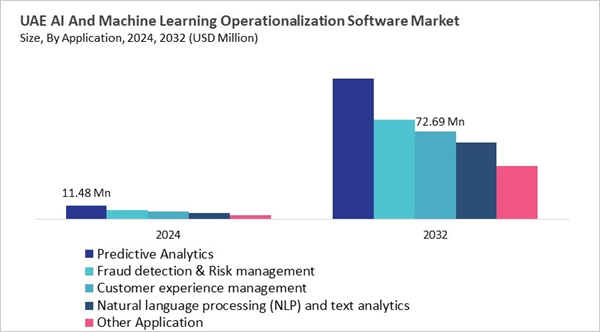
Country Outlook
As Brazil speeds up its digital transformation and moves forward with its National AI strategy, the country's AI and Machine Learning Operationalization Software Market is growing. The use of cloud-native infrastructure is growing, thanks to big investments from global cloud providers like Amazon Web Services, Microsoft Azure, and Google Cloud. This is making it possible for businesses to use MLOps practices to manage the entire machine learning lifecycle in a way that can grow with their needs. Increasing the capacity of local data centers, especially in São Paulo, has made the infrastructure needed for automated model deployment, monitoring, and governance stronger. At the same time, Brazilian businesses that want flexibility, cost-effectiveness, and compliance with data localization rules are increasingly turning to hybrid cloud strategies. Global cloud platforms and local IT consulting firms that help Brazil's regulatory environment customize operationalization frameworks are driving competition.List of Key Companies Profiled
- Microsoft Corporation
- Amazon Web Services, Inc. (Amazon.com, Inc.)
- Google LLC
- Databricks, Inc.
- DataRobot, Inc.
- IBM Corporation
- NVIDIA Corporation
- Hewlett Packard Enterprise Company
- Cloudera, Inc.
- SAS Institute Inc.
Market Report Segmentation
By Deployment- On-premises
- Cloud
- Large Enterprises
- Small & Medium-sized Enterprises (SMEs)
- Model Deployment & Management
- Model Monitoring & Performance Evaluation
- Data Preprocessing & Feature Engineering
- Integration with Existing Systems
- Other Functionality
- Banking, financial services, and insurance (BFSI)
- Healthcare & Life Sciences
- Retail & E-Commerce
- IT & Telecommunications
- Manufacturing
- Other End Use
- Predictive Analytics
- Fraud detection & Risk management
- Customer experience management
- Natural language processing (NLP) and text analytics
- Other Application
- Brazil
- Argentina
- UAE
- Saudi Arabia
- South Africa
- Nigeria
- Rest of LAMEA
Table of Contents
Chapter 1. Market Scope & Methodology
Chapter 2. Market at a Glance
Chapter 3. Market Overview
Chapter 10. Competition Analysis - Global
Chapter 11. LAMEA AI And Machine Learning Operationalization Software Market by Deployment
Chapter 12. LAMEA AI And Machine Learning Operationalization Software Market by Enterprise Size
Chapter 13. LAMEA AI And Machine Learning Operationalization Software Market by Functionality
Chapter 14. LAMEA AI And Machine Learning Operationalization Software Market by End Use
Chapter 15. LAMEA AI And Machine Learning Operationalization Software Market by Application
Chapter 16. LAMEA AI And Machine Learning Operationalization Software Market by Country
Chapter 17. Company Profiles
Companies Mentioned
- Microsoft Corporation
- Amazon Web Services, Inc. (Amazon.com, Inc.)
- Google LLC
- Databricks, Inc.
- DataRobot, Inc.
- IBM Corporation
- NVIDIA Corporation
- Hewlett Packard Enterprise Company
- Cloudera, Inc.
- SAS Institute Inc.


