



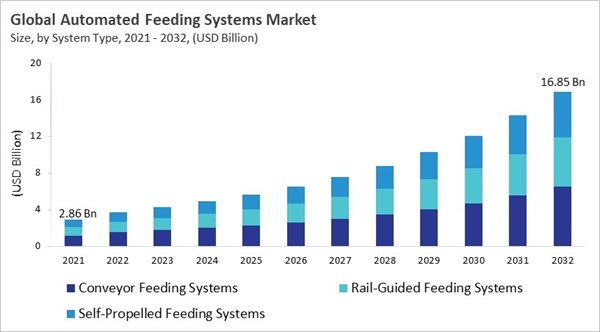
The Global Automated Feeding Systems Market size is estimated at $5.64 billion in 2025 and is expected to reach $16.85 billion by 2032, rising to a market growth of 16.9% CAGR during the forecast period (2025-2032). Rapid livestock intensification, rising demand for protein-rich diets, and labor shortages are accelerating adoption of automated feeding systems. Integration of IoT, AI, and precision nutrition improves feed efficiency and animal health while reducing waste and costs. Supportive farm mechanization policies further sustain strong double-digit market expansion globally.
Automated feeding systems are technology-based solutions that distribute feed to poultry, livestock, and aquaculture with minimal human intervention, using components like robotic feeders, programmable controls, converyors, and integrated software. These systems have developed along with precision livestock farming and agricultural mechanization. Modern automated feeding systems integrate with sensor-based monitoring tools and herd management software, allowing real-time adjustments, precise rationing, and data-driven decision-making. OEMs like GEA Group and Lely prioritize benefits including improved animal welfare, enhanced feed efficiency, and high productivity, thereby positioning automated feeding systems as a core component for modern livestock operations.
The automated feeding systems market is largely shaped by trends like increasing labor constraints, integration with precision livestock technologies, and a strong focus on sustainability. Automation feeding is closely linked with digital farm ecosystems, enabling producers to monitor feed intake, operational performance, and animal health in real-time. Rising costs and labor shortages are surging adoption, as automation ensures consistent feeding. Competitive landscape in the automatic feeding systems market centers on system integration, technological innovation, scalable designs, and service networks. These elements unveil the shift of automated feeding systems into a core component of efficient, smart, and sustainable livestock production globally.
The leading players in the market are competing with diverse innovative offerings to remain competitive in the market. The above illustration shows the percentage of revenue shared by some of the leading companies in the market. The leading players of the market are adopting various strategies in order to cater demand coming from the different industries. The key developmental strategies in the market are Acquisitions, and Partnerships & Collaborations.
In the Asia Pacific region, the automatic feeding systems market is estimated to experience noticeable expansion. The market growth is propelled by rapid industrialization of agriculture, rising demand for animal protein, and expanding commercial livestock operations. Regional nations are investing in automated feeding solutions to enhance feed efficiency, address labor shortages, and modernize farming practices. Government support for increasing disposable incomes, smart agriculture, and rising awareness of precision livestock farming are some of the elements supporting market growth. Moreover, the LAMEA automatic feeding systems market is projected to experience substantial growth. The market is growing due to the embrace of automation to boost productivity and expanding commercial livestock operations. Additionally, the Middle East region is driven by rising feed efficiency needs and modernization efforts.
Key Market Trends & Insights:
- The Europe market dominated Global Automated Feeding Systems Market in 2024, accounting for a 35.03% revenue share in 2024.
- The U.S. market is projected to maintain its leadership in North America, reaching a market size of USD 3.29 billion by 2032.
- Among the various Livestock, the Ruminants segment dominated the global market, contributing a revenue share of 42.93% in 2024.
- In terms of System Type, Conveyor Feeding Systems segment is expected to lead the global market, with a projected revenue share of 38.48% by 2032.
- Hardware segment has emerged as the leading Component in 2024, capturing a 60.39% revenue share, and is projected to retain its dominance during the forecast period.
Automated feeding systems are technology-based solutions that distribute feed to poultry, livestock, and aquaculture with minimal human intervention, using components like robotic feeders, programmable controls, converyors, and integrated software. These systems have developed along with precision livestock farming and agricultural mechanization. Modern automated feeding systems integrate with sensor-based monitoring tools and herd management software, allowing real-time adjustments, precise rationing, and data-driven decision-making. OEMs like GEA Group and Lely prioritize benefits including improved animal welfare, enhanced feed efficiency, and high productivity, thereby positioning automated feeding systems as a core component for modern livestock operations.
The automated feeding systems market is largely shaped by trends like increasing labor constraints, integration with precision livestock technologies, and a strong focus on sustainability. Automation feeding is closely linked with digital farm ecosystems, enabling producers to monitor feed intake, operational performance, and animal health in real-time. Rising costs and labor shortages are surging adoption, as automation ensures consistent feeding. Competitive landscape in the automatic feeding systems market centers on system integration, technological innovation, scalable designs, and service networks. These elements unveil the shift of automated feeding systems into a core component of efficient, smart, and sustainable livestock production globally.
Driving and Restraining Factors
Drivers- Regulatory Pressure for Animal Welfare and Sustainable Livestock Management
- Demand for Productivity and Precision Livestock Farming
- Labor Efficiency and Workforce Constraints in European Agriculture
- Technological Innovation and Competitive Advantage Among European OEMs
- High Capital Costs and Economic Pressures in European Livestock Farms
- Digital Infrastructure Gaps and Technical Integration Challenges
- Regulatory Complexity and Sustainability Compliance Burdens
- Integration With Precision Livestock Farming and Real-Time Nutritional Adjustment
- Customized Solutions for Diverse Livestock Types and Farm Scales
- Enhancing Sustainability and Compliance with Environmental Goals
- Complex Regulatory & Sustainability Frameworks Affecting Adoption
- Structural Diversity of Farm Systems & Technology Suitability
- Data Integration, Digital Skills & Technology Usability Barriers
Market Share Analysis
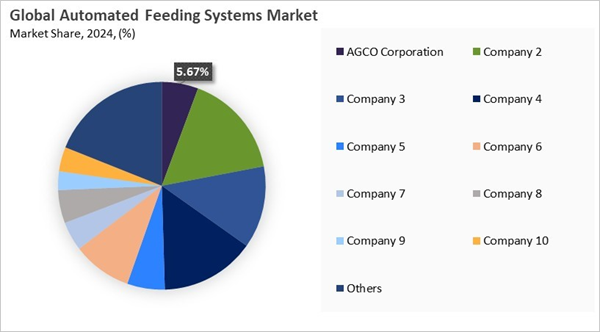
The leading players in the market are competing with diverse innovative offerings to remain competitive in the market. The above illustration shows the percentage of revenue shared by some of the leading companies in the market. The leading players of the market are adopting various strategies in order to cater demand coming from the different industries. The key developmental strategies in the market are Acquisitions, and Partnerships & Collaborations.
COVID-19 Impact Analysis
The Automated Feeding Systems Market faced significant disruption during the COVID-19 pandemic due to lockdowns and global supply chain interruptions. Shortages of critical components delayed production and postponed equipment installations. Capital investment declined as farmers and agribusinesses struggled with financial uncertainty, labor shortages, and reduced food service demand. Many end users deferred or canceled automation projects, slowing market growth. Workforce restrictions also delayed installation, maintenance, and after-sales services. Training and on-site demonstrations were suspended, weakening customer engagement. Additionally, instability in livestock production and feed supply discouraged farm expansion and new investments. As a result, overall market momentum and revenues declined during the pandemic period. Thus, the COVID-19 pandemic had a negative impact on the market.Component Outlook
Based on components, the automated feeding systems market is characterized into hardware, services, and software. The services segment attained 26% revenue share in the automated feeding systems market in 2024. The services segment represents a substantial portion of the global automated feeding systems market, supported by the growing need for installation, system integration, maintenance, training, and technical support. As farms incorporate more sophisticated automated technologies, demand for professional services to ensure optimal performance and minimize downtime has increased significantly.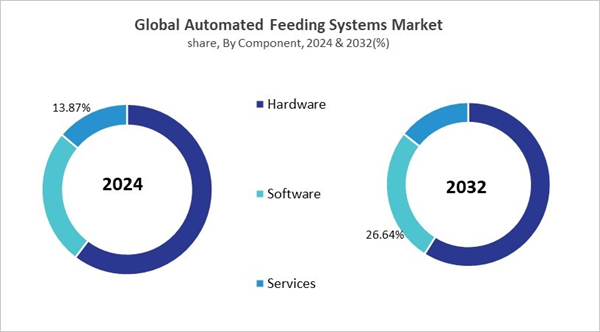
System type Outlook
On the basis of system type, the automated feeding systems market is classified into conveyor feeding systems, rail-guided feeding systems, self-propelled feeding systems. The rail-guided feeding systems segment recorded 31% revenue share in the automated feeding systems market in 2024. Rail-guided feeding systems hold a substantial position in the global automated feeding systems market, supported by the increasing need for structured and precise feed management in large-scale livestock facilities. These systems are particularly suitable for dairy and cattle farms that require controlled feed allocation and systematic movement within barns.Regional Outlook
Region-wise, the automated feeding systems market is analyzed across North America, Europe, Asia Pacific, and LAMEA. The Europe segment witnessed 35% revenue share in the automated feeding systems market in 2024. The automatic feeding systems market is anticipated to grow at a significant rate in North America. This is because of large-scale commercial livestock operations, advanced agricultural infrastructure, and large adoption of precision farming technologies. Regional nations are showcasing expansion propelled by robust investment in IoT integration, automation, and sustainability initiatives that enhance operational efficiency and animal welfare in the poultry, dairy, and swine industry. Also, North America’s market growth is propelled by initiatives that encourage farm modernization and digital agriculture. Furthermore, Europe automatic feeding systems market is expected to capture prominent growth. The market is driven by strict environmental and animal welfare regulations, and supportive policies like the EU’s Common Agricultural Policy. Nations such as France, Germany, and the Netherlands are largely adopting robotic feeding and IoT-enabled solutions to reduce waste and improve precision.In the Asia Pacific region, the automatic feeding systems market is estimated to experience noticeable expansion. The market growth is propelled by rapid industrialization of agriculture, rising demand for animal protein, and expanding commercial livestock operations. Regional nations are investing in automated feeding solutions to enhance feed efficiency, address labor shortages, and modernize farming practices. Government support for increasing disposable incomes, smart agriculture, and rising awareness of precision livestock farming are some of the elements supporting market growth. Moreover, the LAMEA automatic feeding systems market is projected to experience substantial growth. The market is growing due to the embrace of automation to boost productivity and expanding commercial livestock operations. Additionally, the Middle East region is driven by rising feed efficiency needs and modernization efforts.
Recent Strategies Deployed in the Market
- Jan-2024: BouMatic LLC unveiled innovative feeding solutions, including the Butler Gold Pro feed pusher, Shuttle Eco feeding robot, and FlyPit bedding robot. These systems enhance feed delivery, promote animal well-being, and improve efficiency. With remote control and sustainable energy options, BouMatic supports modern, eco-friendly dairy farming and optimal milk production.
- Oct-2023: Lely International N.V. teamed up with Konrad Pumpe GmbH to enhance flexibility in automated feeding. The collaboration adds high-speed dosing systems to Lely’s Vector feeding solution, enabling greater feed capacity, customization, and efficiency. This innovation supports larger dairy farms and allows precise, adaptable feeding strategies tailored to individual herd needs.
- Mar-2023: DeLaval unveiled the OptiWagon, an autonomous feed distribution robot, as part of its Optimat automated feeding system. It offers flexible, efficient feeding up to 12 times daily, optimizing feed conversion and saving labor and energy. The Optimat system serves farms from 120 to 1,000 cows, mainly in Europe.
- Sep-2022: GEA Group AG unveiled the DairyFeed F4500, an autonomous electric feeding robot for dairy farms. It delivers precise feed mixes for different animal groups, reduces waste, improves efficiency, and supports animal welfare. Integrated with GEA DairyNet, it enhances flexibility, sustainability, and farm operations without requiring major infrastructure changes.
- Sep-2021: AGCO Corporation acquired Faromatics, a precision livestock farming company known for its ceiling-suspended robot “ChickenBoy,” which monitors broiler chickens using AI and sensors to enhance animal welfare and productivity. The move strengthens AGCO’s smart farming solutions and innovation in livestock operations, aligning with its goal of supporting sustainable agriculture.
- Jul-2021: GEA Group AG unveiled a new generation of its DairyRobot R9500 and DairyProQ automatic milking systems, enhancing milking efficiency, durability, and cost-effectiveness. With improved hardware, software updates, and eco-friendly features, these systems offer faster milking, reduced downtime, and lower operational costs, driving profitability and sustainability for modern dairy farms.
List of Key Companies Profiled
- AGCO Corporation
- GEA Group AG
- Lely International N.V.
- DeLaval (Tetra Laval Group)
- Dairymaster USA, Inc.
- Trioliet B.V.
- VDL Agrotech BV
- BouMatic LLC
- Rovibec Agrisolutions
- Pellon Group Oy
Market Report Segmentation
By Component- Hardware
- Software
- Services
- Conveyor Feeding Systems
- Rail-Guided Feeding Systems
- Self-Propelled Feeding Systems
- Ruminants
- Poultry
- Other Livestock
- North America
- US
- Canada
- Mexico
- Rest of North America
- Europe
- Germany
- UK
- France
- Russia
- Spain
- Italy
- Rest of Europe
- Asia Pacific
- China
- Japan
- India
- South Korea
- Singapore
- Malaysia
- Rest of Asia Pacific
- LAMEA
- Brazil
- Argentina
- UAE
- Saudi Arabia
- South Africa
- Nigeria
- Rest of LAMEA
Table of Contents
Chapter 1. Market Scope & Methodology
Chapter 2. Market at a Glance
Chapter 3. Market Overview
Chapter 10. Competition Analysis - Global
Chapter 11. Global Automated Feeding Systems Market by Component
Chapter 12. Global Automated Feeding Systems Market by System Type
Chapter 13. Global Automated Feeding Systems Market by Livestock
Chapter 14. Global Automated Feeding Systems Market by Region
Chapter 15. Company Profiles
Companies Mentioned
- AGCO Corporation
- GEA Group AG
- Lely International N.V.
- DeLaval (Tetra Laval Group)
- Dairymaster USA, Inc.
- Trioliet B.V.
- VDL Agrotech BV
- BouMatic LLC
- Rovibec Agrisolutions
- Pellon Group Oy


