



The Europe HMI Sensors In Wearables Market is expected to reach $2.06 billion by 2031 and is expected to witness market growth of 13.4% CAGR during the forecast period (2025-2032).
The Germany market dominated the Europe HMI Sensors In Wearables Market by country in 2024, and is expected to continue to be a dominant market till 2032; thereby, achieving a market value of $424.1 million by 2032. The UK market is exhibiting a CAGR of 12.4% during 2025-2032. Additionally, the France market is expected to exhibit a CAGR of 14.2% during 2025-2032. The Germany and UK led the Europe HMI Sensors In Wearables Market by Country with a market share of 20.1% and 19.2% in 2024. The Spain market is expected to witness a CAGR of 14.8% during throughout the forecast period.
Wearables can understand touch, motion, gestures, and biometric signals thanks to human-machine interface (HMI) sensors. This makes it easier for people to interact with them and keeps an eye on their health all the time. Growth in Europe is being driven by a growing need for digital health and fitness solutions and strong support from the public sector for wearable technology. The European Commission and its Joint Research Centre have pointed out research that shows wearables are becoming more common in healthcare through telemedicine and remote monitoring. STMicroelectronics and Infineon Technologies are two of the top semiconductor companies in Europe that have made ultra-low-power motion, touch, and biosensing chips specifically for wearables. Their new products combine multiple sensing functions with built-in intelligence. This lets them accurately track physiological data and make the user experience more interesting while still saving battery life.
A major trend in Europe is the move toward smart, health-focused wearables that use multi-modal HMI sensors and processing on the device. Collaborative EU research projects make this ecosystem even stronger by bringing together industry, academia, and public funding to work on new MEMS, acoustic, and biosensing technologies. Market leaders look for ways to reduce the number of components and speed up the development of devices by focusing on high integration, energy efficiency, and platform-based sensor solutions. Partnerships with companies that make wearable devices, along with reference designs and software tools, speed up the process of getting products to market. The competition is based on how accurate the sensors are, how well they work with low power, and how many different types of sensors they can use. In general, Europe's HMI sensor market for wearables is shaped by strong research, cutting-edge semiconductor technology, and cooperation between different parts of the ecosystem.
The Germany market dominated the Europe HMI Sensors In Wearables Market by country in 2024, and is expected to continue to be a dominant market till 2032; thereby, achieving a market value of $424.1 million by 2032. The UK market is exhibiting a CAGR of 12.4% during 2025-2032. Additionally, the France market is expected to exhibit a CAGR of 14.2% during 2025-2032. The Germany and UK led the Europe HMI Sensors In Wearables Market by Country with a market share of 20.1% and 19.2% in 2024. The Spain market is expected to witness a CAGR of 14.8% during throughout the forecast period.
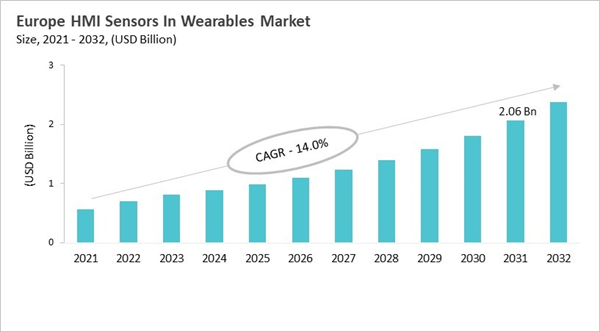
Wearables can understand touch, motion, gestures, and biometric signals thanks to human-machine interface (HMI) sensors. This makes it easier for people to interact with them and keeps an eye on their health all the time. Growth in Europe is being driven by a growing need for digital health and fitness solutions and strong support from the public sector for wearable technology. The European Commission and its Joint Research Centre have pointed out research that shows wearables are becoming more common in healthcare through telemedicine and remote monitoring. STMicroelectronics and Infineon Technologies are two of the top semiconductor companies in Europe that have made ultra-low-power motion, touch, and biosensing chips specifically for wearables. Their new products combine multiple sensing functions with built-in intelligence. This lets them accurately track physiological data and make the user experience more interesting while still saving battery life.
A major trend in Europe is the move toward smart, health-focused wearables that use multi-modal HMI sensors and processing on the device. Collaborative EU research projects make this ecosystem even stronger by bringing together industry, academia, and public funding to work on new MEMS, acoustic, and biosensing technologies. Market leaders look for ways to reduce the number of components and speed up the development of devices by focusing on high integration, energy efficiency, and platform-based sensor solutions. Partnerships with companies that make wearable devices, along with reference designs and software tools, speed up the process of getting products to market. The competition is based on how accurate the sensors are, how well they work with low power, and how many different types of sensors they can use. In general, Europe's HMI sensor market for wearables is shaped by strong research, cutting-edge semiconductor technology, and cooperation between different parts of the ecosystem.
Application Outlook
Based on Application, the market is segmented into Health & Fitness Monitoring, Gesture & Motion Control, Communication & Voice Interaction, Ambient Sensing & Personalization, Gaming & Immersive Experience, and Other Application. Among various UK HMI Sensors In Wearables Market by Application; The Health & Fitness Monitoring market achieved a market size of USD $61.2 Million in 2024 and is expected to grow at a CAGR of 11.6 % during the forecast period. The Gaming & Immersive Experience market is predicted to experience a CAGR of 12.9% throughout the forecast period from (2025-2032).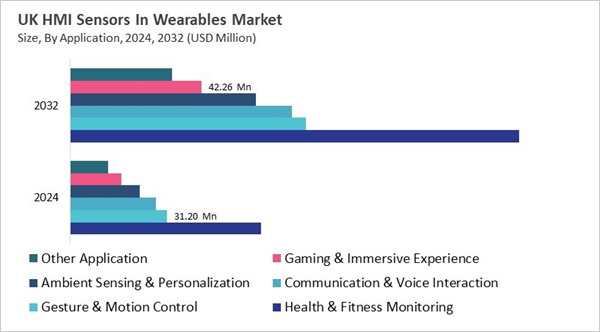
Sensor Type Outlook
Based on Sensor Type, the market is segmented into Touch Sensors, Motion Sensors, Biometric Sensors, Voice & Audio Sensors, and Other Sensor Type.The Touch Sensors market segment dominated the Germany HMI Sensors In Wearables Market by Sensor Type is expected to grow at a CAGR of 10.6 % during the forecast period thereby continuing its dominance until 2032. Also, The Voice & Audio Sensors market is anticipated to grow as a CAGR of 12.8 % during the forecast period during 2025-2032.Country Outlook
Germany's wearables market is growing because many people use connected devices and the country has a strong engineering culture that pushes the development of HMI sensor technologies like optical heart-rate monitors, accelerometers, and gyroscopes. As people get older, they want health-focused wearables that let them track their heart rate, sleep, and activity in real time. Market trends show that consumer wellness and digital healthcare are coming together. More devices can work with telemedicine and health data systems. Apple, Samsung, Garmin, and Fitbit are some of the biggest global OEMs. They compete by making sensors that are accurate, interfaces that are easy to use, and privacy policies that are strong. German customers like responsive touch, gesture control, and clear data display. Continued investment in making sensors smaller and easier to understand is expected to keep growth going. Germany's market is a mix of lifestyle wearables and new digital health apps.List of Key Companies Profiled
- Samsung Electronics Co., Ltd. (Samsung Group)
- Apple, Inc.
- Honeywell International, Inc.
- Rockwell Automation, Inc.
- General Electric Company
- Schneider Electric SE
- Siemens AG
- Omron Corporation
- Emerson Electric Co.
- Mitsubishi Electric Corporation
Market Report Segmentation
By Sensor Type- Touch Sensors
- Motion Sensors
- Biometric Sensors
- Voice & Audio Sensors
- Other Sensor Type
- Health & Fitness Monitoring
- Gesture & Motion Control
- Communication & Voice Interaction
- Ambient Sensing & Personalization
- Gaming & Immersive Experience
- Other Application
- Consumer Electronics
- Healthcare
- Enterprise & Industrial Applications
- Other End Use
- Smartwatches & Fitness Bands
- Hearables / Earbuds
- Smart Glasses / AR Glasses
- Head-Mounted Displays (HMDs)
- Smart Rings / Wristbands
- Smart Clothing
- Other Device Type
- Germany
- UK
- France
- Russia
- Spain
- Italy
- Rest of Europe
Table of Contents
Chapter 1. Market Scope & Methodology
Chapter 2. Market at a Glance
Chapter 3. Market Overview
Chapter 10. Competition Analysis - Global
Chapter 11. Europe HMI Sensors In Wearables Market by Sensor Type
Chapter 12. Europe HMI Sensors In Wearables Market by Application
Chapter 13. Europe HMI Sensors In Wearables Market by End Use
Chapter 14. Europe HMI Sensors In Wearables Market by Device Type
Chapter 15. Europe HMI Sensors In Wearables Market by Country
Chapter 16. Company Profiles
Companies Mentioned
- Samsung Electronics Co., Ltd. (Samsung Group)
- Apple, Inc.
- Honeywell International, Inc.
- Rockwell Automation, Inc.
- General Electric Company
- Schneider Electric SE
- Siemens AG
- Omron Corporation
- Emerson Electric Co.
- Mitsubishi Electric Corporation


