



The Europe Legacy IT System Modernization Market is expected to reach $12.05 billion by 2031 and is expected to witness market growth of 17.0% CAGR during the forecast period (2025-2032).
The Germany market dominated the Europe Legacy IT System Modernization Market by country in 2024, and is expected to continue to be a dominant market till 2032; thereby, achieving a market value of $2.80 billion by 2032. The UK market is exhibiting a CAGR of 16% during 2025-2032. Additionally, the France market is expected to experience a CAGR of 17.8% during 2025-2032. The Germany and UK led the Europe Legacy IT System Modernization Market by Country with a market share of 22% and 19.7% in 2024. The Spain market is expected to witness a CAGR of 18.5% during throughout the forecast period.
Modernizing outdated IT systems has become a strategic priority for public sector organizations in Europe that want to improve digital sovereignty, cybersecurity, interoperability, and service delivery that puts citizens first. Many governments still use monolithic systems that are decades old to handle important tasks like tax collection, healthcare, social welfare, and border control. These systems are becoming less able to meet the needs of modern regulations, security, and cross-border services. Digital government initiatives in the European Union and national reform programs have led to a focus on modular architectures, API-enabled interoperability, and the use of hybrid or sovereign clouds in modernization efforts. European governments prefer a gradual, risk-balanced transformation that is in line with goals for data protection, compliance, and service continuity, rather than replacing the entire system.
Collaboration between global OEMs like IBM, Microsoft, Google Cloud, and AWS, regional system integrators, and public digital agencies shapes the competitive landscape. The main areas of competition are cloud platforms that are secure and follow European data residency and sovereignty rules, as well as hybrid modernization capabilities. Governments are more and more using portfolio-based modernization strategies, which break down old systems into parts that can work together and add security by design and automated compliance controls. Using shared platforms and working together across government departments makes things even more efficient and cuts down on duplication. Overall, Europe's modernization market shows a planned, long-term approach to change that focuses on resilience, regulatory integrity, and long-term digital public value.
The Germany market dominated the Europe Legacy IT System Modernization Market by country in 2024, and is expected to continue to be a dominant market till 2032; thereby, achieving a market value of $2.80 billion by 2032. The UK market is exhibiting a CAGR of 16% during 2025-2032. Additionally, the France market is expected to experience a CAGR of 17.8% during 2025-2032. The Germany and UK led the Europe Legacy IT System Modernization Market by Country with a market share of 22% and 19.7% in 2024. The Spain market is expected to witness a CAGR of 18.5% during throughout the forecast period.
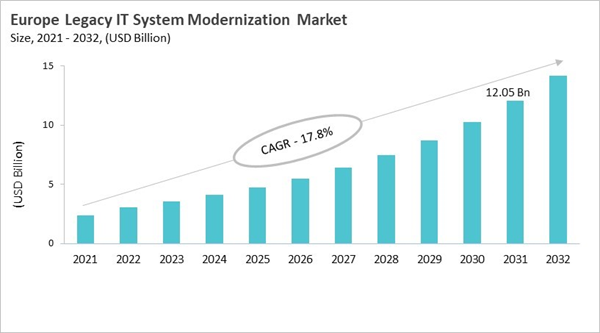
Modernizing outdated IT systems has become a strategic priority for public sector organizations in Europe that want to improve digital sovereignty, cybersecurity, interoperability, and service delivery that puts citizens first. Many governments still use monolithic systems that are decades old to handle important tasks like tax collection, healthcare, social welfare, and border control. These systems are becoming less able to meet the needs of modern regulations, security, and cross-border services. Digital government initiatives in the European Union and national reform programs have led to a focus on modular architectures, API-enabled interoperability, and the use of hybrid or sovereign clouds in modernization efforts. European governments prefer a gradual, risk-balanced transformation that is in line with goals for data protection, compliance, and service continuity, rather than replacing the entire system.
Collaboration between global OEMs like IBM, Microsoft, Google Cloud, and AWS, regional system integrators, and public digital agencies shapes the competitive landscape. The main areas of competition are cloud platforms that are secure and follow European data residency and sovereignty rules, as well as hybrid modernization capabilities. Governments are more and more using portfolio-based modernization strategies, which break down old systems into parts that can work together and add security by design and automated compliance controls. Using shared platforms and working together across government departments makes things even more efficient and cuts down on duplication. Overall, Europe's modernization market shows a planned, long-term approach to change that focuses on resilience, regulatory integrity, and long-term digital public value.
Deployment Type Outlook
Based on Deployment Type, the market is segmented into Cloud and On-Premise. With a compound annual growth rate (CAGR) of 16.1% over the projection period, the Cloud Market, dominate the UK Legacy IT System Modernization Market by Deployment Type in 2024 and would be a prominent market until 2032. The On-Premise market is expected to witness a CAGR of 15.8% during 2025-2032.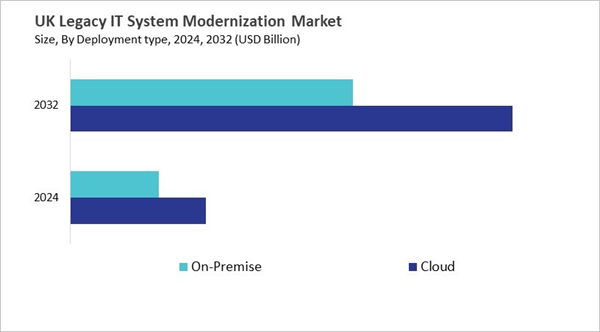
Modernization Approach Outlook
Based on Modernization Approach, the market is segmented into Re-hosting, Re-platforming, Replacement / COTS, Re-architecting and Refactoring. Among various France Legacy IT System Modernization Market by Modernization Approach; The Re-hosting market achieved a market size of USD $149.1 Million in 2024 and is expected to grow at a CAGR of 16.5 % during the forecast period. The Re-architecting market is predicted to experience a CAGR of 18.6% throughout the forecast period from (2025-2032).End-User Industry Outlook
Based on End-User Industry, the market is segmented into BFSI, IT & Telecommunications, Manufacturing, Healthcare, Retail & E-commerce, Government & Public Sector and Other End-User Industry. The BFSI market segment dominated the Germany Legacy IT System Modernization Market by End-User Industry is expected to grow at a CAGR of 13.6 % during the forecast period thereby continuing its dominance until 2032. Also, The Manufacturing market is anticipated to grow as a CAGR of 14.9 % during the forecast period during 2025-2032.Country Outlook
Germany's legacy IT system modernization market is structured and risk-sensitive because of its strong industrial base and federal administrative framework. Many public institutions, utilities, manufacturers, and financial entities still use systems that are decades old and are critical to their operations. This means that modernization is necessary but should be done with great care. National digital strategy priorities, such as cybersecurity, interoperability, and compliance with data protection laws, have a big impact on modernization efforts. Organizations increasingly adopt hybrid and incremental approaches, integrating legacy systems with cloud platforms while aligning with Industry 4.0 objectives. Established companies like SAP, IBM, and Microsoft lead the competition. They set themselves apart by focusing on compliance, stability, and long-term support. Overall, modernization in Germany puts more emphasis on resilience, regulatory alignment, and operational continuity than on quick change.List of Key Companies Profiled
- Accenture PLC
- IBM Corporation
- Cognizant Technology Solutions Corporation
- Infosys Limited
- Tata Consultancy Services Ltd.
- Deloitte Touche Tohmatsu Limited
- Capgemini SE
- Wipro Limited
- HCL Technologies Ltd. (HCL Enterprises)
- DXC Technology Company
Market Report Segmentation
By Component- Services
- Software
- Cloud
- On-Premise
- Large Enterprises
- Small & Medium Enterprises
- Re-hosting
- Re-platforming
- Replacement / COTS
- Re-architecting
- Refactoring
- BFSI
- IT & Telecommunications
- Manufacturing
- Healthcare
- Retail & E-commerce
- Government & Public Sector
- Other End-User Industry
- Germany
- UK
- France
- Russia
- Spain
- Italy
- Rest of Europe
Table of Contents
Chapter 1. Market Scope & Methodology
Chapter 2. Market at a Glance
Chapter 3. Market Overview
Chapter 10. Competition Analysis - Global
Chapter 11. Europe Legacy IT System Modernization Market by Component
Chapter 12. Europe Legacy IT System Modernization Market by Deployment Type
Chapter 13. Europe Legacy IT System Modernization Market by Enterprise Size
Chapter 14. Europe Legacy IT System Modernization Market by Modernization Approach
Chapter 15. Europe Legacy IT System Modernization Market by End-User Industry
Chapter 16. Europe Legacy IT System Modernization Market by Country
Chapter 17. Company Profiles
Companies Mentioned
- Accenture PLC
- IBM Corporation
- Cognizant Technology Solutions Corporation
- Infosys Limited
- Tata Consultancy Services Ltd.
- Deloitte Touche Tohmatsu Limited
- Capgemini SE
- Wipro Limited
- HCL Technologies Ltd. (HCL Enterprises)
- DXC Technology Company


