



The Global Parametric Insurance Market size is estimated at $16.78 billion in 2025 and is expected to reach $32.57 billion by 2032, rising at a market growth of 9.9% CAGR during the forecast period (2025-2032). This growth is being driven by more climate-related disasters, more people wanting quick claims settlements, more agricultural and disaster risk coverage, and more governments and insurers using data to make payouts that are clear.
The parametric insurance market has developed into a transformative segment of the insurance industry by shifting from traditional indemnity-based claims to payout mechanisms triggered by predefined parameters like natural disasters or weather events. Parametric insurance has expanded its footprints across industry verticals such as catastrophe coverage, agriculture, and climate-related risks. This growth has been propelled by advancements into remote sensing, data analytics, and access to high-quality environmental data, which allow faster payouts and risk modelling. International organizations and governments’ supporting initiatives further surged adoption by embedding parametric solutions into resilience frameworks, disaster risk management, and resilience frameworks, strengthening financial protection for businesses and vulnerable communities.
The market growth is majorly driven by elements including rapid technology integration, diversification of applications, and growing focus on climate resilience. Insurers largely use IoT sensors, satellite data, and AI-driven analytics to enhance trigger accuracy, reduce costs, and automate claims. Further, the demand is increasing in agriculture-heavy regions and developing countries because of rising climate risks and limited traditional insurance coverage. Moreover, product innovation is expanding parametric insurance beyond natural catastrophes into areas like travel disruptions, pandemics, and event-based risks. The market competition is increasing with established insurers leveraging scale, regulatory engagement, and reinsurance networks, while new Insurtechs are driving digital innovation and agility, thereby resulting in strategic collaborations and continued innovations in the market.
The major strategies followed by the market participants are Partnerships as the key developmental strategy to keep pace with the changing demands of end users. For instance, In December, 2025, Munich Re came into partnership with KfW and Germany’s Federal Ministry for Economic Affairs and Energy to launch a new geothermal exploration risk cover product, combining low-interest drilling loans with insurance protection to support deep geothermal energy projects. Moreover, In October, 2025, Swiss Re Group entered into a partnership with Willis and subsequently launched a parametric insurance policy triggered by red weather warnings, providing pre-agreed payouts to businesses affected by forecast-based weather disruptions.
Based on the Analysis presented in the KBV Cardinal matrix; Allianz Group, Chubb Limited, and AXA SA are the forerunners in the Parametric Insurance Market. In October, 2025, Allianz Group came into partnership with Swiss Re, along with the Insurance Development Forum and government partners, to launch a parametric flood risk transfer program for urban Ghana, enabling rapid payouts through preset triggers and strengthening disaster response and risk-financing capacity. Companies such as Munich Re Group, Zurich Insurance Group Ltd., and Swiss Re Group are some of the key innovators in Parametric Insurance Market.
The leading players in the market are competing with diverse innovative offerings to remain competitive in the market. The above illustration shows the percentage of revenue shared by some of the leading companies in the market. The leading players of the market are adopting various strategies in order to cater demand coming from the different industries. The key developmental strategies in the market are Acquisitions, and Partnerships & Collaborations.
In the Asia Pacific region, the parametric insurance market is expected to capture a noticeable market share. The market is driven by large agricultural economies, high exposure to natural disasters, and widening insurance protection gaps. Regional nations are largely adopting parametric solutions to address floods, typhoons, earthquakes, and droughts, propelled by enhancing access to mobile technology, satellite data, and government-supported risk pools. Similarly, the LAMEA parametric insurance market is witnessing expansion owing to expanding financial inclusion, increasing climate risks, and strong involvement from sovereign risk-transfer programs, international donors, and development banks. Accelerating digitalization and public-sector support are predicted to surge the adoption of the parametric insurance market.
Price wars are not a part of the competition in the parametric insurance market; instead, companies try to stand out by being creative and different. To stand out, providers focus on making products that are tailored to their customers' needs, improving how technology works together, and forming strategic partnerships. In the competitive landscape, agility, the ability to analyze data, and the speed of settling claims are all important. New companies and niche players keep the market moving, which forces existing companies to keep improving their products and services.
Key Market Trends & Insights:
- The North America market dominated Global Parametric Insurance Market in 2024, accounting for a 38.20% revenue share in 2024.
- The U.S. market is projected to maintain its leadership in North America, reaching a market size of USD 9.12 billion by 2032.
- Among the Type, the Natural Catastrophes Insurance segment dominated the Europe market, contributing a revenue share of 50.48% in 2024.
- In terms of Vertical, Agriculture segment are expected to lead the global market, with a projected revenue share of 30.20% by 2032.
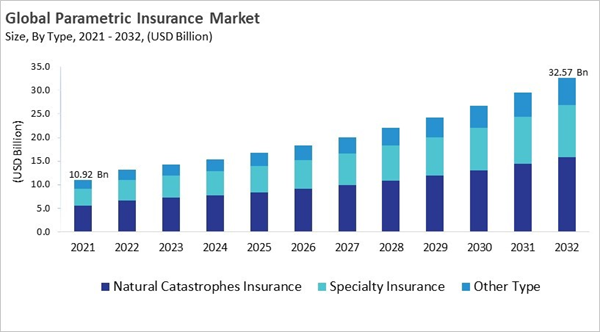
The parametric insurance market has developed into a transformative segment of the insurance industry by shifting from traditional indemnity-based claims to payout mechanisms triggered by predefined parameters like natural disasters or weather events. Parametric insurance has expanded its footprints across industry verticals such as catastrophe coverage, agriculture, and climate-related risks. This growth has been propelled by advancements into remote sensing, data analytics, and access to high-quality environmental data, which allow faster payouts and risk modelling. International organizations and governments’ supporting initiatives further surged adoption by embedding parametric solutions into resilience frameworks, disaster risk management, and resilience frameworks, strengthening financial protection for businesses and vulnerable communities.
The market growth is majorly driven by elements including rapid technology integration, diversification of applications, and growing focus on climate resilience. Insurers largely use IoT sensors, satellite data, and AI-driven analytics to enhance trigger accuracy, reduce costs, and automate claims. Further, the demand is increasing in agriculture-heavy regions and developing countries because of rising climate risks and limited traditional insurance coverage. Moreover, product innovation is expanding parametric insurance beyond natural catastrophes into areas like travel disruptions, pandemics, and event-based risks. The market competition is increasing with established insurers leveraging scale, regulatory engagement, and reinsurance networks, while new Insurtechs are driving digital innovation and agility, thereby resulting in strategic collaborations and continued innovations in the market.
The major strategies followed by the market participants are Partnerships as the key developmental strategy to keep pace with the changing demands of end users. For instance, In December, 2025, Munich Re came into partnership with KfW and Germany’s Federal Ministry for Economic Affairs and Energy to launch a new geothermal exploration risk cover product, combining low-interest drilling loans with insurance protection to support deep geothermal energy projects. Moreover, In October, 2025, Swiss Re Group entered into a partnership with Willis and subsequently launched a parametric insurance policy triggered by red weather warnings, providing pre-agreed payouts to businesses affected by forecast-based weather disruptions.
KBV Cardinal Matrix - Market Competition Analysis
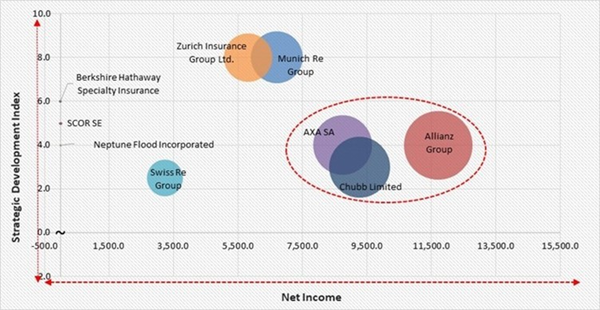
Based on the Analysis presented in the KBV Cardinal matrix; Allianz Group, Chubb Limited, and AXA SA are the forerunners in the Parametric Insurance Market. In October, 2025, Allianz Group came into partnership with Swiss Re, along with the Insurance Development Forum and government partners, to launch a parametric flood risk transfer program for urban Ghana, enabling rapid payouts through preset triggers and strengthening disaster response and risk-financing capacity. Companies such as Munich Re Group, Zurich Insurance Group Ltd., and Swiss Re Group are some of the key innovators in Parametric Insurance Market.
COVID-19 Impact Analysis
The COVID-19 pandemic had a minor impact on the market at first. This was because of economic uncertainty, less business activity, and project delays in important areas like travel, aviation, energy, and construction. Organizations put keeping their cash flow first, which meant putting off investments in new insurance solutions for a while. This slowed down the issuance of new policies and the development of partnerships in 2020. Operational problems, like moving to remote work and short-term delays in underwriting, data collection, and risk modeling - especially in emerging markets - slowed growth even more. Volatility in the capital markets also made it harder for people to invest in insurance-linked securities. Regulatory scrutiny and a re-evaluation of product structures, especially those related to pandemic coverage, also slowed down the decision-making process. However, since parametric insurance is mostly about natural disasters and climate risks, the overall effect was small. By the end of 2021, the market had picked up again, which is good for long-term growth. Thus, the COVID-19 pandemic had a mild negative impact on the market.Driving and Restraining Factors
Drivers- Rising Frequency And Severity Of Catastrophic Natural Events
- Advancements In Data Analytics And Technology Integration
- Increasing Demand For Rapid Liquidity And Financial Resilience
- Expanding Adoption By Emerging Markets And Governments
- Basis Risk And Trigger Mechanism Complexity
- Limited Regulatory Framework And Standardization
- Limited Awareness And Understanding Among Potential Policyholders
- Expansion Through Climate Change-Driven Demand
- Integration Of Advanced Technologies For Enhanced Product Innovation
- Growing Interest From Capital Markets And Alternative Risk Transfer Channels
- Data Accuracy And Verification Complexities
- Regulatory Ambiguity And Fragmentation
- Limited Awareness And Market Education
Market Share Analysis
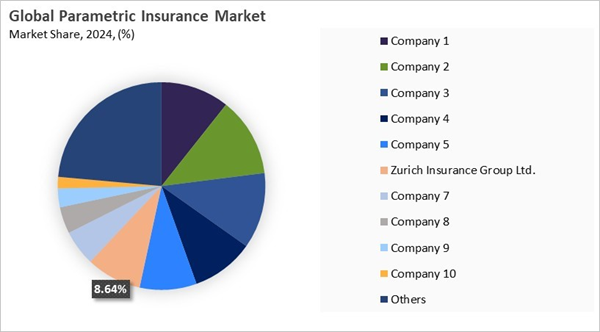
The leading players in the market are competing with diverse innovative offerings to remain competitive in the market. The above illustration shows the percentage of revenue shared by some of the leading companies in the market. The leading players of the market are adopting various strategies in order to cater demand coming from the different industries. The key developmental strategies in the market are Acquisitions, and Partnerships & Collaborations.
Type Outlook
Based on Type, the market is segmented into Natural Catastrophes Insurance, Specialty Insurance, and Other Type. The Specialty Insurance segment attained 33% revenue share in the market in 2024. This segment encompasses parametric solutions designed for niche and complex risks that are not always efficiently covered under conventional insurance structures. Specialty parametric products are commonly structured for sectors such as energy, aviation, marine, construction, tourism, and event management, where operational disruptions can be directly linked to measurable parameters like temperature fluctuations, wind speed thresholds, or lack of snowfall.Vertical Outlook
Based on Vertical, the market is segmented into Agriculture, Energy & Utilities, Construction, Manufacturing, Mining, Aerospace & Defense, and Other Vertical. The Energy & Utilities segment attained 17% revenue share in the market in 2024. Companies operating in power generation, renewable energy, and utility distribution networks face operational and revenue volatility due to weather fluctuations and natural hazards. Parametric insurance solutions in this vertical are typically structured around measurable variables such as wind speed, solar irradiance, temperature levels, or precipitation patterns that directly influence energy production and infrastructure performance.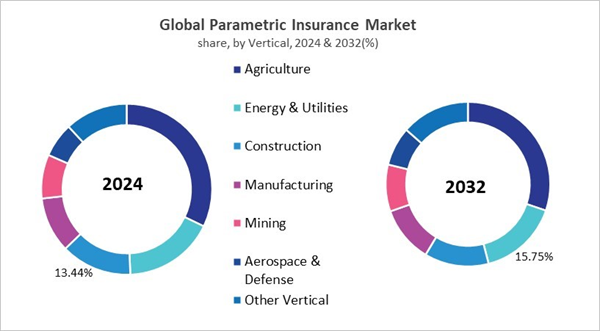
Regional Outlook
Region-wise, the parametric insurance market is analyzed across North America, Europe, Asia Pacific, and LAMEA. The North America segment recorded 38% revenue share in the market in 2024. The parametric insurance market is predicted to expand at a prominent rate in the North America and Europe regions. This is because the region benefits from high insurance penetration, advanced data infrastructure, and strong participation from insurers, reinsurers, and technology providers. Parametric solutions are largely adopted from natural catastrophes like earthquakes, hurricanes, and wildfires. Further, the presence of sophisticated satellite data providers, climate modelling capabilities, and supportive regulatory experimentation has surged customization and product innovation. Likewise, Europe parametric insurance market is growing, supported by regulatory focus on disaster resilience, rising climate volatility, and public-private partnerships. Also, European governments and multilateral institutions widely integrate parametric insurance into risk-transfer frameworks and climate adaptation, especially for drought, flood, and windstorm coverage, thereby offering lucrative market opportunities.In the Asia Pacific region, the parametric insurance market is expected to capture a noticeable market share. The market is driven by large agricultural economies, high exposure to natural disasters, and widening insurance protection gaps. Regional nations are largely adopting parametric solutions to address floods, typhoons, earthquakes, and droughts, propelled by enhancing access to mobile technology, satellite data, and government-supported risk pools. Similarly, the LAMEA parametric insurance market is witnessing expansion owing to expanding financial inclusion, increasing climate risks, and strong involvement from sovereign risk-transfer programs, international donors, and development banks. Accelerating digitalization and public-sector support are predicted to surge the adoption of the parametric insurance market.
Market Competition and Attributes
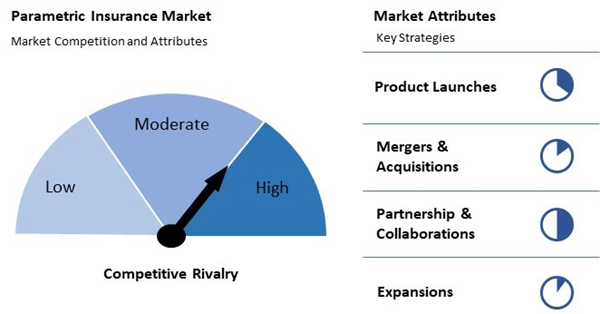
Price wars are not a part of the competition in the parametric insurance market; instead, companies try to stand out by being creative and different. To stand out, providers focus on making products that are tailored to their customers' needs, improving how technology works together, and forming strategic partnerships. In the competitive landscape, agility, the ability to analyze data, and the speed of settling claims are all important. New companies and niche players keep the market moving, which forces existing companies to keep improving their products and services.
Recent Strategies Deployed in the Market
- Jan-2026: Berkshire Hathaway Specialty Insurance (BHSI) launched its Executive First D&O Liability+ in the UK, providing large commercial and financial firms with enhanced, flexible coverage, including expanded Side A protections, broad risk safeguards, and dedicated support services for evolving executive liability exposures.
- Jan-2026: Berkshire Hathaway Specialty Insurance (BHSI) launched its BH FastCAT parametric insurance in Germany under the leadership of Kim Schumacher, Head of General Property, offering innovative coverage for complex property, technical, and specialty risks while reinforcing BHSI’s expertise in advanced risk management.
- Dec-2025: Zurich Insurance Group Ltd. introduced Data Center Project Guard, a first-of-its-kind Builders Risk solution featuring parametric weather coverage and operational property protection, designed to safeguard hyperscale, AI-driven data center construction from delays, climate risks, and complex loss exposures.
- Oct-2025: Munich Re Group came into partnership with Gallagher and New India Assurance to launch India’s first parametric pandemic insurance policy, providing trigger-based payouts for business interruption losses caused by epidemic and pandemic outbreaks.
- Oct-2025: Chubb Limited launched Travel Pro, a digital parametric travel insurance embedded in booking platforms, offering automatic, fast payouts for delays, baggage issues, bad weather, and medical emergencies, using predefined triggers and technology-driven claims to simplify protection for travelers.
- Aug-2025: AXA Hong Kong and Macau came into partnership with MOTOGO to launch Tropical Cyclone Coverage, a parametric insurance product offering automatic payouts triggered by typhoon signals, alongside cross-boundary travel insurance, reflecting innovation in climate risk protection and regional mobility coverage.
List of Key Companies Profiled
- AXA SA
- Swiss Re Group
- Munich Re Group
- Allianz Group
- Chubb Limited
- Zurich Insurance Group Ltd.
- Berkshire Hathaway Specialty Insurance
- SCOR SE
- FloodFlash Limited
- Neptune Flood Incorporated
Market Report Segmentation
By Type- Natural Catastrophes Insurance
- Specialty Insurance
- Other Type
- Agriculture
- Energy & Utilities
- Construction
- Manufacturing
- Mining
- Aerospace & Defense
- Other Vertical
- North America
- US
- Canada
- Mexico
- Rest of North America
- Europe
- Germany
- UK
- France
- Russia
- Spain
- Italy
- Rest of Europe
- Asia Pacific
- China
- Japan
- India
- South Korea
- Singapore
- Malaysia
- Rest of Asia Pacific
- LAMEA
- Brazil
- Argentina
- UAE
- Saudi Arabia
- South Africa
- Nigeria
- Rest of LAMEA
Table of Contents
Chapter 1. Market Scope & Methodology
Chapter 2. Market at a Glance
Chapter 3. Market Overview
Chapter 10. Competition Analysis - Global
Chapter 11. Global Parametric Insurance Market by Type
Chapter 12. Global Parametric Insurance Market by Vertical
Chapter 13. Global Parametric Insurance Market by Region
Chapter 14. Company Profiles
Companies Mentioned
- AXA SA
- Swiss Re Group
- Munich Re Group
- Allianz Group
- Chubb Limited
- Zurich Insurance Group Ltd.
- Berkshire Hathaway Specialty Insurance
- SCOR SE
- FloodFlash Limited
- Neptune Flood Incorporated


