



The Latin America, Middle East and Africa AI-Based Personalization Engines Market is expected to reach $58.24 billion by 2029 and is expected to witness market growth of 6.5% CAGR during the forecast period (2025-2032).
The Brazil market dominated the LAMEA AI-Based Personalization Engines Market by country in 2024, and is expected to continue to be a dominant market till 2032; thereby, achieving a market value of $16.54 billion by 2032. The Argentina market is registering a CAGR of 7.2% during 2025-2032. Additionally, the UAE market is expected to showcase a CAGR of 5.1% during 2025-2032. The Brazil and UAE led the LAMEA AI-Based Personalization Engines Market by Country with a market share of 25.9% and 10.6% in 2024. The South Africa market is expected to witness a CAGR of 7.9% during throughout the forecast period.
The LAMEA (Latin America, Middle East, and Africa) AI-based personalization engines market is growing as part of larger efforts to adopt AI and digital transformation. Governments are pushing for digital services that are based on data and focus on the user. Examples include the UAE Digital Government Strategy 2025 and regional digitization programs backed by groups like the Inter-American Development Bank. These policies don't directly target personalization engines, but they do build a strong base by improving data infrastructure, integrating AI, and using modern digital platforms. More people are using AI personalization in retail, banking, telecom, and public services because more people are using mobile phones, e-commerce is growing, and customers want better engagement. Businesses are starting to see personalization as a keyway to make services more efficient and customers happier.
Companies in LAMEA are using AI personalization in e-commerce, CRM, and digital service platforms to give customers real-time, context-aware experiences. This is good for business and for competition. These systems go beyond rule-based models by learning from user interactions and making predictions about what users will like. IBM, SAP, Salesforce, and Adobe are some of the biggest global technology companies that sell core AI personalization tools. They compete on how well their tools can scale, how deep their analytics are, and how well they work across channels. Faster AI deployment is happening because governments and technology companies are working together. Digital infrastructure development, business adoption, and competitive innovation are what really shape the market, not government market programs that stand on their own.
The Brazil market dominated the LAMEA AI-Based Personalization Engines Market by country in 2024, and is expected to continue to be a dominant market till 2032; thereby, achieving a market value of $16.54 billion by 2032. The Argentina market is registering a CAGR of 7.2% during 2025-2032. Additionally, the UAE market is expected to showcase a CAGR of 5.1% during 2025-2032. The Brazil and UAE led the LAMEA AI-Based Personalization Engines Market by Country with a market share of 25.9% and 10.6% in 2024. The South Africa market is expected to witness a CAGR of 7.9% during throughout the forecast period.
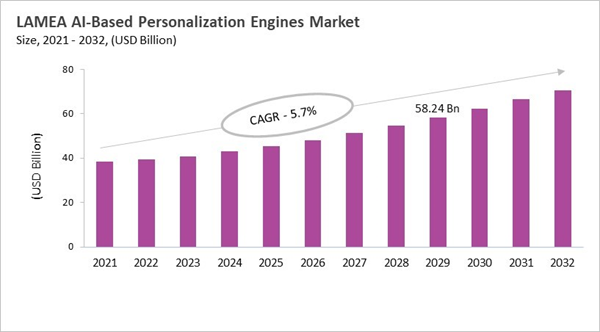
The LAMEA (Latin America, Middle East, and Africa) AI-based personalization engines market is growing as part of larger efforts to adopt AI and digital transformation. Governments are pushing for digital services that are based on data and focus on the user. Examples include the UAE Digital Government Strategy 2025 and regional digitization programs backed by groups like the Inter-American Development Bank. These policies don't directly target personalization engines, but they do build a strong base by improving data infrastructure, integrating AI, and using modern digital platforms. More people are using AI personalization in retail, banking, telecom, and public services because more people are using mobile phones, e-commerce is growing, and customers want better engagement. Businesses are starting to see personalization as a keyway to make services more efficient and customers happier.
Companies in LAMEA are using AI personalization in e-commerce, CRM, and digital service platforms to give customers real-time, context-aware experiences. This is good for business and for competition. These systems go beyond rule-based models by learning from user interactions and making predictions about what users will like. IBM, SAP, Salesforce, and Adobe are some of the biggest global technology companies that sell core AI personalization tools. They compete on how well their tools can scale, how deep their analytics are, and how well they work across channels. Faster AI deployment is happening because governments and technology companies are working together. Digital infrastructure development, business adoption, and competitive innovation are what really shape the market, not government market programs that stand on their own.
Component Outlook
Based on Component, the market is segmented into Software, and Services. The Software market segment dominated the Brazil AI-Based Personalization Engines Market by Component is expected to grow at a CAGR of 4.9 % during the forecast period thereby continuing its dominance until 2032. Also, The Services market is anticipated to grow as a CAGR of 5.6 % during the forecast period during 2025-2032.End Use Outlook
Based on End Use, the market is segmented into Retail & E-commerce, BFSI, IT & Telecom, Media & Entertainment, Healthcare, Travel & Hospitality, Education, Automotive, and Other End Use. Among various South Africa AI-Based Personalization Engines Market by End Use; The Retail & E-commerce market achieved a market size of USD $844.8 Million in 2024 and is expected to grow at a CAGR of 6 % during the forecast period. The Education market is predicted to experience a CAGR of 8.9% throughout the forecast period from (2025-2032).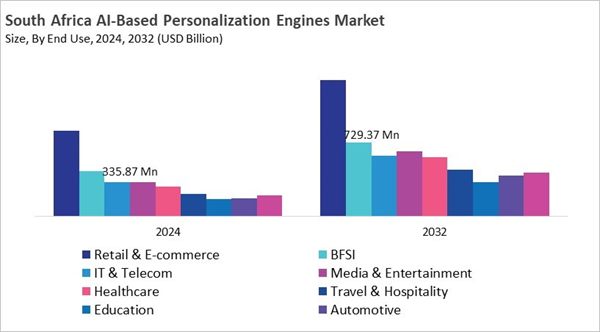
Country Outlook
Brazil is the largest and most digitally advanced market for AI-based personalization engines in Latin America, driven by rapid e-commerce growth, high social media usage, and expanding digital financial services. AI personalization is widely used to customize product recommendations, content, and customer interactions across digital platforms. Strong consumer activity and rising enterprise investment in cloud and analytics accelerate adoption. Market trends show a shift from basic segmentation to real-time, predictive personalization using machine learning. AI is also expanding into customer support, loyalty programs, and digital advertising. Competition includes domestic providers, regional platforms, and global OEMs offering cloud-based solutions. Overall, the market shows strong growth and rising technological sophistication.List of Key Companies Profiled
- Amazon Web Services, Inc. (Amazon.com, Inc.)
- Google LLC
- IBM Corporation
- Microsoft Corporation
- Twilio Inc.
- Adobe, Inc.
- SAP SE
- Salesforce, Inc.
- Oracle Corporation
- Optimizely, Inc.
Market Report Segmentation
By Component- Software
- Services
- Cloud
- On-premises
- Website Personalization
- Display Ads Personalization
- Social Media Personalization
- Email Personalization
- Other Application
- Machine Learning & Deep Learning
- Hybrid Recommendation Systems
- Collaborative Filtering
- Content-Based Filtering
- Natural Language Processing (NLP)
- Other Technology
- Retail & E-commerce
- BFSI
- IT & Telecom
- Media & Entertainment
- Healthcare
- Travel & Hospitality
- Education
- Automotive
- Other End Use
- Brazil
- Argentina
- UAE
- Saudi Arabia
- South Africa
- Nigeria
- Rest of LAMEA
Table of Contents
Chapter 1. Market Scope & Methodology
Chapter 2. Market at a Glance
Chapter 3. Market Overview
Chapter 10. Competition Analysis - Global
Chapter 11. LAMEA AI-Based Personalization Engines Market by Component
Chapter 12. LAMEA AI-Based Personalization Engines Market by Deployment
Chapter 13. LAMEA AI-Based Personalization Engines Market by Application
Chapter 14. LAMEA AI-Based Personalization Engines Market by Technology
Chapter 15. LAMEA AI-Based Personalization Engines Market by End Use
Chapter 16. LAMEA AI-Based Personalization Engines Market by Country
Chapter 17. Company Profiles
Companies Mentioned
- Amazon Web Services, Inc. (Amazon.com, Inc.)
- Google LLC
- IBM Corporation
- Microsoft Corporation
- Twilio Inc.
- Adobe, Inc.
- SAP SE
- Salesforce, Inc.
- Oracle Corporation
- Optimizely, Inc.


