



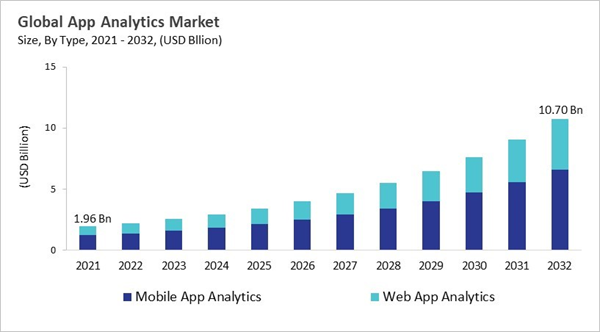
The Global App Analytics Market size is estimated at $3.42 billion in 2025 and is expected to reach $10.70 billion by 2032, rising at a market growth of 17.7% CAGR during the forecast period (2025-2032). The strong growth of this market is justified by rapid smartphone penetration, rising mobile app usage across industries, increased demand for real-time user behavior insights, AI-driven analytics adoption, and growing focus on personalized user experiences, performance optimization, and data-driven decision-making worldwide.
The app analytics market has developed along with the rapid growth of web and mobile applications, as enterprises increasingly rely on data to understand user behaviour, enhance digital engagement, and optimize performance. App analytics has evolved as a core capability supporting personalization, product improvement, and operational efficiency. Key platform providers like Apple and Google have played an essential role by embedding analytics into their developer ecosystems, whereas regulatory frameworks such as GDPR have reshaped the app analytics market by prioritizing data security, prioritizing consent, and transparency. The app analytics market has transformed from a technical add-on to a strategic function embedded throughout the application lifecycle.
The app analytics market is propelled by trends including real-time and event-based monitoring, AI-driven analytics, and privacy-first data architectures. AI allows predictive insights and proactive optimization, while real-time analytics support modern use cases like live services and digital payments. Privacy-preserving approaches- prioritizing data minimization, aggregation, and user trust- have become crucial to innovation. The competitive landscape of the market comprises large platform providers offering integrated solutions along with specialized providers focused on flexibility and advanced behavioral insights. The app analytics market is largely driven by usability for non-technical teams, ecosystem integration, and regulatory compliance.
The leading players in the market are competing with diverse innovative offerings to remain competitive in the market. The above illustration shows the percentage of revenue shared by some of the leading companies in the market. The leading players of the market are adopting various strategies in order to cater demand coming from the different industries. The key developmental strategies in the market are Acquisitions, and Partnerships & Collaborations.
In the Asia Pacific and LAMEA regions, the app analytics market is anticipated to grow at a steady rate. The expansion is supported by rapid digitalization across various sectors, a growing base of smartphone users, and a vibrant start-up ecosystem. Regional nations like Japan, China, and India are key contributors, with e-commerce, mobile gaming, and social applications, accelerating demand for predictive and real-time analytics solutions. Also, the growth is propelled by increasing investment in 5G infrastructure and digital transformation initiatives that prioritize performance insights and user experience optimization. Additionally, the LAMEA app analytics market is offering lucrative opportunities. This is because of expanding mobile adoption and digital services. The Latin America region is driven by surging internet connectivity and demand for analytics in e-commerce and fintech apps. Further, the Middle East and Africa is witnessing increasing investment in mobile infrastructure and digital transformation agendas, encouraging organizations to adopt analytics tools for engagement and performance tracking.
Key Market Trends & Insights:
- The North America market dominated Global App Analytics Market in 2024, accounting for a 36.90% revenue share in 2024.
- The U.S. market is projected to maintain its leadership in North America, reaching a market size of USD 2.74 billion by 2032.
- Among the Type, the Mobile App Analytics segment dominated the Europe market, contributing a revenue share of 62.54% in 2024.
- In terms of Deployment, Cloud segment are expected to lead the Asia Pacific market, with a projected revenue share of 73.38% by 2032.
- The Software market emerged as the leading Component in 2024, capturing a 65.84% revenue share, and is projected to retain its dominance during the forecast period.
- The Marketing Analytics Market in Application is poised to grow at the market in 2032 in North America with a market size of USD 1.02 billion and is projected to maintain its dominant position throughout the forecast period.
- By Vertical the Gaming & Entertainment Segment captured the market size of USD 681.5 million in 2024 and this segment will maintain its position during the forecast period.
The app analytics market has developed along with the rapid growth of web and mobile applications, as enterprises increasingly rely on data to understand user behaviour, enhance digital engagement, and optimize performance. App analytics has evolved as a core capability supporting personalization, product improvement, and operational efficiency. Key platform providers like Apple and Google have played an essential role by embedding analytics into their developer ecosystems, whereas regulatory frameworks such as GDPR have reshaped the app analytics market by prioritizing data security, prioritizing consent, and transparency. The app analytics market has transformed from a technical add-on to a strategic function embedded throughout the application lifecycle.
The app analytics market is propelled by trends including real-time and event-based monitoring, AI-driven analytics, and privacy-first data architectures. AI allows predictive insights and proactive optimization, while real-time analytics support modern use cases like live services and digital payments. Privacy-preserving approaches- prioritizing data minimization, aggregation, and user trust- have become crucial to innovation. The competitive landscape of the market comprises large platform providers offering integrated solutions along with specialized providers focused on flexibility and advanced behavioral insights. The app analytics market is largely driven by usability for non-technical teams, ecosystem integration, and regulatory compliance.
Driving and Restraining Factors
Drivers- Rising Global Mobile App Usage And Engagement
- Demand For Deep User Behavior Insights
- App Performance Monitoring And UX Optimization Needs
- Monetization And Marketing Performance Optimization
- Data Privacy Regulations And Compliance Challenges
- Implementation Complexity, Integration Costs And Technical Barriers
- Security Vulnerabilities And Data Protection Risks
- Ai-Driven Behavioral Intelligence Embedded Directly Into App Development Platforms
- Real-Time App Analytics For In-App Experience Optimization And Operational Responsiveness
- Privacy-First App Analytics Aligned With Platform-Level Data Protection Architectures
- Data Privacy, Security And Regulatory Compliance Challenges
- Integration Of Real-Time, Cross-Platform And High-Velocity Data Streams
- Maintaining Transparency And Trust In Data Collection Practices
Market Share Analysis
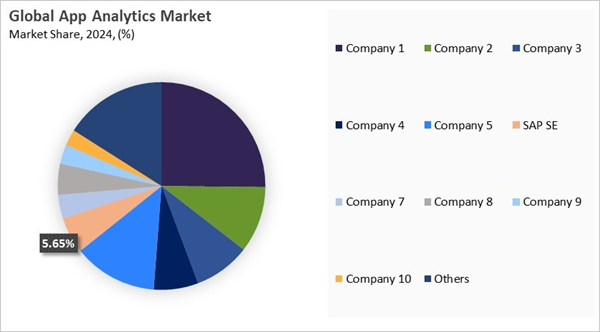
The leading players in the market are competing with diverse innovative offerings to remain competitive in the market. The above illustration shows the percentage of revenue shared by some of the leading companies in the market. The leading players of the market are adopting various strategies in order to cater demand coming from the different industries. The key developmental strategies in the market are Acquisitions, and Partnerships & Collaborations.
COVID-19 Impact Analysis
The COVID-19 pandemic had a beneficial impact on the app analytics market because it sped up the use of technology in fields like e-commerce, healthcare, education, gaming, and fintech. The number of app downloads and daily active users shot up, making it necessary to use advanced analytics to keep an eye on user behavior, improve performance, and provide smooth experiences on a large scale. The widespread move to remote work made the need for real-time insights even stronger, which helped businesses improve productivity, engagement, and feature adoption. Also, more competition pushed businesses to make decisions based on data, create personalized experiences for users, and use targeted marketing strategies. The growing use of cloud-based analytics tools, especially by small and medium-sized businesses, helped businesses grow in a way that was both scalable and cost-effective. This showed that app analytics will still be important for long-term strategy even after the pandemic. Thus, the COVID-19 pandemic had a Positive impact on the market.Type Outlook
Based on Type, the market is segmented into Mobile App Analytics, and Web App Analytics. The web app analytics segment attained 38% revenue share in the app analytics market in 2024. Web app analytics focuses on analyzing user interactions and performance metrics associated with browser-based applications and web platforms. Businesses use web app analytics to monitor user journeys, navigation patterns, conversion flows, and engagement across web interfaces. These analytics solutions help organizations understand how users interact with web-based services, identify usability challenges, and improve overall digital experience.Deployment Outlook
Based on Deployment, the market is segmented into Cloud, and On-Premise. The on-premise segment recorded 27% revenue share in the app analytics market in 2024. On-premise deployment in the app analytics market caters to organizations that require greater control over data management, security, and system customization. These solutions are installed and managed within an organization’s own infrastructure, allowing direct oversight of data storage and processing. On-premise app analytics is often adopted by organizations with strict regulatory, compliance, or internal governance requirements.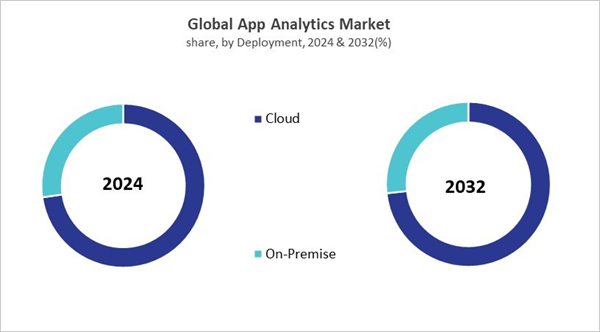
Regional Outlook
Region-wise, the App Analytics Market is analyzed across North America, Europe, Asia Pacific, and LAMEA. The North America segment recorded 37% revenue share in the App Analytics Market in 2024. The app analytics market is estimated to experience prominent expansion in the North America and Europe region. This is because of advanced digital infrastructure, widespread smartphone penetration, and strong organization adoption of analytics solutions, particularly in Canada and Unites States. Enterprises across industry are investing largely in sophisticated analytics platforms to drive customized user experiences, data-driven decision making, and performance optimization. This region also benefits from a dense concentration of tech vendors, early technology adoption, and significant innovation in AI-driven and cloud-based analytics capabilities. Moreover, the European app analytics market is predicted to capture a noticeable market share. The market is driven by strict data protection and privacy regulations, which shape the deployment of analytics solutions to maintain compliance. This regulatory strictness encourages the development of privacy-centric analytics, thereby accelerating the demand for analytics tools that balance insight generation with security requirements and governance.In the Asia Pacific and LAMEA regions, the app analytics market is anticipated to grow at a steady rate. The expansion is supported by rapid digitalization across various sectors, a growing base of smartphone users, and a vibrant start-up ecosystem. Regional nations like Japan, China, and India are key contributors, with e-commerce, mobile gaming, and social applications, accelerating demand for predictive and real-time analytics solutions. Also, the growth is propelled by increasing investment in 5G infrastructure and digital transformation initiatives that prioritize performance insights and user experience optimization. Additionally, the LAMEA app analytics market is offering lucrative opportunities. This is because of expanding mobile adoption and digital services. The Latin America region is driven by surging internet connectivity and demand for analytics in e-commerce and fintech apps. Further, the Middle East and Africa is witnessing increasing investment in mobile infrastructure and digital transformation agendas, encouraging organizations to adopt analytics tools for engagement and performance tracking.
Recent Strategies Deployed in the Market
- Mar-2025: Adobe, Inc. unveiled the Adobe Experience Platform (AEP) Agent Orchestrator, which allows businesses to build and manage AI agents across various ecosystems. These agents, including tools for marketing, personalization, and content optimization, aim to enhance customer experiences. Adobe also launched the Brand Concierge, a new app that offers tailored, immersive, and conversational experiences for customers. Strategic partnerships with major tech companies ensure seamless integration across various AI-powered workflows.
- Feb-2025: SAP SE unveiled new generative AI features in its Business Data Fabric within SAP Datasphere. These updates aim to streamline data access and context across different systems. The AI-driven enhancements help businesses quickly find, connect, and use data efficiently, supporting smarter decision-making and improved business operations through a unified data experience.
- Dec-2024: Amazon Web Services, Inc. teamed up with Adobe to integrate the Adobe Experience Platform with AWS, enabling brands to enhance customer engagement. The collaboration focuses on providing deeper insights and helping businesses create personalized experiences. This aims to boost customer satisfaction through better data-driven decision-making and seamless integrations.
- Feb-2023: Kochava Inc. announced the acquisition of Machine Advertising, a UK-based mobile attribution and marketing analytics firm. This move enhances Kochava’s mobile measurement capabilities and strengthens its global presence. The acquisition aligns with Kochava’s strategy to provide advanced tools for marketers, improving campaign performance and user engagement across mobile platforms.
- Jun-2022: Google LLC unveiled updates to Firebase Crashlytics, including improved Flutter app crash reporting, enhanced developer productivity, crash filtering, and better unity crash handling.
- Jun-2022: Adobe, Inc. unveiled new services in Adobe Analytics, delivering a single workspace for brands to unify data and insights across all media types including the metaverse and streaming media with global brands adopting Adobe Analytics, and also launched a new service to transition data from other analytics products while preserving historical compliance with regulations such as Global Data Protection Regulation (GDPR) and California Consumer Privacy Act (CCPA).
List of Key Companies Profiled
- Google LLC (Alphabet Inc.)
- Microsoft Corporation
- Amazon Web Services, Inc. (Amazon.com, Inc.)
- IBM Corporation
- Adobe, Inc.
- SAP SE
- Upland Software, Inc.
- Kochava Inc.
- Qonversion, Inc.
- Taplytics Inc.
Market Report Segmentation
By Type- Mobile App Analytics
- Web App Analytics
- Cloud
- On-Premise
- Software
- Services
- Marketing Analytics
- Performance Analytics
- In-App Analytics
- Revenue Analytics
- Other Application
- Gaming & Entertainment
- Retail & E-commerce
- Social Media
- IT & Telecommunications
- BFSI
- Health & Fitness
- Travel & Hospitality
- Education & Learning
- Other Verticals
- North America
- US
- Canada
- Mexico
- Rest of North America
- Europe
- Germany
- UK
- France
- Russia
- Spain
- Italy
- Rest of Europe
- Asia Pacific
- China
- Japan
- India
- South Korea
- Singapore
- Malaysia
- Rest of Asia Pacific
- LAMEA
- Brazil
- Argentina
- UAE
- Saudi Arabia
- South Africa
- Nigeria
- Rest of LAMEA
Table of Contents
Chapter 1. Market Scope & Methodology
Chapter 2. Market at a Glance
Chapter 3. Market Overview
Chapter 10. Competition Analysis - Global
Chapter 11. Global App Analytics Market by Type
Chapter 12. Global App Analytics Market by Deployment
Chapter 13. Global App Analytics Market by Component
Chapter 14. Global App Analytics Market by Application
Chapter 15. Global App Analytics Market by Vertical
Chapter 16. Global App Analytics Market by Region
Chapter 17. Company Profiles
Companies Mentioned
- Google LLC (Alphabet Inc.)
- Microsoft Corporation
- Amazon Web Services, Inc. (Amazon.com, Inc.)
- IBM Corporation
- Adobe, Inc.
- SAP SE
- Upland Software, Inc.
- Kochava Inc.
- Qonversion, Inc.
- Taplytics Inc.


