



The Asia Pacific Bot Services Market is expected to reach $2.02 billion by 2027 and is expected to witness market growth of 29.8% CAGR during the forecast period (2025-2032).
The China market dominated the Asia Pacific Bot Services Market by country in 2024, and is expected to continue to be a dominant market till 2032; thereby, achieving a market value of $2.18 billion by 2032. The Japan market is showcasing a CAGR of 28.9% during 2025-2032. Additionally, the India market would register a CAGR of 30.5% during 2025-2032. The China and India led the Asia Pacific Bot Services Market by Country with a market share of 32.4% and 19.7% in 2024.The Malaysia market is expected to witness a CAGR of 33% during throughout the forecast period.
The Asia Pacific bot services market has grown from simple rule-based automation to advanced AI-driven digital agents. This is thanks to the quick adoption of NLP, machine learning, and cloud infrastructure. Businesses in the area are using bots more in their main operations to help with customer service, automate workflows, and make predictions. Generative AI platforms, cloud region expansion, and enterprise AI frameworks from big companies like Microsoft and Google have sped up this change. Government digital strategies and regional policy initiatives make adoption even more likely, making bots key to digital transformation in all industries.
Some important trends are the growth of generative AI conversational agents, the deep integration of these agents with business systems, and the use of hybrid or multi-cloud deployment models. Leaders focus on AI-first strategies, training workers to use new technologies, and creating bots that are specific to their industry to get the most value out of their businesses. Global cloud providers, regional system integrators, and businesses that make their own bots all compete. They do this by being faster at coming up with new ideas, making their bots work better in different places, and having a stronger ecosystem. Overall, the market is marked by fast innovation, a lot of influence from OEMs, and wide adoption by businesses and employees.
The China market dominated the Asia Pacific Bot Services Market by country in 2024, and is expected to continue to be a dominant market till 2032; thereby, achieving a market value of $2.18 billion by 2032. The Japan market is showcasing a CAGR of 28.9% during 2025-2032. Additionally, the India market would register a CAGR of 30.5% during 2025-2032. The China and India led the Asia Pacific Bot Services Market by Country with a market share of 32.4% and 19.7% in 2024.The Malaysia market is expected to witness a CAGR of 33% during throughout the forecast period.
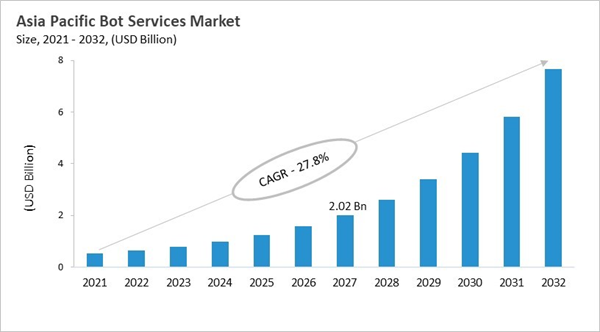
The Asia Pacific bot services market has grown from simple rule-based automation to advanced AI-driven digital agents. This is thanks to the quick adoption of NLP, machine learning, and cloud infrastructure. Businesses in the area are using bots more in their main operations to help with customer service, automate workflows, and make predictions. Generative AI platforms, cloud region expansion, and enterprise AI frameworks from big companies like Microsoft and Google have sped up this change. Government digital strategies and regional policy initiatives make adoption even more likely, making bots key to digital transformation in all industries.
Some important trends are the growth of generative AI conversational agents, the deep integration of these agents with business systems, and the use of hybrid or multi-cloud deployment models. Leaders focus on AI-first strategies, training workers to use new technologies, and creating bots that are specific to their industry to get the most value out of their businesses. Global cloud providers, regional system integrators, and businesses that make their own bots all compete. They do this by being faster at coming up with new ideas, making their bots work better in different places, and having a stronger ecosystem. Overall, the market is marked by fast innovation, a lot of influence from OEMs, and wide adoption by businesses and employees.
Deployment Channel Outlook
Based on Deployment Channel, the market is segmented into Website (Web-based), Social / Messaging Platforms, Voice / IVR Customer-Care, Mobile Application (In-app) and Email and In-Product Widgets. Among various China Bot Services Market by Deployment Channel; The Website (Web-based) market achieved a market size of USD $120.2 Million in 2024 and is expected to grow at a CAGR of 26.9 % during the forecast period. The Mobile Application (In-app) market is predicted to experience a CAGR of 29% throughout the forecast period from (2025-2032).Organization Size Outlook
Based on Organisation Size, the market is segmented into Large Enterprises and Small and Mid-sized Enterprises (SMEs). The Large Enterprises market segment dominated the Singapore Bot Services Market by Organization Size is expected to grow at a CAGR of 31.3 % during the forecast period thereby continuing its dominance until 2032. Also, The Small and Mid-sized Enterprises (SMEs) market is anticipated to grow as a CAGR of 32.7 % during the forecast period during 2025-2032.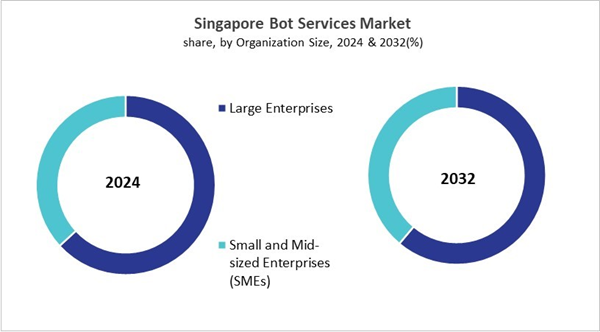
Country Outlook
China has one of the biggest and most advanced bot services ecosystems in the Asia Pacific region. This is because it has a lot of digital users and strong domestic technology platforms. Bots are used a lot in e-commerce, finance, telecom, logistics, and public services because people are used to using automated digital interfaces. Domestic OEMs like Alibaba Cloud and Tencent Cloud are the market leaders because they offer cloud platforms and conversational AI that work together. Government policies that support digitalization and AI in industry make it even more likely that businesses and public services will use bots. Market trends show that bots that are smart, aware of their surroundings, and can understand voice commands are becoming more popular. These bots can work with smart devices and business systems. Competition is driven by ecosystems, and local platforms and system integrators decide how to solve problems. Overall, China's market is characterized by its size, advanced technology, and strong government support, which will lead to more people using bots.List of Key Companies Profiled
- Microsoft Corporation
- Google LLC (Alphabet Inc.)
- OpenAI, LLC
- HubSpot, Inc.
- IBM Corporation
- Amazon Web Services, Inc. (Amazon.com, Inc.)
- Salesforce, Inc.
- SAP SE
- Drift Innovation Limited
- Baidu, Inc.
Market Report Segmentation
By Deployment Channel- Website (Web-based)
- Social / Messaging Platforms
- Voice / IVR Customer-Care
- Mobile Application (In-app)
- Email and In-Product Widgets
- Large Enterprises
- Small and Mid-sized Enterprises (SMEs)
- Text-based Chatbots
- Generative-AI Agents
- Voice Assistants
- NLP Engine Licensing
- Smart Speakers / IoT Hubs
- Retail & eCommerce
- IT & Telecom
- BFSI
- Manufacturing & Logistics
- Healthcare & Life-Sciences
- Government & Public Sector
- Other End-User Industry
- China
- Japan
- India
- South Korea
- Singapore
- Malaysia
- Rest of Asia Pacific
Table of Contents
Chapter 1. Market Scope & Methodology
Chapter 2. Market at a Glance
Chapter 3. Market Overview
Chapter 10. Competition Analysis - Global
Chapter 11. Asia Pacific Bot Services Market by Deployment Channel
Chapter 12. Asia Pacific Bot Services Market by Organisation Size
Chapter 13. Asia Pacific Bot Services Market by Product Type
Chapter 14. Asia Pacific Bot Services Market by End-User Industry
Chapter 15. Asia Pacific Bot Services Market by Country
Chapter 16. Company Profiles
Companies Mentioned
- Microsoft Corporation
- Google LLC (Alphabet Inc.)
- OpenAI, LLC
- HubSpot, Inc.
- IBM Corporation
- Amazon Web Services, Inc. (Amazon.com, Inc.)
- Salesforce, Inc.
- SAP SE
- Drift Innovation Limited
- Baidu, Inc.


