



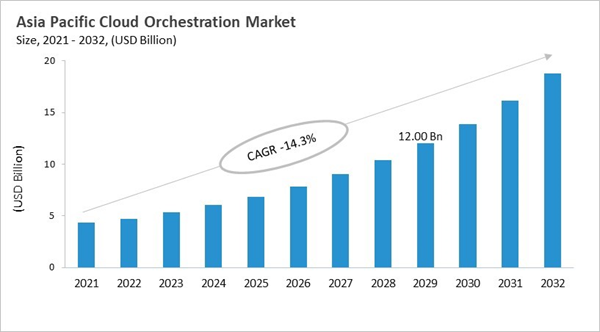
The Asia Pacific Cloud Orchestration Market is expected to reach $12.00 billion by 2029 and is expected to witness market growth of 15.4% CAGR during the forecast period (2025-2032).
The China market dominated the Asia Pacific Cloud Orchestration Market by country in 2024, and is expected to continue to be a dominant market till 2032; thereby, achieving a market value of $4.87 billion by 2032. The Japan market is registering a CAGR of 14.6% during 2025-2032. Additionally, the India market is expected to showcase a CAGR of 16.1% during 2025-2032. The China and Japan led the Asia Pacific Cloud Orchestration Market by Country with a market share of 29.9% and 18% in 2024. The Australia market is expected to witness a CAGR of 16.6% during throughout the forecast period.
Cloud orchestration in the Asia Pacific region has changed from simple infrastructure automation to a strategic tool that lets you manage complex hybrid and multi-cloud environments all at once. A lot of businesses are quickly moving to the cloud, which has led to a need for orchestration platforms that can handle the dependencies between applications, infrastructure, and workflows while making sure that they can grow, stay stable, and work the same way every time. Microsoft, Oracle, AWS, and Alibaba Cloud are some of the biggest cloud providers that have added more infrastructure in different regions and improved their orchestration services to make it easier to move workloads, automate tasks with AI, and manage the entire lifecycle of a project across multiple environments. Companies are increasingly relying on cloud platforms to help with digital transformation, advanced analytics, and new technologies like AI and edge computing.
Hybrid and multi-cloud architectures are becoming more popular, AI-driven automation is being added to orchestration frameworks, and compliance with data sovereignty and regulatory requirements is becoming more important. Organizations are using orchestration to enforce rules, automate governance, and build compliance controls directly into cloud workflows. This helps them deal with the region's many different rules. Hyperscalers and regional providers set the rules for competition by using smart automation, orchestration that focuses on compliance, and partnerships with system integrators in specific areas. In the Asia Pacific, cloud orchestration has become a key part of enterprise IT strategy. It makes businesses more flexible, helps them save money, and keeps them running even in more complicated cloud environments.
The China market dominated the Asia Pacific Cloud Orchestration Market by country in 2024, and is expected to continue to be a dominant market till 2032; thereby, achieving a market value of $4.87 billion by 2032. The Japan market is registering a CAGR of 14.6% during 2025-2032. Additionally, the India market is expected to showcase a CAGR of 16.1% during 2025-2032. The China and Japan led the Asia Pacific Cloud Orchestration Market by Country with a market share of 29.9% and 18% in 2024. The Australia market is expected to witness a CAGR of 16.6% during throughout the forecast period.
Cloud orchestration in the Asia Pacific region has changed from simple infrastructure automation to a strategic tool that lets you manage complex hybrid and multi-cloud environments all at once. A lot of businesses are quickly moving to the cloud, which has led to a need for orchestration platforms that can handle the dependencies between applications, infrastructure, and workflows while making sure that they can grow, stay stable, and work the same way every time. Microsoft, Oracle, AWS, and Alibaba Cloud are some of the biggest cloud providers that have added more infrastructure in different regions and improved their orchestration services to make it easier to move workloads, automate tasks with AI, and manage the entire lifecycle of a project across multiple environments. Companies are increasingly relying on cloud platforms to help with digital transformation, advanced analytics, and new technologies like AI and edge computing.
Hybrid and multi-cloud architectures are becoming more popular, AI-driven automation is being added to orchestration frameworks, and compliance with data sovereignty and regulatory requirements is becoming more important. Organizations are using orchestration to enforce rules, automate governance, and build compliance controls directly into cloud workflows. This helps them deal with the region's many different rules. Hyperscalers and regional providers set the rules for competition by using smart automation, orchestration that focuses on compliance, and partnerships with system integrators in specific areas. In the Asia Pacific, cloud orchestration has become a key part of enterprise IT strategy. It makes businesses more flexible, helps them save money, and keeps them running even in more complicated cloud environments.
Deployment Model Outlook
Based on Deployment Model, the market is segmented into Hybrid Cloud, Public Cloud and Private Cloud. The Hybrid Cloud market segment dominated the Australia Cloud Orchestration Market by Deployment Model is expected to grow at a CAGR of 17.2 % during the forecast period thereby continuing its dominance until 2032. Also, The Private Cloud market is anticipated to grow as a CAGR of 17.3 % during the forecast period during 2025-2032.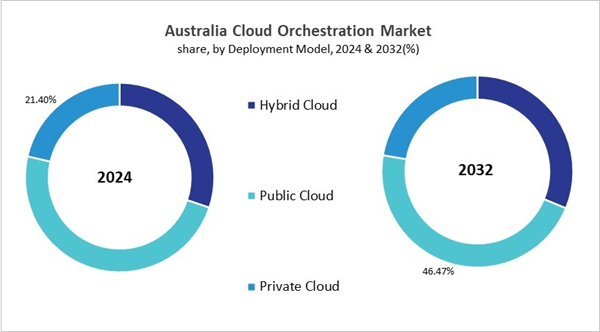
Industry Vertical Outlook
Based on Industry Vertical, the market is segmented into IT and Telecom, BFSI, Healthcare, Government & Education, Retail, Manufacturing, Media & Entertainment and Other Industry Verticals. Among various Japan Cloud Orchestration Market by Industry Vertical; The IT and Telecom market achieved a market size of USD $283.1 Million in 2024 and is expected to grow at a CAGR of 12.6 % during the forecast period. The BFSI market is predicted to experience a CAGR of 13.3% throughout the forecast period from (2025-2032).Country Outlook
China is a key player in the Asia Pacific cloud orchestration market because its digital economy is so big, and so many businesses and government agencies use cloud services. High-growth industries like e-commerce, manufacturing, fintech, logistics, and digital media create huge, ever-changing workloads. This makes automated orchestration necessary for managing distributed cloud environments. Because of strict rules about cybersecurity and data governance, the demand for centralized orchestration platforms that make sure visibility, control, and policy compliance has grown. Market trends show a strong move toward cloud-native architectures, such as containerization and microservices, which need advanced orchestration for deployment, scaling, and lifecycle management. Domestic OEMs that offer integrated platforms with built-in orchestration are the main competitors, along with the widespread use of open-source tools. In general, cloud orchestration has become a key factor in making China's rapidly growing digital infrastructure more scalable, efficient, and stable.List of Key Companies Profiled
- Cisco Systems, Inc.
- IBM Corporation
- Microsoft Corporation
- Google LLC (Alphabet Inc.)
- Oracle Corporation
- Amazon Web Services, Inc. (Amazon.com, Inc.)
- Hewlett Packard Enterprise Company
- VMware, Inc. (Broadcom Inc.)
- Huawei Technologies Co., Ltd. (Huawei Investment & Holding Co., Ltd.)
- DXC Technology Company
Market Report Segmentation
By User Type- Large Enterprises
- Small & Medium Enterprises (SMEs)
- Hybrid Cloud
- Public Cloud
- Private Cloud
- Configuration
- Managed Support
- Portable Service
- Other Solution
- IT and Telecom
- BFSI
- Healthcare
- Government & Education
- Retail
- Manufacturing
- Media & Entertainment
- Other Industry Verticals
- China
- Japan
- India
- South Korea
- Australia
- Malaysia
- Rest of Asia Pacific
Table of Contents
Chapter 1. Market Scope & Methodology
Chapter 2. Market at a Glance
Chapter 3. Market Overview
Chapter 10. Competition Analysis - Global
Chapter 11. Asia Pacific Cloud Orchestration Market by User Type
Chapter 12. Asia Pacific Cloud Orchestration Market by Deployment Model
Chapter 13. Asia Pacific Cloud Orchestration Market by Solution
Chapter 14. Asia Pacific Cloud Orchestration Market by Industry Vertical
Chapter 15. Asia Pacific Cloud Orchestration Market by Country
Chapter 16. Company Profiles
Companies Mentioned
- Cisco Systems, Inc.
- IBM Corporation
- Microsoft Corporation
- Google LLC (Alphabet Inc.)
- Oracle Corporation
- Amazon Web Services, Inc. (Amazon.com, Inc.)
- Hewlett Packard Enterprise Company
- VMware, Inc. (Broadcom Inc.)
- Huawei Technologies Co., Ltd. (Huawei Investment & Holding Co., Ltd.)
- DXC Technology Company


