



The Latin America, Middle East and Africa Cloud Orchestration Market is expected to reach $3.60 billion by 2028 and is expected to witness market growth of 16.1% CAGR during the forecast period (2025-2032).
The Brazil market dominated the LAMEA Cloud Orchestration Market by country in 2024, and is expected to continue to be a dominant market till 2032; thereby, achieving a market value of $1.49 billion by 2032. The Argentina market is showcasing a CAGR of 17.6% during 2025-2032. Additionally, the UAE market would register a CAGR of 15.1% during 2025-2032. The Brazil and UAE led the LAMEA Cloud Orchestration Market by Country with a market share of 24.8% and 16.1% in 2024. The South Africa market is expected to witness a CAGR of 17.4% during throughout the forecast period.
Cloud orchestration in the LAMEA region has become a key factor in the widespread use of cloud computing. It allows for the automated management of computing, storage, networking, and security across hybrid and multi-cloud environments. Organizations are moving beyond basic cloud use and toward more complex, distributed architectures. This is happening because of national digital transformation plans in Latin America, faster cloud migration in the Middle East, and steadily better digital infrastructure in Africa. This change makes operations more complicated, which makes orchestration platforms that allow for centralized control, governance, scalability, and resilience very important. Because of this, orchestration is becoming more and more seen as a basic skill rather than an extra layer of automation. This helps businesses and governments improve efficiency, service delivery, and cost-cutting.
The market is changing quickly because more and more companies are using hybrid and multi-cloud strategies, automation, AI, and analytics are becoming more integrated, and security and regulatory compliance are getting more attention. Top companies in LAMEA work with global cloud providers, invest in cloud and DevOps skills, and use phased deployment strategies to lower risk and get the most value. Global hyperscalers, regional system integrators, telecom operators, and open-source platforms all compete in the same space. They all want to improve automation depth, interoperability, governance, and performance. All of these things together point to a shift toward cloud orchestration as a strategic asset that supports digital ecosystems, the modernization of public services, and innovation in businesses across the region.
The Brazil market dominated the LAMEA Cloud Orchestration Market by country in 2024, and is expected to continue to be a dominant market till 2032; thereby, achieving a market value of $1.49 billion by 2032. The Argentina market is showcasing a CAGR of 17.6% during 2025-2032. Additionally, the UAE market would register a CAGR of 15.1% during 2025-2032. The Brazil and UAE led the LAMEA Cloud Orchestration Market by Country with a market share of 24.8% and 16.1% in 2024. The South Africa market is expected to witness a CAGR of 17.4% during throughout the forecast period.
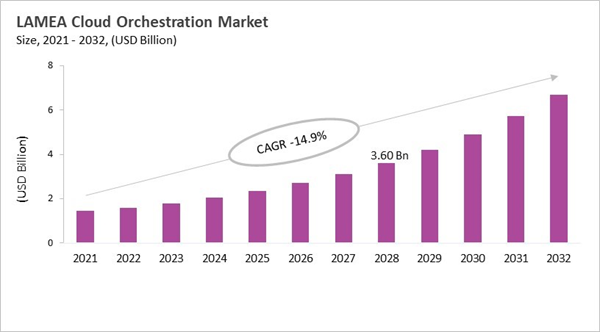
Cloud orchestration in the LAMEA region has become a key factor in the widespread use of cloud computing. It allows for the automated management of computing, storage, networking, and security across hybrid and multi-cloud environments. Organizations are moving beyond basic cloud use and toward more complex, distributed architectures. This is happening because of national digital transformation plans in Latin America, faster cloud migration in the Middle East, and steadily better digital infrastructure in Africa. This change makes operations more complicated, which makes orchestration platforms that allow for centralized control, governance, scalability, and resilience very important. Because of this, orchestration is becoming more and more seen as a basic skill rather than an extra layer of automation. This helps businesses and governments improve efficiency, service delivery, and cost-cutting.
The market is changing quickly because more and more companies are using hybrid and multi-cloud strategies, automation, AI, and analytics are becoming more integrated, and security and regulatory compliance are getting more attention. Top companies in LAMEA work with global cloud providers, invest in cloud and DevOps skills, and use phased deployment strategies to lower risk and get the most value. Global hyperscalers, regional system integrators, telecom operators, and open-source platforms all compete in the same space. They all want to improve automation depth, interoperability, governance, and performance. All of these things together point to a shift toward cloud orchestration as a strategic asset that supports digital ecosystems, the modernization of public services, and innovation in businesses across the region.
User Type Outlook
Based on User Type, the market is segmented into Large Enterprises and Small & Medium Enterprises (SMEs). The Large Enterprises market segment dominated the South Africa Cloud Orchestration Market by User Type is expected to grow at a CAGR of 16.9 % during the forecast period thereby continuing its dominance until 2032. Also, The Small & Medium Enterprises (SMEs) market is anticipated to grow as a CAGR of 18.2 % during the forecast period during 2025-2032.Solution Outlook
Based on Solution, the market is segmented into Configuration, Managed Support, Portable Service and Other Solution. Among various Brazil Cloud Orchestration Market by Solution; The Configuration market achieved a market size of USD $197.1 Million in 2024 and is expected to grow at a CAGR of 13.9 % during the forecast period. The Portable Service market is predicted to experience a CAGR of 15.1% throughout the forecast period from (2025-2032).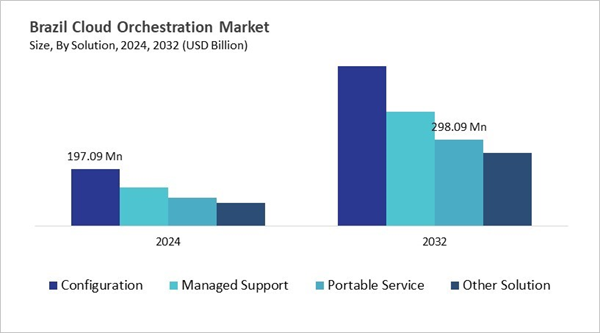
Country Outlook
Brazil has the biggest and most developed cloud market in Latin America. It is a key player in the LAMEA Cloud Orchestration Market as businesses in important sectors speed up their digital transformation. Cloud orchestration is now necessary for automating workload management, making sure that rules are followed, and keeping operations consistent because hybrid and multi-cloud environments are becoming more complicated. A lot of people are using cloud-native and containerized, microservices-based architectures, which is driving up the need for orchestration to help with application deployment, scaling, and lifecycle management. Global cloud providers, enterprise software vendors, and widely used open-source platforms are all competing in the market, with a focus on automation, security, and scalability. In Brazil, cloud orchestration has become a strategic enabler of large-scale, resilient, and efficient digital operations.List of Key Companies Profiled
- Cisco Systems, Inc.
- IBM Corporation
- Microsoft Corporation
- Google LLC (Alphabet Inc.)
- Oracle Corporation
- Amazon Web Services, Inc. (Amazon.com, Inc.)
- Hewlett Packard Enterprise Company
- VMware, Inc. (Broadcom Inc.)
- Huawei Technologies Co., Ltd. (Huawei Investment & Holding Co., Ltd.)
- DXC Technology Company
Market Report Segmentation
By User Type- Large Enterprises
- Small & Medium Enterprises (SMEs)
- Hybrid Cloud
- Public Cloud
- Private Cloud
- Configuration
- Managed Support
- Portable Service
- Other Solution
- IT and Telecom
- BFSI
- Healthcare
- Government & Education
- Retail
- Manufacturing
- Media & Entertainment
- Other Industry Verticals
- Brazil
- Argentina
- UAE
- Saudi Arabia
- South Africa
- Nigeria
- Rest of LAMEA
Table of Contents
Chapter 1. Market Scope & Methodology
Chapter 2. Market at a Glance
Chapter 3. Market Overview
Chapter 10. Competition Analysis - Global
Chapter 11. LAMEA Cloud Orchestration Market by User Type
Chapter 12. LAMEA Cloud Orchestration Market by Deployment Model
Chapter 13. LAMEA Cloud Orchestration Market by Solution
Chapter 14. LAMEA Cloud Orchestration Market by Industry Vertical
Chapter 15. LAMEA Cloud Orchestration Market by Country
Chapter 16. Company Profiles
Companies Mentioned
- Cisco Systems, Inc.
- IBM Corporation
- Microsoft Corporation
- Google LLC (Alphabet Inc.)
- Oracle Corporation
- Amazon Web Services, Inc. (Amazon.com, Inc.)
- Hewlett Packard Enterprise Company
- VMware, Inc. (Broadcom Inc.)
- Huawei Technologies Co., Ltd. (Huawei Investment & Holding Co., Ltd.)
- DXC Technology Company


