



The Asia Pacific Mobile Business Process Management Market is expected to reach $2.46 billion by 2029 and is expected to witness market growth of 13.7% CAGR during the forecast period (2025-2032).
The China market dominated the Asia Pacific Mobile Business Process Management Market by country in 2024, and is expected to continue to be a dominant market till 2032; thereby, achieving a market value of $918.8 million by 2032. The Japan market is registering a CAGR of 12.9% during 2025-2032. Additionally, the India market is expected to showcase a CAGR of 14.4% during 2025-2032. The China and Japan led the Asia Pacific Mobile Business Process Management Market by Country with a market share of 28.9% and 18.1% in 2024. The Singapore market is expected to witness a CAGR of 15.4% during throughout the forecast period.
The Asia-Pacific mobile BPM market has grown along with the rise of smartphones, the spread of digital technology, and strong mobile connectivity. Companies and governments used BPM to make things run more smoothly and grow. Later, they added it to mobile platforms as mobile-first economies grew. Cloud computing sped up adoption by making mobile workflows that are secure, cost-effective, and easy to scale. The COVID-19 pandemic made it even more clear that processes need to be accessible on mobile devices to support remote and cross-border operations. Some important trends are designing workflows that work best on mobile devices, making them work with low-code and automation tools, and using more cloud and hybrid deployments to find a balance between scalability and regulatory needs.
To get more people to use their products, top companies like IBM, SAP, Microsoft, Oracle, and Appian focus on platform-based delivery, cloud-first strategies, and low-code enablement. Security, compliance, and reliability remain central to building enterprises and government trust. The market is competitive, and companies from all over the world and in the same region are setting themselves apart by making their products easy to use on mobile devices, scalable in the cloud, and able to work with other products in the ecosystem. Flexibility in deployment models and support for a wide range of regulatory environments are two of the most important factors that set competitors apart.
The China market dominated the Asia Pacific Mobile Business Process Management Market by country in 2024, and is expected to continue to be a dominant market till 2032; thereby, achieving a market value of $918.8 million by 2032. The Japan market is registering a CAGR of 12.9% during 2025-2032. Additionally, the India market is expected to showcase a CAGR of 14.4% during 2025-2032. The China and Japan led the Asia Pacific Mobile Business Process Management Market by Country with a market share of 28.9% and 18.1% in 2024. The Singapore market is expected to witness a CAGR of 15.4% during throughout the forecast period.
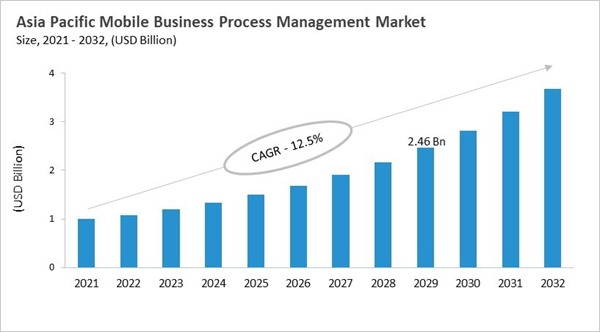
The Asia-Pacific mobile BPM market has grown along with the rise of smartphones, the spread of digital technology, and strong mobile connectivity. Companies and governments used BPM to make things run more smoothly and grow. Later, they added it to mobile platforms as mobile-first economies grew. Cloud computing sped up adoption by making mobile workflows that are secure, cost-effective, and easy to scale. The COVID-19 pandemic made it even more clear that processes need to be accessible on mobile devices to support remote and cross-border operations. Some important trends are designing workflows that work best on mobile devices, making them work with low-code and automation tools, and using more cloud and hybrid deployments to find a balance between scalability and regulatory needs.
To get more people to use their products, top companies like IBM, SAP, Microsoft, Oracle, and Appian focus on platform-based delivery, cloud-first strategies, and low-code enablement. Security, compliance, and reliability remain central to building enterprises and government trust. The market is competitive, and companies from all over the world and in the same region are setting themselves apart by making their products easy to use on mobile devices, scalable in the cloud, and able to work with other products in the ecosystem. Flexibility in deployment models and support for a wide range of regulatory environments are two of the most important factors that set competitors apart.
Deployment Mode Outlook
Based on Deployment Mode, the market is segmented into Cloud and On-Premise. The Cloud market segment dominated the Japan Mobile Business Process Management Market by Deployment Mode is expected to grow at a CAGR of 13 % during the forecast period thereby continuing its dominance until 2032. Also, The On-Premise market is anticipated to grow as a CAGR of 12.7 % during the forecast period during 2025-2032.Enterprise Size Outlook
Based on Enterprise Size, the market is segmented into Large Enterprises and Small & Medium Enterprises. With a compound annual growth rate (CAGR) of 15.2% over the projection period, the Large Enterprises Market, dominate the Singapore Mobile Business Process Management Market by Enterprise Size in 2024 and would be a prominent market until 2032. The Small & Medium Enterprises market is expected to witness a CAGR of 16% during 2025-2032.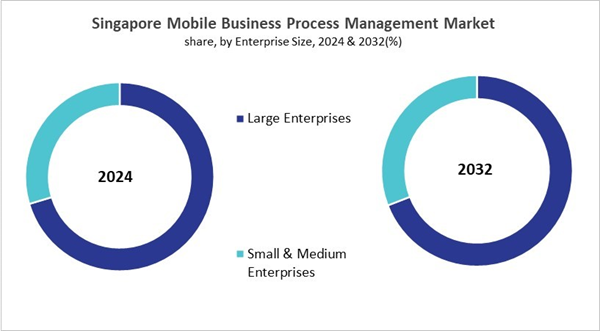
Country Outlook
China’s mobile BPM market is driven by national digital transformation programs such as the “Digital China” initiative, which promote mobile-enabled services, integrated data platforms, and automated workflows. High smartphone penetration and strong 4G/5G infrastructure support widespread mobile BPM adoption across government and enterprises. Policies encouraging smart governance, cloud computing, and new digital infrastructure foster mobile-centric process management to improve efficiency and coordination. Enterprises increasingly use cloud-native BPM with mobile interfaces to support field operations, customer engagement, and real-time decision-making, with COVID-19 further accelerating adoption.List of Key Companies Profiled
- IBM Corporation
- Oracle Corporation
- Software AG
- Pegasystems, Inc.
- Open Text Corporation
- Appian Corporation
- Fujitsu Limited
- Microsoft Corporation
- TIBCO Software, Inc.
- Nintex, Inc.
Market Report Segmentation
By Component- Solutions
- Services
- Cloud
- On-Premise
- Large Enterprises
- Small & Medium Enterprises
- IT & Telecom
- Healthcare
- Manufacturing
- Government & Defense
- Retail
- Transportation & Logistics
- Other End-User Industry
- China
- Japan
- India
- South Korea
- Singapore
- Malaysia
- Rest of Asia Pacific
Table of Contents
Chapter 1. Market Scope & Methodology
Chapter 2. Market at a Glance
Chapter 3. Market Overview
Chapter 10. Competition Analysis - Global
Chapter 11. Asia Pacific Mobile Business Process Management Market by Component
Chapter 12. Asia Pacific Mobile Business Process Management Market by Deployment Mode
Chapter 13. Asia Pacific Mobile Business Process Management Market by Enterprise Size
Chapter 14. Asia Pacific Mobile Business Process Management Market by End-User Industry
Chapter 15. Asia Pacific Mobile Business Process Management Market by Country
Chapter 16. Company Profiles
Companies Mentioned
- IBM Corporation
- Oracle Corporation
- Software AG
- Pegasystems, Inc.
- Open Text Corporation
- Appian Corporation
- Fujitsu Limited
- Microsoft Corporation
- TIBCO Software, Inc.
- Nintex, Inc.


