



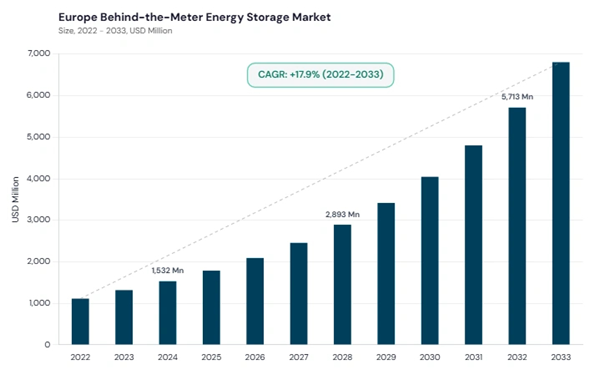
The Europe Behind-the-Meter Energy Storage Market size is expected to reach USD 5.71 billion by 2032, rising at a market growth of 18.4% CAGR during the forecast period (2026-2033).
The Germany market dominated the Europe Behind-the-Meter Energy Storage Market by country in 2025 and is expected to continue to be a dominant market till 2033; thereby, achieving a market value of USD 1.38 billion by 2033. The UK market is expected to witness a CAGR of 17.0% during 2026-2033. Additionally, the France market is expected to witness a CAGR of 19.4% during 2026-2033. The Germany and UK led the Europe Behind-the-Meter Energy Storage Market by Country with a market share of 26.3% and 16.8% in 2025. The Italy market is expected to witness a CAGR of 18.8% during throughout the forecast period.
The behind-the-meter (BTM) energy storage market in Europe has witnessed substantial growth due to the region’s aggressive decarbonization goals, increasing renewable energy penetration, and strong focus on energy security. Initially, energy storage systems were primarily deployed for backup power and industrial energy management applications. However, the rapid adoption of rooftop solar installations, smart grid technologies, and advanced battery systems transformed the regional market into a highly dynamic clean energy ecosystem. Government initiatives such as the European Green Deal, net-zero carbon targets, and incentives for distributed energy resources have accelerated the deployment of residential and commercial battery storage systems across major European countries. Rising electricity prices, grid instability concerns, and increasing demand for self-consumption solutions have further supported market expansion across the region.
Europe is increasingly integrating BTM storage systems with renewable energy installations, electric vehicle charging infrastructure, and digital energy management platforms. Residential users are adopting battery storage solutions to maximize solar self-consumption and improve household energy resilience. Commercial and industrial facilities are leveraging BTM storage for peak demand management, operational efficiency, and energy cost optimization. Market participants are focusing on AI-enabled energy optimization platforms, modular storage technologies, and virtual power plant integration to strengthen their competitive positioning. Strategic collaborations between utilities, technology providers, and energy service companies are also accelerating innovation and deployment across the region. Competition is driven by technological advancements, battery efficiency, software capabilities, and integrated energy service offerings rather than only system pricing.
The UK market is witnessing significant growth due to rising renewable energy integration, increasing electrification, and strong investments in smart energy systems. Commercial and residential consumers are increasingly adopting storage systems to manage electricity costs and improve energy resilience. Growing investments in distributed energy resources and smart grid modernization are expected to further support market expansion across the country.
The Germany market dominated the Europe Behind-the-Meter Energy Storage Market by country in 2025 and is expected to continue to be a dominant market till 2033; thereby, achieving a market value of USD 1.38 billion by 2033. The UK market is expected to witness a CAGR of 17.0% during 2026-2033. Additionally, the France market is expected to witness a CAGR of 19.4% during 2026-2033. The Germany and UK led the Europe Behind-the-Meter Energy Storage Market by Country with a market share of 26.3% and 16.8% in 2025. The Italy market is expected to witness a CAGR of 18.8% during throughout the forecast period.
The behind-the-meter (BTM) energy storage market in Europe has witnessed substantial growth due to the region’s aggressive decarbonization goals, increasing renewable energy penetration, and strong focus on energy security. Initially, energy storage systems were primarily deployed for backup power and industrial energy management applications. However, the rapid adoption of rooftop solar installations, smart grid technologies, and advanced battery systems transformed the regional market into a highly dynamic clean energy ecosystem. Government initiatives such as the European Green Deal, net-zero carbon targets, and incentives for distributed energy resources have accelerated the deployment of residential and commercial battery storage systems across major European countries. Rising electricity prices, grid instability concerns, and increasing demand for self-consumption solutions have further supported market expansion across the region.
Europe is increasingly integrating BTM storage systems with renewable energy installations, electric vehicle charging infrastructure, and digital energy management platforms. Residential users are adopting battery storage solutions to maximize solar self-consumption and improve household energy resilience. Commercial and industrial facilities are leveraging BTM storage for peak demand management, operational efficiency, and energy cost optimization. Market participants are focusing on AI-enabled energy optimization platforms, modular storage technologies, and virtual power plant integration to strengthen their competitive positioning. Strategic collaborations between utilities, technology providers, and energy service companies are also accelerating innovation and deployment across the region. Competition is driven by technological advancements, battery efficiency, software capabilities, and integrated energy service offerings rather than only system pricing.
Battery Type Outlook
Based on Battery Type, the market is segmented into Lithium-ion Batteries, Lead-acid Batteries, and Other Battery Type. The Lithium-ion Batteries segment dominated the Europe Behind-the-Meter Energy Storage Market by Battery Type in 2025 and is expected to continue to be a dominant segment till 2033; thereby, achieving a market value of USD 4.14 million by 2033, growing at a CAGR of 18.0% during the forecast period. The Lead-acid Batteries market is expected to witness a CAGR of 19.3% during 2026-2033. Additionally, the Other Battery Type market is expected to witness the highest CAGR of 19.7% during the forecast period.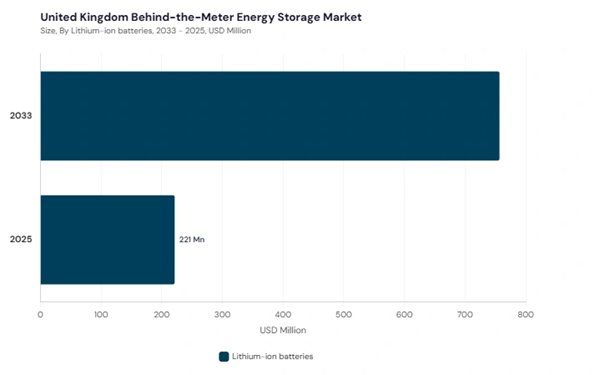
End Use Outlook
Based on End Use, the market is segmented into Residential, Commercial, and Industrial. The Residential segment dominated the Europe Behind-the-Meter Energy Storage Market by End Use in 2025 and is expected to continue to be a dominant market till 2033; thereby, achieving a market value of USD 2.52 billion by 2032, growing at a CAGR of 17.7% during the forecast period. The Commercial market is expected to witness a CAGR of 18.8% during 2026-2033. Additionally, the Industrial market is expected to witness the highest CAGR of 19.1% during the forecast period.Country Outlook
Germany represents the largest market for behind-the-meter energy storage in Europe due to its strong renewable energy adoption, advanced energy transition policies, and widespread deployment of residential solar-plus-storage systems. Government incentives, high electricity prices, and strong consumer awareness regarding energy independence have accelerated battery storage adoption across residential and commercial sectors. German industries are increasingly deploying energy storage systems for grid balancing, energy optimization, and backup applications. The country’s advanced manufacturing ecosystem and strong clean energy infrastructure continue to support market leadership across Europe.The UK market is witnessing significant growth due to rising renewable energy integration, increasing electrification, and strong investments in smart energy systems. Commercial and residential consumers are increasingly adopting storage systems to manage electricity costs and improve energy resilience. Growing investments in distributed energy resources and smart grid modernization are expected to further support market expansion across the country.
List of Key Companies Profiled
- LG Energy Solution Ltd.
- Samsung SDI Co., Ltd.
- Panasonic Holdings Corporation
- ABB Ltd.
- Schneider Electric SE
- Siemens AG
- Enphase Energy, Inc.
- Sonnen GmbH
- Delta Electronics, Inc.
- Stem, Inc.
Market Report Segmentation
By Battery Type- Lithium-ion Batteries
- Lead-acid Batteries
- Other Battery Type
- Residential
- Commercial
- Industrial
- Germany
- UK
- France
- Russia
- Spain
- Italy
- Rest of Europe
Table of Contents
Chapter 1. Europe Market1.1 Market Overview
1.2 Key Factors Impacting Market
1.2.1 Market Drivers
1.2.2 Market Restraints
1.2.3 Market Opportunities
1.2.4 Market Challenges
1.2.5 Market Trends
1.2.6 State of Competition
1.2.7 Market Consolidation
1.2.8 Key Customer Criteria
1.3 Product Life Cycle
1.4 Segmentation By Battery Type
1.4.1 Lithium-ion Batteries
1.4.2 Lead-acid Batteries
1.4.3 Other Battery Types
1.5 Segmentation by End Use
1.5.1 Residential
1.5.2 Commercial
1.5.3 Industrial
1.6 Segmentation By Country
1.6.1 Germany
1.6.1.1 Segmentation By Battery Type
1.6.1.1.1 Lithium-ion Batteries
1.6.1.1.2 Lead-acid Batteries
1.6.1.1.3 Other Battery Type
1.6.1.2 Segmentation By End Use
1.6.1.2.1 Residential
1.6.1.2.2 Commercial
1.6.2 United Kingdom
1.6.2.1 Segmentation By Battery Type
1.6.2.1.1 Lithium-ion Batteries
1.6.2.1.2 Lead-acid Batteries
1.6.2.1.3 Other Battery Type
1.6.2.2 Segmentation By End Use
1.6.2.2.1 Residential
1.6.2.2.2 Commercial
1.6.3 France
1.6.3.1 Segmentation By Battery Type
1.6.3.1.1 Lithium-ion Batteries
1.6.3.1.2 Lead-acid Batteries
1.6.3.1.3 Other Battery Type
1.6.3.2 Segmentation By End Use
1.6.3.2.1 Residential
1.6.3.2.2 Commercial
1.6.4 Russia
1.6.4.1 Segmentation By Battery Type
1.6.4.1.1 Lithium-ion Batteries
1.6.4.1.2 Lead-acid Batteries
1.6.4.1.3 Other Battery Type
1.6.4.2 Segmentation By End Use
1.6.4.2.1 Residential
1.6.4.2.2 Commercial
1.6.5 Spain
1.6.5.1 Segmentation By Battery Type
1.6.5.1.1 Lithium-ion Batteries
1.6.5.1.2 Lead-acid Batteries
1.6.5.1.3 Other Battery Type
1.6.5.2 Segmentation By End Use
1.6.5.2.1 Residential
1.6.5.2.2 Commercial
1.6.6 Italy
1.6.6.1 Segmentation By Battery Type
1.6.6.1.1 Lithium-ion Batteries
1.6.6.1.2 Lead-acid Batteries
1.6.6.1.3 Other Battery Type
1.6.6.2 Segmentation By End Use
1.6.6.2.1 Residential
1.6.6.2.2 Commercial
1.6.7 Rest Of Europe
1.6.7.1 Segmentation By Battery Type
1.6.7.1.1 Lithium-ion Batteries
1.6.7.1.2 Lead-acid Batteries
1.6.7.1.3 Other Battery Type
1.6.7.2 Segmentation By End Use
1.6.7.2.1 Residential
1.6.7.2.2 Commercial
Chapter 2. Company Profiles
2.1 ABB Ltd.
2.1.1 Company Overview
2.1.2 Recent Strategies and Developments
2.1.2.1 Product Launches and Product Expansions
2.1.3 Company Focus
2.1.2 Strategic Insights
2.1.5 Strategy Deployed
2.1.6 SWOT Analysis
2.1.7 Future Outlook
2.2 Schneider Electric SE
2.2.1 Company Overview
2.2.2 Financial Analysis
2.2.3 Segmental and Regional Analysis
2.2.2 Research & Development Expense
2.2.5 Recent Strategies and Developments
2.2.5.1 Product Launches and Product Expansions
2.2.5.2 Geographical Expansions
2.2.6 Company Focus
2.2.7 Strategic Insights
2.2.8 Strategy Deployed
2.2.9 SWOT Analysis
2.2.10 Future Outlook
2.3 Siemens AG
2.3.1 Company Overview
2.3.2 Financial Analysis
2.3.3 Segmental and Regional Analysis
2.3.2 Research & Development Expense
2.3.5 Recent Strategies and Developments
2.3.5.1 Partnerships, Collaborations, and Agreements
2.3.6 Company Focus
2.3.7 Strategic Insights
2.3.8 Strategy Deployed
2.3.9 SWOT Analysis
2.3.10 Future Outlook
2.2 Eaton Corporation PLC
2.2.1 Company Overview
2.2.2 Financial Analysis
2.2.3 Segmental and Regional Analysis
2.2.2 Research & Development Expense
2.2.5 Company Focus
2.2.6 Strategic Insights
2.2.7 Strategy Deployed
2.2.8 SWOT Analysis
2.2.9 Future Outlook
2.5 Mitsubishi Electric Corporation
2.5.1 Company Overview
2.5.2 Financial Analysis
2.5.3 Segmental and Regional Analysis
2.5.2 Research & Development Expense
2.5.5 Recent Strategies and Developments
2.5.5.1 Partnerships, Collaborations, and Agreements
2.5.5.2 Product Launches and Product Expansions
2.5.6 Company Focus
2.5.7 Strategic Insights
2.5.8 Strategy Deployed
2.5.9 SWOT Analysis
2.5.10 Future Outlook
2.6 Legrand S.A. (Legrand Group)
2.6.1 Company Overview
2.6.2 Financial Analysis
2.6.3 Regional Analysis
2.6.2 Research & Development Expense
2.6.5 Recent Strategies and Developments
2.6.5.1 Product Launches and Product Expansions
2.6.6 Company Focus
2.6.7 Strategic Insights
2.6.8 Strategy Deployed
2.6.9 SWOT Analysis
2.6.10 Future Outlook
2.7 General Electric Company
2.7.1 Company Overview
2.7.2 Company Focus
2.7.3 Strategic Insights
2.7.2 Strategy Deployed
2.7.5 SWOT Analysis
2.7.6 Future Outlook
2.8 Hager Group
2.8.1 Company Overview
2.8.2 Company Focus
2.8.3 Strategic Insights
2.8.2 Strategy Deployed
2.8.5 SWOT Analysis
2.8.6 Future Outlook
2.9 Fuji Electric Co. Ltd.
2.9.1 Company Overview
2.9.2 Financial Analysis
2.9.3 Segmental and Regional Analysis
2.9.2 Research & Development Expense
2.9.5 Company Focus
2.9.6 Strategic Insights
2.9.7 Strategy Deployed
2.9.8 SWOT Analysis
2.9.9 Future Outlook
2.1 CHINT Group Co., Ltd.
2.10.1 Company Overview
2.10.2 Recent Strategies and Developments
2.10.2.1 Partnerships, Collaborations, and Agreements
2.10.2.2 Geographical Expansions
2.10.3 Company Focus
2.10.2 Strategic Insights
2.10.5 Strategy Deployed
2.10.6 SWOT Analysis
2.10.7 Future Outlook
Companies Mentioned
- LG Energy Solution Ltd.
- Samsung SDI Co., Ltd.
- Panasonic Holdings Corporation
- ABB Ltd.
- Schneider Electric SE
- Siemens AG
- Enphase Energy, Inc.
- Sonnen GmbH
- Delta Electronics, Inc.
- Stem, Inc.


