+353-1-416-8900REST OF WORLD
+44-20-3973-8888REST OF WORLD
1-917-300-0470EAST COAST U.S
1-800-526-8630U.S. (TOLL FREE)

Global CNC Metal Cutting Machine Market Size, Share & Industry Analysis Report by End-User, Product, Regional Outlook and Forecast, 2026-2033

  • PDF Icon

    Report

  • 549 Pages
  • May 2026
  • Marqual IT Solutions Pvt. Ltd (KBV Research)
  • ID: 6275905
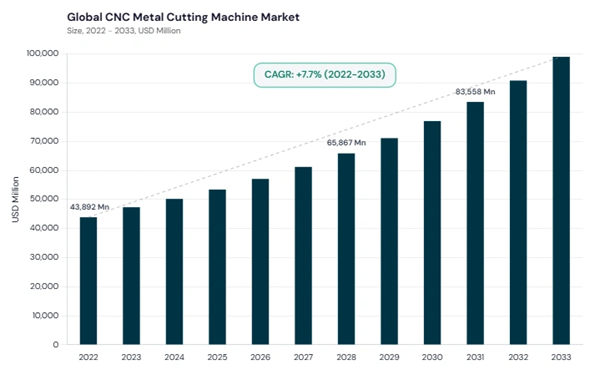
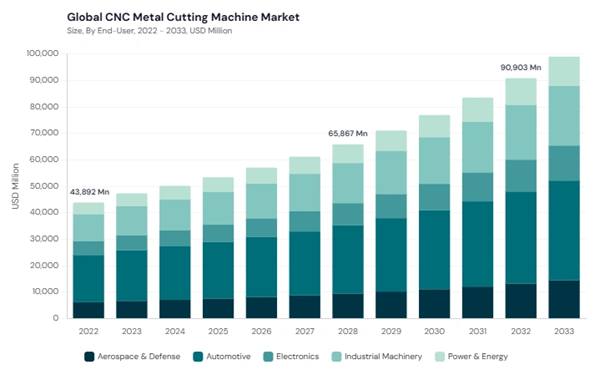
The Global CNC Metal Cutting Machine Market size is expected to reach USD 99.06 billion by 2033, rising at a market growth of 8.2% CAGR during the forecast period (2026 to 2033).


The market is witnessing strong growth due to rising industrial automation, increasing demand for precision-engineered metal components, and growing adoption of smart manufacturing technologies across automotive, aerospace, electronics, and industrial machinery sectors. Advancements in multi-axis machining, AI-enabled systems, and Industry 4.0 integration are further supporting market expansion globally.

Key Market Trends & Insights:

  • The Asia Pacific CNC Metal Cutting Machine market dominated the Global Market in 2025, accounting for a 45.54% revenue share in 2025.
  • The Automotive segment dominated the global market contributing a revenue share of 40.01% in 2025.
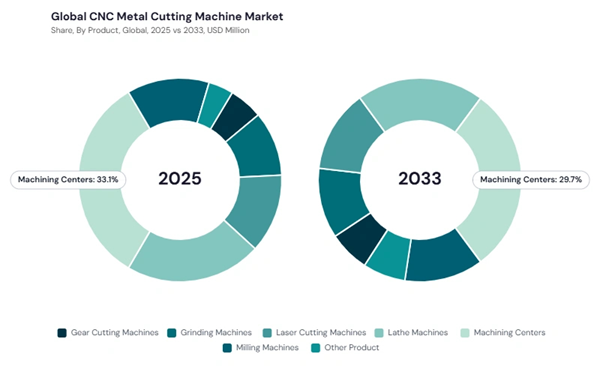
  • The Machining Centers segment led the Product segment in 2025, capturing a 33.12% revenue share.
  • The Industrial Machinery segment accounted for a 23.17% revenue share in 2025 and is projected to reach USD 20.74 billion by 2032.
  • The Aerospace & Defense segment is expected to reach a market size of USD 13.20 billion by 2032.
  • The Electronics segment is projected to reach USD 12.03 billion by 2032 owing to increasing demand for precision electronic components.
The Global CNC Metal Cutting Machine Market has evolved significantly from traditional programmable machining systems into highly automated and digitally integrated manufacturing solutions. Initially adopted across aerospace and automotive industries for high-precision metal fabrication, CNC metal cutting machines have become essential across industrial manufacturing environments due to their ability to deliver high accuracy, repeatability, and production efficiency. Advancements in computer controls, servo technologies, and multi-axis machining systems have further expanded their capabilities for complex component manufacturing.

Today, technologies such as artificial intelligence, IoT connectivity, predictive maintenance, cloud-based monitoring, and smart factory integration are transforming the CNC metal cutting machine industry. Manufacturers are increasingly investing in automation-enabled machining systems to improve productivity, reduce operational downtime, and support flexible production requirements. The growing adoption of electric vehicles, aerospace modernization, industrial automation, and precision engineering is further accelerating the demand for advanced CNC machining solutions across global manufacturing sectors.


The major strategies followed by the market participants are Product Launches as the key developmental strategy to keep pace with the changing demands of end users. For instance, in March 2026, Yamazaki Mazak showcased future-ready CNC machining and automation solutions at MACH 2026, focusing on multi-axis machining, digital integration, and real-time monitoring to improve productivity and operational efficiency. Additionally, in March 2025, TRUMPF introduced advanced 3D laser cutting systems integrated with automated material transport, improving workflow efficiency and supporting Industry 4.0 adoption in metal cutting operations.

COVID-19 Impact Analysis

The COVID-19 pandemic negatively impacted the CNC metal cutting machine market due to disruptions in global supply chains, manufacturing shutdowns, and delays in industrial production activities. Restrictions on movement and workforce availability affected machine production, installation, and maintenance services across major manufacturing regions. In addition, declining investments from automotive, aerospace, and industrial sectors during the peak of the pandemic reduced demand for CNC machinery and delayed capital expenditure projects.

However, the pandemic accelerated the adoption of automation, remote monitoring, predictive maintenance, and digitally connected manufacturing systems. Manufacturers increasingly focused on smart factory solutions and resilient production systems to improve operational continuity. Post-pandemic recovery has led to gradual normalization in supply chains and renewed investments in automation and advanced machining technologies. Thus, the COVID-19 pandemic had a negative impact on the market.

Driving and Restraining Factors

Drivers
  • Increased Integration of Automation and Smart Technologies
  • Rising Demand for Precision and Complexity in Metal Components
  • Emphasis on Sustainability and Environmental Regulations
  • Expansion of Flexible Manufacturing and Customization Capabilities
Restraints
  • High Initial Investment and Operating Costs
  • Shortage of Skilled Workforce and Technical Expertise
  • Supply Chain Disruptions And Raw Material Price Volatility
Opportunities
  • Growth In Aerospace And Electric Vehicle Manufacturing
  • Increasing Adoption Of Industry 4.0 And Smart Manufacturing
  • Expansion Of AI-Driven CNC Automation Solutions
Challenges
  • High Implementation Complexity and Integration Barriers
  • Cybersecurity Vulnerabilities and Operational Risks
  • Interoperability Challenges with Legacy Manufacturing Systems

Market Share Analysis


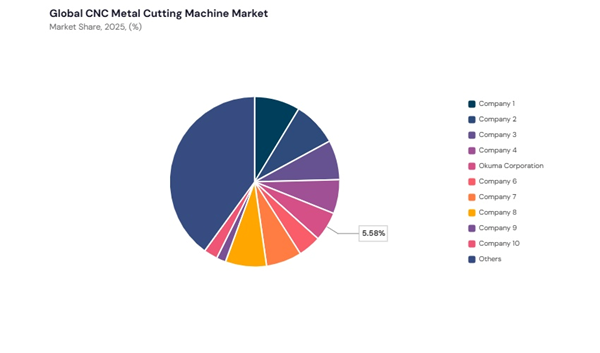
The leading players in the market are competing with diverse innovative offerings to remain competitive in the market. The above illustration shows the percentage of revenue shared by some of the leading companies in the market. The leading players of the market are adopting various strategies in order to cater demand coming from different industrial sectors. The key developmental strategies in the market are Product Launches, Partnerships & Collaborations, and Regional Expansion.

Product Outlook

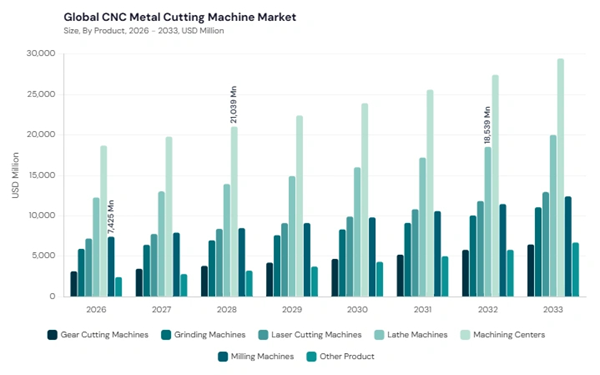
On the basis of product, the CNC metal cutting machine market is classified into machining centers, lathe machines, milling machines, laser cutting machines, grinding machines, gear cutting machines, and other products. The machining centers segment recorded 33.12% revenue share in the CNC metal cutting machine market in 2025. The dominance of this segment is driven by its capability to perform multiple machining operations within a single setup, improving productivity, operational efficiency, and precision across automotive, aerospace, and industrial manufacturing applications.

End-user Outlook

Based on end-user, the CNC metal cutting machine market is classified into automotive, industrial machinery, aerospace & defense, electronics, and power & energy. Globally, the automotive segment dominated the CNC metal cutting machine market in 2025. The segment continues to witness strong adoption of CNC machining systems due to increasing production of precision automotive components, rising electric vehicle manufacturing, and growing focus on automated production lines and lightweight vehicle structures.

Regional Outlook

Region-wise, the CNC Metal Cutting Machine Market is analyzed across North America, Europe, Asia Pacific, and LAMEA. The Asia Pacific segment recorded 45.54% revenue share in the CNC metal cutting machine market in 2025. The region is supported by strong industrialization, expanding automotive manufacturing, rapid adoption of automation technologies, and growing investments in precision engineering across countries such as China, Japan, and India.

North America and Europe continue to witness strong adoption of advanced CNC machining technologies due to the presence of established aerospace, automotive, and industrial manufacturing industries. Manufacturers across these regions are increasingly integrating AI, IoT, and predictive maintenance solutions into CNC systems to improve production efficiency and operational reliability.

In Asia Pacific and LAMEA, increasing industrialization, infrastructure development, and investments in smart manufacturing technologies are accelerating demand for CNC metal cutting machines. The growing presence of local manufacturing hubs and government initiatives supporting industrial automation are further contributing to regional market expansion.

Market Competition and Attributes

The CNC metal cutting machine market is highly competitive and characterized by strong technological innovation, automation integration, and precision engineering capabilities. Companies are competing on the basis of multi-axis machining systems, AI-enabled automation, IoT connectivity, predictive maintenance solutions, and smart manufacturing integration. Vendors are increasingly focusing on advanced control software, digital monitoring platforms, and energy-efficient machining systems to strengthen competitive positioning.

Strategic partnerships, regional expansion initiatives, and localized manufacturing facilities are playing an important role in market competition. In addition, after-sales services, customization capabilities, software interoperability, and cloud-based monitoring systems are becoming critical differentiating factors across the market. The competitive environment is expected to intensify further with increasing adoption of Industry 4.0 and intelligent manufacturing technologies.
Recent Strategies Deployed in the Market

  • Mar-2026: Yamazaki Mazak showcased future-ready CNC machining and automation solutions at MACH 2026, focusing on multi-axis machining, digital integration, and real-time monitoring to improve productivity and operational efficiency.
  • Mar-2026: Haas Automation showcased new CNC machining technologies at MACH 2026, highlighting high-speed machining, automation integration, and user-friendly controls to improve productivity and reduce cycle times.
  • Jun-2025: FANUC engaged in strategic collaboration to advance AI-driven smart manufacturing solutions, enabling predictive maintenance, real-time monitoring, and improved machine utilization in CNC metal cutting operations.
  • Mar-2025: TRUMPF introduced advanced 3D laser cutting systems integrated with automated material transport, improving precision, workflow efficiency, and supporting Industry 4.0 adoption.
  • Oct-2024: Amada introduced the HRB ATC press brake with automatic tool changer, reducing setup time and enhancing productivity in high-mix manufacturing environments.
  • Jan-2024: TRUMPF expanded its manufacturing presence with a new facility in Pune, India, strengthening localized production and improving customer support capabilities.

List of Key Companies Profiled

  • Yamazaki Mazak Corporation
  • DMG MORI Co., Ltd.
  • FANUC Corporation
  • TRUMPF Group
  • Amada Co., Ltd.
  • Haas Automation, Inc.
  • Okuma Corporation
  • Makino Milling Machine Co., Ltd.
  • Hurco Companies, Inc.
  • EMAG GmbH & Co. KG

Market Report Segmentation

By Product
  • Machining Centers
  • Lathe Machines
  • Milling Machines
  • Laser Cutting Machines
  • Grinding Machines
  • Gear Cutting Machines
  • Other Product
By End-user
  • Automotive
  • Industrial Machinery
  • Aerospace & Defense
  • Electronics
  • Power & Energy
By Geography
  • North America
    • US
    • Canada
    • Mexico
    • Rest of North America

  • Europe
    • Germany
    • UK
    • France
    • Russia
    • Spain
    • Italy
    • Rest of Europe

  • Asia Pacific
    • China
    • Japan
    • India
    • South Korea
    • Singapore
    • Malaysia
    • Rest of Asia Pacific

  • LAMEA
    • Brazil
    • Argentina
    • UAE
    • Saudi Arabia
    • South Africa
    • Nigeria
    • Rest of LAMEA

Table of Contents

Chapter 1. Market Overview
1.1 COVID-19 Impact
1.2 Market Composition and Scenario
Chapter 2. Key Factors Impacting Market
2.1.1 Market Drivers
2.1.2 Market Restraints
2.1.3 Market Opportunities
2.1.4 Market Challenges
2.1.5 Market Trends
2.1.6 State of Competition
2.1.7 Market Consolidation
2.1.8 Key Customer Criteria
Chapter 3. Product Life CycleChapter 4. Value Chain Analysis of CNC Metal Cutting Machine Market
Chapter 5. Competition Analysis - Global
5.1 Market Share Analysis
5.2 Recent Strategies Deployed in CNC Metal Cutting Machine Market
5.3 Porter Five Forces Analysis
Chapter 6. Segmentation By End-User
6.1 Automotive
6.2 Industrial Machinery
6.3 Aerospace & Defense
6.4 Electronics
6.5 Power & Energy
Chapter 7. Segmentation By Product
7.1 Machining Centers
7.2 Lathe Machines
7.3 Milling Machines
7.4 Laser Cutting Machines
7.5 Grinding Machines
7.6 Gear Cutting Machines
7.7 Other Product
Chapter 8. North America Market
8.1 Market Overview
8.2 Key Factors Impacting Market
8.2.1 Market Drivers
8.2.2 Market Restraints
8.2.3 Market Opportunities
8.2.4 Market Challenges
8.2.5 Market Trends
8.2.6 State of Competition
8.2.7 Market Consolidation
8.2.8 Key Customer Criteria
8.3 Product Life Cycle
8.4 Segmentation By End-User
8.4.1 Automotive
8.4.2 Industrial Machinery
8.4.3 Aerospace & Defense
8.4.4 Electronics
8.4.5 Power & Energy
8.5 Segmentation By Product
8.5.1 Machining Centers
8.5.2 Lathe Machines
8.5.3 Milling Machines
8.5.4 Laser Cutting Machines
8.5.5 Grinding Machines
8.5.6 Gear Cutting Machines
8.5.7 Other Product
8.6 Segmentation By Country
8.6.1 United States
8.6.1.1 Segmentation By End-User
8.6.1.1.1 Automotive
8.6.1.1.2 Industrial Machinery
8.6.1.1.3 Aerospace & Defense
8.6.1.1.4 Electronics
8.6.1.1.5 Power & Energy
8.6.1.2 Segmentation By Product
8.6.1.2.1 Machining Centers
8.6.1.2.2 Lathe Machines
8.6.1.2.3 Milling Machines
8.6.1.2.4 Laser Cutting Machines
8.6.1.2.5 Grinding Machines
8.6.1.2.6 Gear Cutting Machines
8.6.1.2.7 Other Product
8.6.2 Canada
8.6.2.1 Segmentation By End-User
8.6.2.1.1 Automotive
8.6.2.1.2 Industrial Machinery
8.6.2.1.3 Aerospace & Defense
8.6.2.1.4 Electronics
8.6.2.1.5 Power & Energy
8.6.2.2 Segmentation By Product
8.6.2.2.1 Machining Centers
8.6.2.2.2 Lathe Machines
8.6.2.2.3 Milling Machines
8.6.2.2.4 Laser Cutting Machines
8.6.2.2.5 Grinding Machines
8.6.2.2.6 Gear Cutting Machines
8.6.2.2.7 Other Product
8.6.3 Mexico
8.6.3.1 Segmentation By End-User
8.6.3.1.1 Automotive
8.6.3.1.2 Industrial Machinery
8.6.3.1.3 Aerospace & Defense
8.6.3.1.4 Electronics
8.6.3.1.5 Power & Energy
8.6.3.2 Segmentation By Product
8.6.3.2.1 Machining Centers
8.6.3.2.2 Lathe Machines
8.6.3.2.3 Milling Machines
8.6.3.2.4 Laser Cutting Machines
8.6.3.2.5 Grinding Machines
8.6.3.2.6 Gear Cutting Machines
8.6.3.2.7 Other Product
8.6.4 Rest of North America
8.6.4.1 Segmentation By End-User
8.6.4.1.1 Automotive
8.6.4.1.2 Industrial Machinery
8.6.4.1.3 Aerospace & Defense
8.6.4.1.4 Electronics
8.6.4.1.5 Power & Energy
8.6.4.2 Segmentation By Product
8.6.4.2.1 Machining Centers
8.6.4.2.2 Lathe Machines
8.6.4.2.3 Milling Machines
8.6.4.2.4 Laser Cutting Machines
8.6.4.2.5 Grinding Machines
8.6.4.2.6 Gear Cutting Machines
8.6.4.2.7 Other Product
Chapter 9. Europe Market
9.1 Market Overview
9.2 Key Factors Impacting Market
9.2.1 Market Drivers
9.2.2 Market Restraints
9.2.3 Market Opportunities
9.2.4 Market Challenges
9.2.5 Market Trends
9.2.6 State of Competition
9.2.7 Market Consolidation
9.2.8 Key Customer Criteria
9.3 Product Life Cycle
9.4 Segmentation By End-User
9.4.1 Automotive
9.4.2 Industrial Machinery
9.4.3 Aerospace & Defense
9.4.4 Electronics
9.4.5 Power & Energy
9.5 Segmentation By Product
9.5.1 Machining Centers
9.5.2 Lathe Machines
9.5.3 Milling Machines
9.5.4 Laser Cutting Machines
9.5.5 Grinding Machines
9.5.6 Gear Cutting Machines
9.5.7 Other Product
9.6 Segmentation By Country
9.6.1 Germany
9.6.1.1 Segmentation By End-User
9.6.1.1.1 Automotive
9.6.1.1.2 Industrial Machinery
9.6.1.1.3 Aerospace & Defense
9.6.1.1.4 Electronics
9.6.1.1.5 Power & Energy
9.6.1.2 Segmentation By Product
9.6.1.2.1 Machining Centers
9.6.1.2.2 Lathe Machines
9.6.1.2.3 Milling Machines
9.6.1.2.4 Laser Cutting Machines
9.6.1.2.5 Grinding Machines
9.6.1.2.6 Gear Cutting Machines
9.6.1.2.7 Other Product
9.6.2 United Kingdom
9.6.2.1 Segmentation By End-User
9.6.2.1.1 Automotive
9.6.2.1.2 Industrial Machinery
9.6.2.1.3 Aerospace & Defense
9.6.2.1.4 Electronics
9.6.2.1.5 Power & Energy
9.6.2.2 Segmentation By Product
9.6.2.2.1 Machining Centers
9.6.2.2.2 Lathe Machines
9.6.2.2.3 Milling Machines
9.6.2.2.4 Laser Cutting Machines
9.6.2.2.5 Grinding Machines
9.6.2.2.6 Gear Cutting Machines
9.6.2.2.7 Other Product
9.6.3 France
9.6.3.1 Segmentation By End-User
9.6.3.1.1 Automotive
9.6.3.1.2 Industrial Machinery
9.6.3.1.3 Aerospace & Defense
9.6.3.1.4 Electronics
9.6.3.1.5 Power & Energy
9.6.3.2 Segmentation By Product
9.6.3.2.1 Machining Centers
9.6.3.2.2 Lathe Machines
9.6.3.2.3 Milling Machines
9.6.3.2.4 Laser Cutting Machines
9.6.3.2.5 Grinding Machines
9.6.3.2.6 Gear Cutting Machines
9.6.3.2.7 Other Product
9.6.4 Russia
9.6.4.1 Segmentation By End-User
9.6.4.1.1 Automotive
9.6.4.1.2 Industrial Machinery
9.6.4.1.3 Aerospace & Defense
9.6.4.1.4 Electronics
9.6.4.1.5 Power & Energy
9.6.4.2 Segmentation By Product
9.6.4.2.1 Machining Centers
9.6.4.2.2 Lathe Machines
9.6.4.2.3 Milling Machines
9.6.4.2.4 Laser Cutting Machines
9.6.4.2.5 Grinding Machines
9.6.4.2.6 Gear Cutting Machines
9.6.4.2.7 Other Product
9.6.5 Spain
9.6.5.1 Segmentation By End-User
9.6.5.1.1 Automotive
9.6.5.1.2 Industrial Machinery
9.6.5.1.3 Aerospace & Defense
9.6.5.1.4 Electronics
9.6.5.1.5 Power & Energy
9.6.5.2 Segmentation By Product
9.6.5.2.1 Machining Centers
9.6.5.2.2 Lathe Machines
9.6.5.2.3 Milling Machines
9.6.5.2.4 Laser Cutting Machines
9.6.5.2.5 Grinding Machines
9.6.5.2.6 Gear Cutting Machines
9.6.5.2.7 Other Product
9.6.6 Italy
9.6.6.1 Segmentation By End-User
9.6.6.1.1 Automotive
9.6.6.1.2 Industrial Machinery
9.6.6.1.3 Aerospace & Defense
9.6.6.1.4 Electronics
9.6.6.1.5 Power & Energy
9.6.6.2 Segmentation By Product
9.6.6.2.1 Machining Centers
9.6.6.2.2 Lathe Machines
9.6.6.2.3 Milling Machines
9.6.6.2.4 Laser Cutting Machines
9.6.6.2.5 Grinding Machines
9.6.6.2.6 Gear Cutting Machines
9.6.6.2.7 Other Product
9.6.7 Rest of Europe
9.6.7.1 Segmentation By End-User
9.6.7.1.1 Automotive
9.6.7.1.2 Industrial Machinery
9.6.7.1.3 Aerospace & Defense
9.6.7.1.4 Electronics
9.6.7.1.5 Power & Energy
9.6.7.2 Segmentation By Product
9.6.7.2.1 Machining Centers
9.6.7.2.2 Lathe Machines
9.6.7.2.3 Milling Machines
9.6.7.2.4 Laser Cutting Machines
9.6.7.2.5 Grinding Machines
9.6.7.2.6 Gear Cutting Machines
9.6.7.2.7 Other Product
Chapter 10. Asia Pacific Market
10.1 Market Overview
10.2 Key Factors Impacting Market
10.2.1 Market Drivers
10.2.2 Market Restraints
10.2.3 Market Opportunities
10.2.4 Market Challenges
10.2.5 Market Trends
10.2.6 State of Competition
10.2.7 Market Consolidation
10.2.8 Key Customer Criteria
10.3 Product Life Cycle
10.4 Segmentation By End-User
10.4.1 Automotive
10.4.2 Industrial Machinery
10.4.3 Aerospace & Defense
10.4.4 Electronics
10.4.5 Power & Energy
10.5 Segmentation By Product
10.5.1 Machining Centers
10.5.2 Lathe Machines
10.5.3 Milling Machines
10.5.4 Laser Cutting Machines
10.5.5 Grinding Machines
10.5.6 Gear Cutting Machines
10.5.7 Other Product
10.6 Segmentation By Country
10.6.1 China
10.6.1.1 Segmentation By End-User
10.6.1.1.1 Automotive
10.6.1.1.2 Industrial Machinery
10.6.1.1.3 Aerospace & Defense
10.6.1.1.4 Electronics
10.6.1.1.5 Power & Energy
10.6.1.2 Segmentation By Product
10.6.1.2.1 Machining Centers
10.6.1.2.2 Lathe Machines
10.6.1.2.3 Milling Machines
10.6.1.2.4 Laser Cutting Machines
10.6.1.2.5 Grinding Machines
10.6.1.2.6 Gear Cutting Machines
10.6.1.2.7 Other Product
10.6.2 Japan
10.6.2.1 Segmentation By End-User
10.6.2.1.1 Automotive
10.6.2.1.2 Industrial Machinery
10.6.2.1.3 Aerospace & Defense
10.6.2.1.4 Electronics
10.6.2.1.5 Power & Energy
10.6.2.2 Segmentation By Product
10.6.2.2.1 Machining Centers
10.6.2.2.2 Lathe Machines
10.6.2.2.3 Milling Machines
10.6.2.2.4 Laser Cutting Machines
10.6.2.2.5 Grinding Machines
10.6.2.2.6 Gear Cutting Machines
10.6.2.2.7 Other Product
10.6.3 India
10.6.3.1 Segmentation By End-User
10.6.3.1.1 Automotive
10.6.3.1.2 Industrial Machinery
10.6.3.1.3 Aerospace & Defense
10.6.3.1.4 Electronics
10.6.3.1.5 Power & Energy
10.6.3.2 Segmentation By Product
10.6.3.2.1 Machining Centers
10.6.3.2.2 Lathe Machines
10.6.3.2.3 Milling Machines
10.6.3.2.4 Laser Cutting Machines
10.6.3.2.5 Grinding Machines
10.6.3.2.6 Gear Cutting Machines
10.6.3.2.7 Other Product
10.6.4 South Korea
10.6.4.1 Segmentation By End-User
10.6.4.1.1 Automotive
10.6.4.1.2 Industrial Machinery
10.6.4.1.3 Aerospace & Defense
10.6.4.1.4 Electronics
10.6.4.1.5 Power & Energy
10.6.4.2 Segmentation By Product
10.6.4.2.1 Machining Centers
10.6.4.2.2 Lathe Machines
10.6.4.2.3 Milling Machines
10.6.4.2.4 Laser Cutting Machines
10.6.4.2.5 Grinding Machines
10.6.4.2.6 Gear Cutting Machines
10.6.4.2.7 Other Product
10.6.5 Singapore
10.6.5.1 Segmentation By End-User
10.6.5.1.1 Automotive
10.6.5.1.2 Industrial Machinery
10.6.5.1.3 Aerospace & Defense
10.6.5.1.4 Electronics
10.6.5.1.5 Power & Energy
10.6.5.2 Segmentation By Product
10.6.5.2.1 Machining Centers
10.6.5.2.2 Lathe Machines
10.6.5.2.3 Milling Machines
10.6.5.2.4 Laser Cutting Machines
10.6.5.2.5 Grinding Machines
10.6.5.2.6 Gear Cutting Machines
10.6.5.2.7 Other Product
10.6.6 Malaysia
10.6.6.1 Segmentation By End-User
10.6.6.1.1 Automotive
10.6.6.1.2 Industrial Machinery
10.6.6.1.3 Aerospace & Defense
10.6.6.1.4 Electronics
10.6.6.1.5 Power & Energy
10.6.6.2 Segmentation By Product
10.6.6.2.1 Machining Centers
10.6.6.2.2 Lathe Machines
10.6.6.2.3 Milling Machines
10.6.6.2.4 Laser Cutting Machines
10.6.6.2.5 Grinding Machines
10.6.6.2.6 Gear Cutting Machines
10.6.6.2.7 Other Product
10.6.7 Rest of Asia Pacific
10.6.7.1 Segmentation By End-User
10.6.7.1.1 Automotive
10.6.7.1.2 Industrial Machinery
10.6.7.1.3 Aerospace & Defense
10.6.7.1.4 Electronics
10.6.7.1.5 Power & Energy
10.6.7.2 Segmentation By Product
10.6.7.2.1 Machining Centers
10.6.7.2.2 Lathe Machines
10.6.7.2.3 Milling Machines
10.6.7.2.4 Laser Cutting Machines
10.6.7.2.5 Grinding Machines
10.6.7.2.6 Gear Cutting Machines
10.6.7.2.7 Other Product
Chapter 11. LAMEA Market
11.1 Market Overview
11.2 Key Factors Impacting Market
11.2.1 Market Drivers
11.2.2 Market Restraints
11.2.3 Market Opportunities
11.2.4 Market Challenges
11.2.5 Market Trends
11.2.6 State of Competition
11.2.7 Market Consolidation
11.2.8 Key Customer Criteria
11.3 Product Life Cycle
11.4 Segmentation By End-User
11.4.1 Automotive
11.4.2 Industrial Machinery
11.4.3 Aerospace & Defense
11.4.4 Electronics
11.4.5 Power & Energy
11.5 Segmentation By Product
11.5.1 Machining Centers
11.5.2 Lathe Machines
11.5.3 Milling Machines
11.5.4 Laser Cutting Machines
11.5.5 Grinding Machines
11.5.6 Gear Cutting Machines
11.5.7 Other Product
11.6 Segmentation By Country
11.6.1 Brazil
11.6.1.1 Segmentation By End-User
11.6.1.1.1 Automotive
11.6.1.1.2 Industrial Machinery
11.6.1.1.3 Aerospace & Defense
11.6.1.1.4 Electronics
11.6.1.1.5 Power & Energy
11.6.1.2 Segmentation By Product
11.6.1.2.1 Machining Centers
11.6.1.2.2 Lathe Machines
11.6.1.2.3 Milling Machines
11.6.1.2.4 Laser Cutting Machines
11.6.1.2.5 Grinding Machines
11.6.1.2.6 Gear Cutting Machines
11.6.1.2.7 Other Product
11.6.2 Argentina
11.6.2.1 Segmentation By End-User
11.6.2.1.1 Automotive
11.6.2.1.2 Industrial Machinery
11.6.2.1.3 Aerospace & Defense
11.6.2.1.4 Electronics
11.6.2.1.5 Power & Energy
11.6.2.2 Segmentation By Product
11.6.2.2.1 Machining Centers
11.6.2.2.2 Lathe Machines
11.6.2.2.3 Milling Machines
11.6.2.2.4 Laser Cutting Machines
11.6.2.2.5 Grinding Machines
11.6.2.2.6 Gear Cutting Machines
11.6.2.2.7 Other Product
11.6.3 UAE
11.6.3.1 Segmentation By End-User
11.6.3.1.1 Automotive
11.6.3.1.2 Industrial Machinery
11.6.3.1.3 Aerospace & Defense
11.6.3.1.4 Electronics
11.6.3.1.5 Power & Energy
11.6.3.2 Segmentation By Product
11.6.3.2.1 Machining Centers
11.6.3.2.2 Lathe Machines
11.6.3.2.3 Milling Machines
11.6.3.2.4 Laser Cutting Machines
11.6.3.2.5 Grinding Machines
11.6.3.2.6 Gear Cutting Machines
11.6.3.2.7 Other Product
11.6.4 Saudi Arabia
11.6.4.1 Segmentation By End-User
11.6.4.1.1 Automotive
11.6.4.1.2 Industrial Machinery
11.6.4.1.3 Aerospace & Defense
11.6.4.1.4 Electronics
11.6.4.1.5 Power & Energy
11.6.4.2 Segmentation By Product
11.6.4.2.1 Machining Centers
11.6.4.2.2 Lathe Machines
11.6.4.2.3 Milling Machines
11.6.4.2.4 Laser Cutting Machines
11.6.4.2.5 Grinding Machines
11.6.4.2.6 Gear Cutting Machines
11.6.4.2.7 Other Product
11.6.5 South Africa
11.6.5.1 Segmentation By End-User
11.6.5.1.1 Automotive
11.6.5.1.2 Industrial Machinery
11.6.5.1.3 Aerospace & Defense
11.6.5.1.4 Electronics
11.6.5.1.5 Power & Energy
11.6.5.2 Segmentation By Product
11.6.5.2.1 Machining Centers
11.6.5.2.2 Lathe Machines
11.6.5.2.3 Milling Machines
11.6.5.2.4 Laser Cutting Machines
11.6.5.2.5 Grinding Machines
11.6.5.2.6 Gear Cutting Machines
11.6.5.2.7 Other Product
11.6.6 Nigeria
11.6.6.1 Segmentation By End-User
11.6.6.1.1 Automotive
11.6.6.1.2 Industrial Machinery
11.6.6.1.3 Aerospace & Defense
11.6.6.1.4 Electronics
11.6.6.1.5 Power & Energy
11.6.6.2 Segmentation By Product
11.6.6.2.1 Machining Centers
11.6.6.2.2 Lathe Machines
11.6.6.2.3 Milling Machines
11.6.6.2.4 Laser Cutting Machines
11.6.6.2.5 Grinding Machines
11.6.6.2.6 Gear Cutting Machines
11.6.6.2.7 Other Product
11.6.7 Rest of LAMEA
11.6.7.1 Segmentation By End-User
11.6.7.1.1 Automotive
11.6.7.1.2 Industrial Machinery
11.6.7.1.3 Aerospace & Defense
11.6.7.1.4 Electronics
11.6.7.1.5 Power & Energy
11.6.7.2 Segmentation By Product
11.6.7.2.1 Machining Centers
11.6.7.2.2 Lathe Machines
11.6.7.2.3 Milling Machines
11.6.7.2.4 Laser Cutting Machines
11.6.7.2.5 Grinding Machines
11.6.7.2.6 Gear Cutting Machines
11.6.7.2.7 Other Product
Chapter 12. Company Profiles
12.1 Yamazaki Mazak Corporation
12.1.1 Company Overview
12.1.2 Recent Strategies and Developments
12.1.2.1 Product Launches and Product Expansions
12.1.3 Focus of Yamazaki Mazak Corporation on CNC Metal Cutting Machine Market
12.1.12 Strategic Insights of Yamazaki Mazak Corporation on CNC Metal Cutting Machine Market
12.1.5 Strategy Deployed by Yamazaki Mazak Corporation in CNC Metal Cutting Machine Market
12.1.6 SWOT Analysis of Yamazaki Mazak Corporation in CNC Metal Cutting Machine Market
12.1.7 Future Outlook of Yamazaki Mazak Corporation in CNC Metal Cutting Machine Market
12.2 DMG MORI Co. Ltd.
12.2.1 Company Overview
12.2.2 Financial Analysis
12.2.3 Segmental and Regional Analysis
12.2.12 Research & Development Expenses
12.2.5 Focus of DMG MORI Co., Ltd. on CNC Metal Cutting Machine Market
12.2.6 Strategic Insights of DMG MORI Co., Ltd. on CNC Metal Cutting Machine Market
12.2.7 Strategy Deployed by DMG MORI Co., Ltd. in CNC Metal Cutting Machine Market
12.2.8 SWOT Analysis of DMG MORI Co., Ltd. in CNC Metal Cutting Machine Market
12.2.9 Future Outlook of DMG MORI Co., Ltd. on CNC Metal Cutting Machine Market
12.3 TRUMPF SE + Co. KG.
12.3.1 Company Overview
12.3.2 Financial Analysis
12.3.3 Segmental and Regional Analysis
12.3.12 Research & Development Expenses
12.3.5 Recent Strategies and Developments
12.3.5.1 Product Launches and Product Expansions
12.3.6 Focus of TRUMPF GmbH + Co. KG on CNC Metal Cutting Machine Market
12.3.7 Strategic Insights of TRUMPF GmbH + Co. KG on CNC Metal Cutting Machine Market
12.3.8 Strategy Deployed by TRUMPF GmbH + Co. KG in CNC Metal Cutting Machine Market
12.3.9 SWOT Analysis of TRUMPF GmbH + Co. KG in CNC Metal Cutting Machine Market
12.3.10 Future Outlook of TRUMPF GmbH + Co. KG on CNC Metal Cutting Machine Market
12.12 Haas Automation, Inc.
12.12.1 Company Overview
12.12.2 Recent Strategies and Developments
12.12.2.1 Product Launches and Product Expansions
12.12.3 Focus of Haas Automation, Inc. on CNC Metal Cutting Machine Market
12.12.12 Strategic Insights of Haas Automation, Inc. on CNC Metal Cutting Machine Market
12.12.5 Strategy Deployed by Haas Automation, Inc. in CNC Metal Cutting Machine Market
12.12.6 SWOT Analysis of Haas Automation, Inc. in CNC Metal Cutting Machine Market
12.12.7 Future Outlook of Haas Automation, Inc. on CNC Metal Cutting Machine Market
12.5 Okuma Corporation
12.5.1 Company Overview
12.5.2 Financial Analysis
12.5.3 Regional Analysis
12.5.12 Research & Development Expenses
12.5.5 Focus of Okuma Corporation on CNC Metal Cutting Machine Market
12.5.6 Strategic Insights of Okuma Corporation on CNC Metal Cutting Machine Market
12.5.7 Strategy Deployed by Okuma Corporation in CNC Metal Cutting Machine Market
12.5.8 SWOT Analysis of Okuma Corporation in CNC Metal Cutting Machine Market
12.5.9 Future Outlook of Okuma Corporation on CNC Metal Cutting Machine Market
12.6 Makino Milling Machine Co., Ltd.
12.6.1 Company Overview
12.6.2 Financial Analysis
12.6.3 Segmental and Regional Analysis
12.6.12 Research & Development Expenses
12.6.5 Focus of Makino Milling Machine Co., Ltd. on CNC Metal Cutting Machine Market
12.6.6 Strategic Insights of Makino Milling Machine Co., Ltd. on CNC Metal Cutting Machine Market
12.6.7 Strategy Deployed by Makino Milling Machine Co., Ltd. in CNC Metal Cutting Machine Market
12.6.8 SWOT Analysis of Makino Milling Machine Co., Ltd. in CNC Metal Cutting Machine Market
12.6.9 Future Outlook of Makino Milling Machine Co., Ltd. on CNC Metal Cutting Machine Market
12.7 Amada Co., Ltd.
12.7.1 Company Overview
12.7.2 Financial Analysis
12.7.3 Segmental and Regional Analysis
12.7.12 Recent Strategies and Developments
12.7.12.1 Product Launches and Product Expansions
12.7.5 Focus of Amada Co., Ltd. on CNC Metal Cutting Machine Market
12.7.6 Strategic Insights of Amada Co., Ltd. on CNC Metal Cutting Machine Market
12.7.7 Strategy Deployed by Amada Co., Ltd. in CNC Metal Cutting Machine Market
12.7.8 SWOT Analysis of Amada Co., Ltd. in CNC Metal Cutting Machine Market
12.7.9 Future Outlook of Amada Co., Ltd. on CNC Metal Cutting Machine Market
12.8 FANUC Corporation
12.8.1 Company Overview
12.8.2 Financial Analysis
12.8.3 Segmental and Regional Analysis
12.8.12 Research & Development Expenses
12.8.5 Recent Strategies and Developments
12.8.5.1 Partnerships, Collaborations, and Agreements
12.8.5.2 Product Launches and Product Expansions
12.8.6 Focus of FANUC Corporation on CNC Metal Cutting Machine Market
12.8.7 Strategic Insights of FANUC Corporation on CNC Metal Cutting Machine Market
12.8.8 Strategy Deployed by FANUC Corporation in CNC Metal Cutting Machine Market
12.8.9 SWOT Analysis of FANUC Corporation in CNC Metal Cutting Machine Market
12.8.10 Future Outlook of FANUC Corporation on CNC Metal Cutting Machine Market
12.9 Hurco Companies, Inc.
12.9.1 Company Overview
12.9.2 Financial Analysis
12.9.3 Regional Analysis
12.9.12 Recent Strategies and Developments
12.9.12.1 Product Launches and Product Expansions
12.9.5 Focus of Hurco Companies, Inc. on CNC Metal Cutting Machine Market
12.9.6 Strategic Insights of Hurco Companies, Inc. on CNC Metal Cutting Machine Market
12.9.7 Strategy Deployed by Hurco Companies, Inc. in CNC Metal Cutting Machine Market
12.9.8 SWOT Analysis of Hurco Companies, Inc. in CNC Metal Cutting Machine Market
12.9.9 Future Outlook of Hurco Companies, Inc. on CNC Metal Cutting Machine Market
12.1 EMAG Systems GmbH
12.10.1 Company Overview
12.10.2 Focus of EMAG Systems GmbH on CNC Metal Cutting Machine Market
12.10.3 Strategic Insights of EMAG Systems GmbH on CNC Metal Cutting Machine Market
12.10.12 Strategy Deployed by EMAG Systems GmbH in CNC Metal Cutting Machine Market
12.10.5 SWOT Analysis of EMAG Systems GmbH in CNC Metal Cutting Machine Market
12.10.6 Future Outlook of EMAG Systems GmbH on CNC Metal Cutting Machine Market
Chapter 13. Winning Imperatives of CNC Metal Cutting Machine Market

Companies Mentioned

  • Yamazaki Mazak Corporation
  • DMG MORI Co., Ltd.
  • FANUC Corporation
  • TRUMPF Group
  • Amada Co., Ltd.
  • Haas Automation, Inc.
  • Okuma Corporation
  • Makino Milling Machine Co., Ltd.
  • Hurco Companies, Inc.
  • EMAG GmbH & Co. KG