



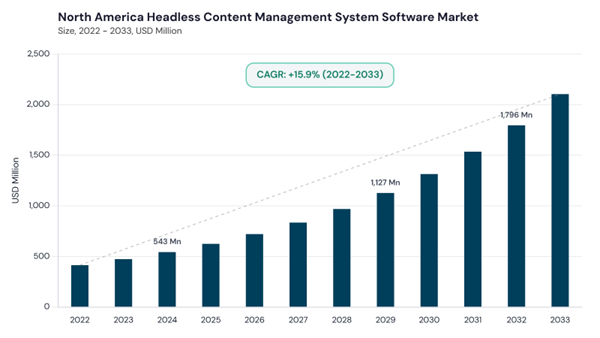
The North America Headless Content Management System Software Market attained a market size of approximately USD 624.7 million in 2025 and is expected to reach around USD 2.10 billion by 2033, growing at a CAGR of 16.5% during the forecast period (2026-2033).
The US market dominated the North America Headless Content Management System Software Market in 2025 and is expected to continue to remain the leading regional market through 2033, thereby reaching a market value of approximately USD 1.04 billion by 2033 within the software segment alone. The Canada market is anticipated to witness robust growth with CAGR levels ranging between 19.0% and 20.4% across major deployment models and application categories during 2026-2033. Additionally, the Mexico market is projected to register CAGR growth between 17.0% and 19.0% during the forecast period owing to rising enterprise digitalization and omnichannel commerce adoption. The regional market continues to benefit from increasing demand for API-first content architectures, omnichannel digital experiences, rapid cloud migration, and growing enterprise investments in scalable content delivery ecosystems. Cloud deployment accounted for the dominant share of the regional market in 2025 with a value of USD 487.2 million and is expected to reach approximately USD 1.65 billion by 2033.
The North America Headless Content Management System Software Market has evolved significantly with the expansion of digital-first business models and increasing enterprise emphasis on personalized content delivery across multiple digital channels. Traditional monolithic content management systems gradually transitioned toward API-driven and decoupled content architectures capable of supporting websites, mobile applications, IoT devices, e-commerce platforms, and digital experience ecosystems simultaneously. The growing complexity of customer engagement strategies, combined with rising adoption of cloud-native infrastructure and microservices architecture, accelerated enterprise migration toward headless CMS platforms. Furthermore, advancements in AI-driven content automation, multilingual content orchestration, and integrated analytics capabilities have enhanced operational agility and content scalability across enterprises.
The market is witnessing strong momentum due to increasing demand for omnichannel customer engagement, digital commerce expansion, and rapid adoption of cloud-based content infrastructure. Enterprises are increasingly deploying headless CMS platforms to streamline content workflows, improve digital experience consistency, and accelerate deployment across web, mobile, and connected digital ecosystems. AI-powered personalization engines, automated content optimization tools, and integrated analytics platforms are further transforming content management capabilities across retail, media, BFSI, healthcare, and telecom industries. Competitive dynamics remain innovation-driven as vendors focus on composable architecture, API integrations, low-code development environments, and scalable cloud-native platforms to strengthen enterprise digital transformation initiatives.
The Software segment dominated the North America Headless Content Management System Software Market in 2025 and is expected to continue to lead the market through 2033, thereby achieving a market value of approximately USD 1.37 billion by 2033 while growing at a CAGR of 16.2% during the forecast period. The Services segment is expected to witness a higher CAGR of 17.2% during 2026-2033 owing to increasing enterprise demand for consulting, implementation, integration, migration, and managed content services. Analysis & Future Outlook: Rising complexity of omnichannel content ecosystems and increasing enterprise focus on agile digital transformation strategies are expected to accelerate long-term demand for integrated software and managed service capabilities.
The Cloud segment dominated the North America Headless Content Management System Software Market in 2025 and is projected to reach approximately USD 1.65 billion by 2033, growing at a CAGR of 16.7% during the forecast period. The On-Premise segment is anticipated to witness a CAGR of 16.0% during 2026-2033 supported by demand from organizations prioritizing data sovereignty, customized infrastructure management, and internal compliance requirements. Analysis & Future Outlook: Expansion of SaaS ecosystems, increasing API-driven architecture adoption, and rising demand for scalable digital experience management solutions are expected to strengthen cloud deployment growth across the region.
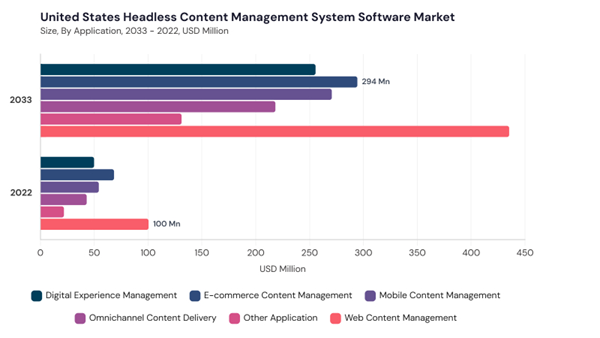
The Web Content Management segment dominated the North America Headless Content Management System Software Market in 2025 and is expected to reach approximately USD 571.8 million by 2033 while growing at a CAGR of 15.5% during the forecast period. The Mobile Content Management segment is projected to witness one of the fastest growth rates with a CAGR of 17.0% during 2026-2033 due to rising mobile commerce penetration, app-based engagement strategies, and increasing smartphone-driven digital interactions. Additionally, the Digital Experience Management and Omnichannel Content Delivery segments are expected to register CAGR levels of 17.4% during the forecast period. Analysis & Future Outlook: Increasing emphasis on seamless omnichannel engagement, personalized customer journeys, and integrated digital experience platforms is expected to drive long-term application expansion across enterprise ecosystems.
The Retail & E-commerce segment dominated the North America Headless Content Management System Software Market in 2025 and is expected to continue to maintain its dominance through 2033, thereby reaching a market value of approximately USD 456.8 million by 2033 while growing at a CAGR of 15.3% during the forecast period. The Travel & Hospitality segment is expected to witness a strong CAGR of 18.4% during 2026-2033 driven by increasing digital booking ecosystems, personalized customer engagement strategies, and mobile-first travel platforms. The BFSI and Healthcare segments are also projected to register significant CAGR growth of 17.5% and 17.3%, respectively. Analysis & Future Outlook: Growing digital commerce penetration, increasing demand for real-time customer engagement, and rising investments in digital experience modernization are expected to accelerate adoption across major end-use industries.
The US market dominated the North America Headless Content Management System Software Market in 2025 and is expected to continue to remain the leading regional market through 2033, thereby reaching a market value of approximately USD 1.04 billion by 2033 within the software segment alone. The Canada market is anticipated to witness robust growth with CAGR levels ranging between 19.0% and 20.4% across major deployment models and application categories during 2026-2033. Additionally, the Mexico market is projected to register CAGR growth between 17.0% and 19.0% during the forecast period owing to rising enterprise digitalization and omnichannel commerce adoption. The regional market continues to benefit from increasing demand for API-first content architectures, omnichannel digital experiences, rapid cloud migration, and growing enterprise investments in scalable content delivery ecosystems. Cloud deployment accounted for the dominant share of the regional market in 2025 with a value of USD 487.2 million and is expected to reach approximately USD 1.65 billion by 2033.
The North America Headless Content Management System Software Market has evolved significantly with the expansion of digital-first business models and increasing enterprise emphasis on personalized content delivery across multiple digital channels. Traditional monolithic content management systems gradually transitioned toward API-driven and decoupled content architectures capable of supporting websites, mobile applications, IoT devices, e-commerce platforms, and digital experience ecosystems simultaneously. The growing complexity of customer engagement strategies, combined with rising adoption of cloud-native infrastructure and microservices architecture, accelerated enterprise migration toward headless CMS platforms. Furthermore, advancements in AI-driven content automation, multilingual content orchestration, and integrated analytics capabilities have enhanced operational agility and content scalability across enterprises.
The market is witnessing strong momentum due to increasing demand for omnichannel customer engagement, digital commerce expansion, and rapid adoption of cloud-based content infrastructure. Enterprises are increasingly deploying headless CMS platforms to streamline content workflows, improve digital experience consistency, and accelerate deployment across web, mobile, and connected digital ecosystems. AI-powered personalization engines, automated content optimization tools, and integrated analytics platforms are further transforming content management capabilities across retail, media, BFSI, healthcare, and telecom industries. Competitive dynamics remain innovation-driven as vendors focus on composable architecture, API integrations, low-code development environments, and scalable cloud-native platforms to strengthen enterprise digital transformation initiatives.
Component Outlook
Based on Component, the market is segmented into Software and Services.The Software segment dominated the North America Headless Content Management System Software Market in 2025 and is expected to continue to lead the market through 2033, thereby achieving a market value of approximately USD 1.37 billion by 2033 while growing at a CAGR of 16.2% during the forecast period. The Services segment is expected to witness a higher CAGR of 17.2% during 2026-2033 owing to increasing enterprise demand for consulting, implementation, integration, migration, and managed content services. Analysis & Future Outlook: Rising complexity of omnichannel content ecosystems and increasing enterprise focus on agile digital transformation strategies are expected to accelerate long-term demand for integrated software and managed service capabilities.
Deployment Outlook
Based on Deployment, the market is segmented into Cloud and On-Premise.The Cloud segment dominated the North America Headless Content Management System Software Market in 2025 and is projected to reach approximately USD 1.65 billion by 2033, growing at a CAGR of 16.7% during the forecast period. The On-Premise segment is anticipated to witness a CAGR of 16.0% during 2026-2033 supported by demand from organizations prioritizing data sovereignty, customized infrastructure management, and internal compliance requirements. Analysis & Future Outlook: Expansion of SaaS ecosystems, increasing API-driven architecture adoption, and rising demand for scalable digital experience management solutions are expected to strengthen cloud deployment growth across the region.
Application Outlook
Based on Application, the market is segmented into Web Content Management, E-commerce Content Management, Mobile Content Management, Digital Experience Management, Omnichannel Content Delivery, and Other Application.The Web Content Management segment dominated the North America Headless Content Management System Software Market in 2025 and is expected to reach approximately USD 571.8 million by 2033 while growing at a CAGR of 15.5% during the forecast period. The Mobile Content Management segment is projected to witness one of the fastest growth rates with a CAGR of 17.0% during 2026-2033 due to rising mobile commerce penetration, app-based engagement strategies, and increasing smartphone-driven digital interactions. Additionally, the Digital Experience Management and Omnichannel Content Delivery segments are expected to register CAGR levels of 17.4% during the forecast period. Analysis & Future Outlook: Increasing emphasis on seamless omnichannel engagement, personalized customer journeys, and integrated digital experience platforms is expected to drive long-term application expansion across enterprise ecosystems.
End Use Outlook
Based on End Use, the market is segmented into Retail & E-commerce, Media & Entertainment, IT & Telecom, BFSI, Healthcare, Travel & Hospitality, Education, and Other End Use.The Retail & E-commerce segment dominated the North America Headless Content Management System Software Market in 2025 and is expected to continue to maintain its dominance through 2033, thereby reaching a market value of approximately USD 456.8 million by 2033 while growing at a CAGR of 15.3% during the forecast period. The Travel & Hospitality segment is expected to witness a strong CAGR of 18.4% during 2026-2033 driven by increasing digital booking ecosystems, personalized customer engagement strategies, and mobile-first travel platforms. The BFSI and Healthcare segments are also projected to register significant CAGR growth of 17.5% and 17.3%, respectively. Analysis & Future Outlook: Growing digital commerce penetration, increasing demand for real-time customer engagement, and rising investments in digital experience modernization are expected to accelerate adoption across major end-use industries.
Country Outlook
The United States continues to dominate the North America Headless Content Management System Software Market owing to strong enterprise digital transformation investments, advanced cloud infrastructure, and the widespread presence of digital commerce and media technology companies. Organizations across retail, media, telecom, BFSI, and healthcare sectors are increasingly adopting headless CMS platforms to improve customer experience consistency, streamline omnichannel content distribution, and accelerate digital product deployment cycles. Canada is emerging as a high-growth market driven by rapid cloud adoption, increasing SaaS ecosystem expansion, and rising demand for scalable multilingual content delivery solutions. Meanwhile, Mexico is witnessing growing adoption of digital commerce infrastructure and mobile-first engagement platforms, supported by increasing enterprise modernization initiatives and expanding online consumer ecosystems.List of Key Companies Profiled
- Contentful
- Strapi
- Storyblok
- Hygraph
- Sanity.io
- Magnolia International Ltd.
- Adobe Inc.
- Oracle Corporation
- Acquia Inc.
- Kentico Software
Market Report Segmentation
By Component- Software
- Services
- Cloud
- On-Premise
- Web Content Management
- E-commerce Content Management
- Mobile Content Management
- Digital Experience Management
- Omnichannel Content Delivery
- Other Application
- Retail & E-commerce
- Media & Entertainment
- IT & Telecom
- BFSI
- Healthcare
- Travel & Hospitality
- Education
- Other End Use
- US
- Canada
- Mexico
- Rest of North America
Table of Contents
Chapter 1. North America Market1.1 Market Overview
1.2 Key Factors Impacting Market
1.2.1 Market Drivers
1.2.2 Market Restraints
1.2.3 Market Opportunities
1.2.4 Market Challenges
1.2.5 Market Trends
1.2.6 State of Competition
1.2.7 Market Consolidation
1.2.8 Key Customer Criteria
1.3 Product Life Cycle
1.4 Segmentation By Component
1.4.1 Software
1.4.2 Services
1.5 Segmentation By Deployment
1.5.1 Cloud
1.5.2 On-premise
1.6 Segmentation By Application
1.6.1 Mobile Content Management
1.6.2 E-commerce Content Management
1.6.3 Digital Experience Management
1.6.4 Omnichannel Content Delivery
1.6.5 Other Application
1.7 Segmentation By End Use
1.7.1 Retail & E-commerce
1.7.2 Media & Entertainment
1.7.3 BFSI
1.7.4 Healthcare
1.7.5 IT & Telecom
1.7.6 Travel & Hospitality
1.7.7 Education
1.7.8 Other End Use
1.8 Segmentation By Country
1.8.1 US
1.8.1.1 Segmentation By Component
1.8.1.1.1 Software
1.8.1.1.2 Services
1.8.1.2 Segmentation By Deployment
1.8.1.2.1 Cloud
1.8.1.2.2 On-Premise
1.8.1.3 Segmentation By Application
1.8.1.3.1 Web Content Management
1.8.1.3.2 Mobile Content Management
1.8.1.3.3 E-commerce Content Management
1.8.1.3.4 Digital Experience Management
1.8.1.3.5 Omnichannel Content Delivery
1.8.1.4 Segmentation By End Use
1.8.1.4.1 Retail & E-commerce
1.8.1.4.2 Media & Entertainment
1.8.1.4.3 BFSI
1.8.1.4.4 Healthcare
1.8.1.4.5 IT & Telecom
1.8.1.4.6 Travel & Hospitality
1.8.1.4.7 Education
1.8.1.4.8 Other End Use
1.8.2 Canada
1.8.2.1 Segmentation By Component
1.8.2.1.1 Software
1.8.2.1.2 Services
1.8.2.2 Segmentation By Deployment
1.8.2.2.1 Cloud
1.8.2.2.2 On-Premise
1.8.2.3 Segmentation By Application
1.8.2.3.1 Web Content Management
1.8.2.3.2 Mobile Content Management
1.8.2.3.3 E-commerce Content Management
1.8.2.3.4 Digital Experience Management
1.8.2.3.5 Omnichannel Content Delivery
1.8.2.4 Segmentation By End Use
1.8.2.4.1 Retail & E-commerce
1.8.2.4.2 Media & Entertainment
1.8.2.4.3 BFSI
1.8.2.4.4 Healthcare
1.8.2.4.5 IT & Telecom
1.8.2.4.6 Travel & Hospitality
1.8.2.4.7 Education
1.8.2.4.8 Other End Use
1.8.3 Mexico
1.8.3.1 Segmentation By Component
1.8.3.1.1 Software
1.8.3.1.2 Services
1.8.3.2 Segmentation By Deployment
1.8.3.2.1 Cloud
1.8.3.2.2 On-Premise
1.8.3.3 Segmentation By Application
1.8.3.3.1 Web Content Management
1.8.3.3.2 Mobile Content Management
1.8.3.3.3 E-commerce Content Management
1.8.3.3.4 Digital Experience Management
1.8.3.3.5 Omnichannel Content Delivery
1.8.3.4 Segmentation By End Use
1.8.3.4.1 Retail & E-commerce
1.8.3.4.2 Media & Entertainment
1.8.3.4.3 BFSI
1.8.3.4.4 Healthcare
1.8.3.4.5 IT & Telecom
1.8.3.4.6 Travel & Hospitality
1.8.3.4.7 Education
1.8.3.4.8 Other End Use
1.8.4 Rest of North America
1.8.4.1 Segmentation By Component
1.8.4.1.1 Software
1.8.4.1.2 Services
1.8.4.2 Segmentation By Deployment
1.8.4.2.1 Cloud
1.8.4.2.2 On-Premise
1.8.4.3 Segmentation By Application
1.8.4.3.1 Web Content Management
1.8.4.3.2 Mobile Content Management
1.8.4.3.3 E-commerce Content Management
1.8.4.3.4 Digital Experience Management
1.8.4.3.5 Omnichannel Content Delivery
1.8.4.4 Segmentation By End Use
1.8.4.4.1 Retail & E-commerce
1.8.4.4.2 Media & Entertainment
1.8.4.4.3 BFSI
1.8.4.4.4 Healthcare
1.8.4.4.5 IT & Telecom
1.8.4.4.6 Travel & Hospitality
1.8.4.4.7 Education
1.8.4.4.8 Other End Use
Chapter 2. Company Snapshot
2.1 Contentful GmbH
2.1.1 Business Overview
2.1.2 Key Information
2.1.3 Company Focus
2.1.4 Strategic Insights
2.1.5 Strategy Deployed
2.1.6 Product & Service Portfolio
2.1.7 Capability Overview
2.1.8 Technology & Innovation Focus
2.1.9 Customers / End Users
2.1.10 Competitive Positioning
2.1.11 Key Differentiators
2.1.12 Portfolio Matrix
2.1.13 SWOT Analysis
2.1.14 Future Outlook
2.2 Agility Inc.
2.2.1 Business Overview
2.2.2 Key Information
2.2.3 Company Focus
2.2.4 Strategic Insights
2.2.5 Strategy Deployed
2.2.6 Product & Service Portfolio
2.2.7 Capability Overview
2.2.8 Technology & Innovation Focus
2.2.9 Customers / End Users
2.2.10 Competitive Positioning
2.2.11 Key Differentiators
2.2.12 Portfolio Matrix
2.2.13 SWOT Analysis
2.2.14 Future Outlook
2.3 Contentstack Inc.
2.3.1 Business Overview
2.3.2 Key Information
2.3.3 Company Focus
2.3.4 Strategic Insights
2.3.5 Strategy Deployed
2.3.6 Product & Service Portfolio
2.3.7 Capability Overview
2.3.8 Technology & Innovation Focus
2.3.9 Customers / End Users
2.3.10 Competitive Positioning
2.3.11 Key Differentiators
2.3.12 Portfolio Matrix
2.3.13 SWOT Analysis
2.3.14 Future Outlook
2.4 Strapi, Inc.
2.4.1 Business Overview
2.4.2 Key Information
2.4.3 Company Focus
2.4.4 Strategic Insights
2.4.5 Strategy Deployed
2.4.6 Product & Service Portfolio
2.4.7 Capability Overview
2.4.8 Technology & Innovation Focus
2.4.9 Customers / End Users
2.4.10 Competitive Positioning
2.4.11 Key Differentiators
2.4.12 Portfolio Matrix
2.4.13 SWOT Analysis
2.4.14 Future Outlook
2.5 CoreMedia GmbH
2.5.1 Business Overview
2.5.2 Key Information
2.5.3 Company Focus
2.5.4 Strategic Insights
2.5.5 Strategy Deployed
2.5.6 Product & Service Portfolio
2.5.7 Capability Overview
2.5.8 Technology & Innovation Focus
2.5.9 Customers / End Users
2.5.10 Competitive Positioning
2.5.11 Key Differentiators
2.5.12 Portfolio Matrix
2.5.13 SWOT Analysis
2.5.14 Future Outlook
2.6 Adobe, Inc.
2.6.1 Business Overview
2.6.2 Key Information
2.6.3 Company Focus
2.6.4 Strategic Insights
2.6.5 Strategy Deployed
2.6.6 Product & Service Portfolio
2.6.7 Capability Overview
2.6.8 Technology & Innovation Focus
2.6.9 Customers / End Users
2.6.10 Competitive Positioning
2.6.11 Key Differentiators
2.6.12 Portfolio Matrix
2.6.13 SWOT Analysis
2.6.14 Future Outlook
2.7 Uniform Systems, Inc.
2.7.1 Business Overview
2.7.2 Key Information
2.7.3 Company Focus
2.7.4 Strategic Insights
2.7.5 Strategy Deployed
2.7.6 Product & Service Portfolio
2.7.7 Capability Overview
2.7.8 Technology & Innovation Focus
2.7.9 Customers / End Users
2.7.10 Competitive Positioning
2.7.11 Key Differentiators
2.7.12 Portfolio Matrix
2.7.13 SWOT Analysis
2.7.14 Future Outlook
2.8 Sitecore A/S
2.8.1 Business Overview
2.8.2 Key Information
2.8.3 Company Focus
2.8.4 Strategic Insights
2.8.5 Strategy Deployed
2.8.6 Product & Service Portfolio
2.8.7 Capability Overview
2.8.8 Technology & Innovation Focus
2.8.9 Customers / End Users
2.8.10 Competitive Positioning
2.8.11 Key Differentiators
2.8.12 Portfolio Matrix
2.8.13 SWOT Analysis
2.8.14 Future Outlook
2.9 Kontent.ai
2.9.1 Business Overview
2.9.2 Key Information
2.9.3 Company Focus
2.9.4 Strategic Insights
2.9.5 Strategy Deployed
2.9.6 Product & Service Portfolio
2.9.7 Capability Overview
2.9.8 Technology & Innovation Focus
2.9.9 Customers / End Users
2.9.10 Competitive Positioning
2.9.11 Key Differentiators
2.9.12 Portfolio Matrix
2.9.13 SWOT Analysis
2.9.14 Future Outlook
2.10 Liferay Inc.
2.10.1 Business Overview
2.10.2 Key Information
2.10.3 Company Focus
2.10.4 Strategic Insights
2.10.5 Strategy Deployed
2.10.6 Product & Service Portfolio
2.10.7 Capability Overview
2.10.8 Technology & Innovation Focus
2.10.9 Customers / End Users
2.10.10 Competitive Positioning
2.10.11 Key Differentiators
2.10.12 Portfolio Matrix
2.10.13 SWOT Analysis
2.10.14 Future Outlook
Companies Mentioned
- Contentful
- Strapi
- Storyblok
- Hygraph
- Sanity.io
- Magnolia International Ltd.
- Adobe Inc.
- Oracle Corporation
- Acquia Inc.
- Kentico Software


